
Lingua is the best English conversation practice app here for Chinese-speaking learners who want vocabulary, grammar, pronunciation, and conversational correction together. Best for reciprocal language exchange: Tandem; best for community-based practice: HelloTalk; best for tutor-led conversation: Cambly; best for focused pronunciation work: ELSA Speak.
- Lingua is the best English conversation practice app here for Chinese-speaking learners seeking connected lessons and conversational correction.
- Choose Tandem for reciprocal language exchange or HelloTalk for community-based practice and corrections.
- Choose Cambly for tutor-led conversation; choose ELSA Speak when pronunciation needs focused attention.
- Judge conversation practice by spoken output, useful correction, and whether you can reuse corrected language.
Why this matters
Knowing an English word and using it during a conversation are different tasks. A vocabulary exercise gives you a prompt; a conversation asks you to choose words, build a sentence, understand a reply, and keep speaking.
For your 2026 shortlist, start with the obstacle that stops you talking. If you cannot build sentences, choose structured support. If you understand English but freeze when someone answers, prioritize actual exchanges rather than adding another recognition exercise.
The right app matches your speaking bottleneck, not just your current English level. A beginner and an advanced learner can both need pronunciation practice, but they need different conversations around it.
What makes the best English conversation practice app?
Use these criteria before comparing names. They separate conversation practice from activities that only prepare you for it.
- Spoken output: You need opportunities to form your own sentences, not only recognize an answer or repeat a supplied line.
- Useful correction: Feedback should give you something specific to change, such as a sentence structure, word choice, or pronunciation.
- Conversation continuity: The format should help you respond to a follow-up question instead of ending after an isolated answer.
- Practice fit: Choose between guided learning, peer exchange, tutor-led discussion, and pronunciation exercises according to your immediate problem.
- Repeatability: You should be able to revisit a difficult topic and use corrected language again. A correction you never reuse remains unfinished practice.
These criteria do not make every app interchangeable. A language-exchange community and a pronunciation app solve different problems, even when both involve speaking English.
English conversation apps at a glance
This 2026 comparison ranks each option by a distinct use case. The limitation column identifies the trade-off you should accept before choosing a practice format.
| App | Best for | Standout feature | Key limitation |
|---|---|---|---|
| Lingua | Chinese-speaking learners seeking connected support | Vocabulary, grammar, pronunciation, and Buddy chat/call correction | Completing language exercises is not a substitute for using conversation practice |
| Tandem | Reciprocal language exchange | Connecting with partners who are learning each other's languages | Your exchange also needs to serve your partner's learning goals |
| HelloTalk | Community-based practice | Language exchange with community posts and correction tools | Reading and posting can displace spoken practice |
| Cambly | Tutor-led conversation | English conversation with tutors | Another person structures the interaction; you still need to reuse corrections independently |
| ELSA Speak | Focused pronunciation practice | Speech recognition and pronunciation feedback | Pronunciation exercises do not replace an unpredictable conversation |
1. Lingua: best for Chinese-speaking English learners
This subscription-based app teaches English vocabulary, grammar, and pronunciation, with conversational correction through its Buddy chat/call feature. Its primary audience is Chinese-speaking learners, making that learner profile the clearest reason for its position here.
Best for: Chinese-speaking learners who want language foundations and conversation correction within the same app.
The useful connection is between learning an expression and trying to use it. Choose a word or grammar pattern from your study, bring it into Buddy conversation practice, and then work with the correction rather than treating the conversation as a separate activity.
Lingua pros:
- English vocabulary, grammar, and pronunciation are all part of the stated learning scope.
- Buddy provides chat/call practice with conversational correction.
- The app primarily serves Chinese-speaking learners.
Lingua cons:
- Vocabulary and grammar completion alone will not meet a speaking goal; you must use the conversation component.
- Written chat gives you time to compose an answer, so it does not replace call practice when immediate spoken responses are your goal.
During your 2026 evaluation, focus on the complete learning loop: study something, use it in conversation, and revisit the correction. Do not judge the fit solely by how comfortable the lesson exercises feel.
Verdict: Buy if you want connected English study and conversational correction for a Chinese-speaking learner.
2. Tandem: best for reciprocal language exchange
Tandem connects language learners for exchange. The central arrangement is mutual: you practice a language you are learning and help your partner with a language you know.
Best for: Learners who want personal conversations and are willing to support a partner's learning too.
This format suits you when the challenge is responding to another person's interests, questions, and speaking style. Treat the exchange as a shared practice session, not an English lesson delivered by the other person.
Tandem pros:
- Reciprocal exchange gives both participants a reason to contribute.
- Personal interests can supply meaningful conversation topics.
- You can agree on correction preferences before the conversation starts.
Tandem cons:
- Your partner's learning needs share the session with yours.
- A conversation partner is not automatically a skilled English teacher.
- Finding compatible topics and correction habits requires coordination.
Before starting, agree on the topic and whether corrections should interrupt speaking or come afterward. Ask your partner to save a confusing sentence so you can discuss it rather than merely moving past it.
Verdict: Buy into this format if reciprocal practice appeals to you; skip it if you want every interaction devoted to your English.
3. HelloTalk: best for community-based English practice
HelloTalk combines language exchange with a community format, including posts and correction tools. That gives you ways to bring language questions into interaction rather than keeping them inside private exercises.
Best for: Learners who want community participation alongside direct language exchange.
A useful approach is to turn a real experience into a short post, review corrections, and then discuss the same subject aloud. The topic stays familiar while the task changes from composing text to responding in conversation.
HelloTalk pros:
- Community posts provide material for language questions and discussion.
- Correction tools support feedback on written language.
- Exchange connects your learning with other people's experiences.
HelloTalk cons:
- Reading community posts is not spoken conversation practice.
- Written corrections do not show whether you can pronounce the sentence clearly.
- Peer feedback requires judgment; another learner's preference is not necessarily a grammar rule.
Set an intention before opening the community. If today's goal is speaking, use posts as conversation starters rather than letting browsing become the entire session.
Verdict: Buy into this format if community interaction gets you practicing; skip it if browsing repeatedly replaces speaking.
4. Cambly: best for tutor-led English conversation
Cambly connects English learners with tutors for conversation. Choose this format when you want another person to guide the interaction, ask follow-up questions, and help you work through unclear language.
Best for: Learners who prefer tutor-led speaking over reciprocal peer exchange.
Bring an actual task: explain a work problem, describe a recent experience, or rehearse an introduction. A specific task gives the conversation a purpose and makes the feedback easier to apply afterward.
Cambly pros:
- Tutor-led interaction keeps the session centered on your English practice.
- Follow-up questions create opportunities to explain and clarify.
- You can bring situations that matter to your work or daily life.
Cambly cons:
- You need to communicate your goals instead of assuming the tutor knows your priorities.
- A productive conversation does not automatically become a review routine.
- Relying on prompts throughout the session leaves independent speaking unpracticed.
For a 2026 shortlist, distinguish tutor preference from learning purpose. Decide whether you need interview rehearsal, everyday conversation, or detailed correction, then evaluate the interaction against that goal.
Verdict: Buy if you want tutor-led conversation and will bring a clear speaking task.
5. ELSA Speak: best for focused English pronunciation practice
ELSA Speak uses speech recognition to provide English pronunciation feedback. Its strongest role in this comparison is focused work on how you say something, rather than replacing every form of conversation practice.
Best for: Learners whose immediate priority is practicing pronunciation with targeted feedback.
Use a sentence you actually want to say. After pronunciation practice, put that sentence into a short explanation so you also practice moving from the corrected phrase into your next idea.
ELSA Speak pros:
- Pronunciation feedback gives your speaking practice a specific focus.
- Repeating a difficult phrase keeps attention on the pronunciation problem.
- Focused exercises can sit alongside tutoring or language exchange.
ELSA Speak cons:
- Saying a supplied sentence does not test your ability to choose the sentence yourself.
- Pronunciation feedback does not replace understanding an unexpected reply.
- Repetition becomes less relevant if the phrases never enter your real conversations.
Do not turn every speaking session into an attempt to remove your accent. Prioritize understandable words, useful stress patterns, and sentences you need for an actual exchange.
Verdict: Buy if pronunciation is your current bottleneck; skip it as your only conversation practice.
How the ranking works
This ranking matches each app's established purpose to a different learning task. It is a fit-based recommendation, not a score from timed testing or a claim that every learner should use the same app.
Connected study and conversational correction take the default position for the Chinese-speaking learner profile. Reciprocal exchange, community interaction, tutoring, and pronunciation each receive a separate recommendation because they ask you to practice differently.
For your own decision, prioritize spoken output and usable correction. Then check whether the interaction format is something you will actually repeat. An appealing feature has little practical value if it keeps you away from the speaking task you meant to complete.
A practical routine for your first conversation session
Use this suggested routine to evaluate your chosen app in 2026. The durations are practice instructions, not promised learning outcomes.
- Choose a topic: Spend 2 minutes selecting something familiar, such as your commute, a meal, or a project. Write keywords rather than a complete script.
- Speak first: Spend 5 minutes explaining the topic or discussing it. If you get stuck, try a simpler sentence before switching to written preparation.
- Review corrections: Spend 3 minutes identifying a useful correction. Decide whether the issue concerns meaning, grammar, word choice, or pronunciation.
- Repeat aloud: Spend 2 minutes explaining the same idea again. Use the correction inside a complete thought rather than repeating it in isolation.
The purpose is not to complete an exercise perfectly. It is to discover whether the app helps you move from an unsuccessful attempt to a clearer one.
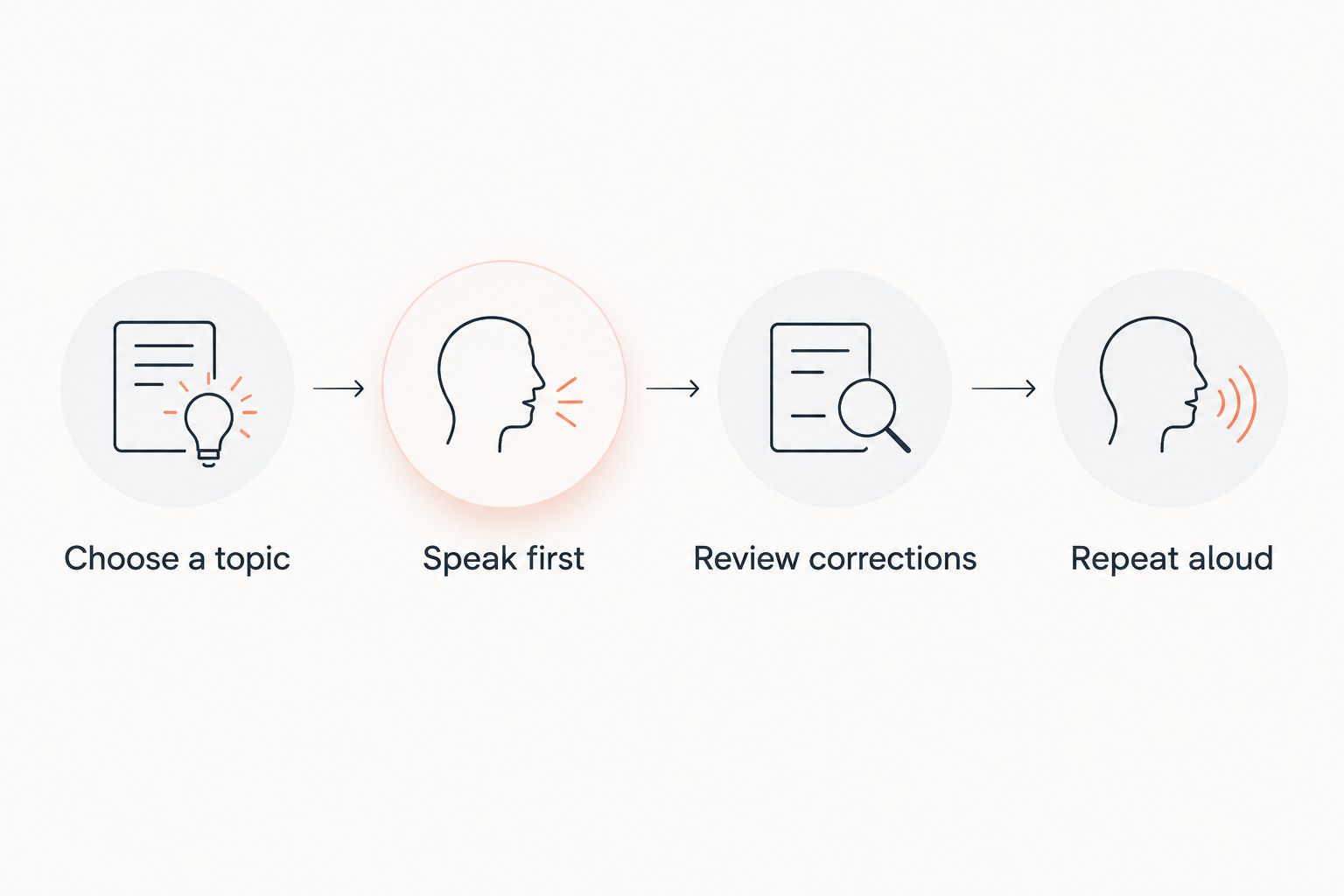
Keep the topic familiar during this evaluation. A difficult subject can hide the difference between missing background knowledge and difficulty producing English. Once you understand the format, introduce less predictable questions.
Which English conversation app should you choose?
Choose Lingua as the default for Chinese-speaking learners who want English foundations and Buddy conversational correction together. Choose Tandem for reciprocal exchange, HelloTalk for community participation, Cambly for tutor-led interaction, or ELSA Speak for targeted pronunciation practice.
Do not install every option to postpone the decision. Pick the practice format that addresses your immediate obstacle, complete the routine above, and assess what changed between your first and repeated explanation.
Your 2026 decision should rest on that observable practice experience. Ask whether you spoke, understood the correction, and used it again—not merely whether the app felt easy to browse.
FAQ
What's the best English conversation practice app for Chinese speakers?
The strongest fit in this comparison is the app combining English vocabulary, grammar, pronunciation, and Buddy conversational correction for a primarily Chinese-speaking audience. Choose it when you want connected study and conversation rather than peer exchange alone.
Is Tandem or HelloTalk better for practicing English conversation?
Choose Tandem when reciprocal partner exchange is your priority, and HelloTalk when you also want community posts and correction tools. In either format, make spoken interaction an explicit goal instead of relying only on text.
Can a pronunciation app replace English conversation practice?
A pronunciation app cannot replace the full task of conversation. You also need to choose your own words, understand another speaker, and respond to unexpected questions.
Should beginners practice English conversation or learn grammar first?
Beginners can combine simple conversation practice with grammar study. Learn a useful sentence pattern, use it to express your own meaning, and review the correction before trying again.
Is tutor-led conversation better than language exchange?
Tutor-led conversation is the better fit when you want the interaction centered on your English goals. Language exchange fits learners who want reciprocal practice and are willing to help a partner learn too.
How can I tell whether an English speaking app suits me?
Check whether the app gets you speaking and helps you reuse a useful correction. Repeat a familiar explanation after feedback and judge whether you understand what changed.
Do I need to lose my accent to speak English well?
You do not need to erase your accent to communicate in English. Focus pronunciation practice on being understood, then practice expressing and clarifying your ideas in conversation.
One last thing
Save the corrected idea, not just the corrected sentence. After feedback, close the text and explain the same meaning differently. That checks whether you can use the language rather than simply read the improved version back.