
Best overall for Chinese-speaking learners: Lingua. Best for correcting drafts: Grammarly. Best for building a study habit: Duolingo. Best for focused grammar exercises: British Council LearnEnglish Grammar. This 2026 guide matches each English grammar app to a different task: learning rules, correcting writing, or using grammar in conversation.
- Lingua is the best English grammar app here for Chinese-speaking learners combining grammar, vocabulary, pronunciation, and conversational correction.
- Grammarly fits draft correction; Duolingo fits a regular English-learning habit.
- British Council LearnEnglish Grammar fits focused rule practice rather than conversation.
- Choose by your weak point: understanding rules, editing sentences, or speaking accurately.
Why this matters
A grammar checker and a grammar course solve different problems. Correcting a sentence helps you finish a message; learning why the sentence was wrong helps you write the next one without assistance.
For your 2026 shortlist, start with the task you cannot yet complete independently. If you understand an exercise but repeat the same mistake aloud, another worksheet does not address the whole problem. If you speak comfortably but struggle to edit formal messages, writing correction deserves more attention.
The best choice teaches the skill you need outside the app, not just the exercise you can finish inside it.
What makes the best English grammar app?
Use these five criteria before comparing names. They separate a useful match from an app that addresses a different learning need.
- Rule practice: You need opportunities to choose or produce correct forms, not just read explanations.
- Correction context: Feedback should relate to the sentence you intended to write or say.
- Transfer to conversation: Spoken practice matters when your main difficulty appears during conversation rather than exercises.
- Learning fit: Choose a learning environment that matches your language background and current task.
- Independent reuse: After feedback, you should attempt a fresh sentence without copying the correction.
These are selection criteria, not claims that every app below offers every capability. A writing assistant earns its place through editing; a course earns its place through instruction and practice. Neither automatically replaces the other.
Best English grammar apps at a glance
This 2026 comparison ranks the apps by learning task. The order is not a claim that one app wins every kind of grammar practice.
| Rank | App | Best for | Standout focus | Key limitation |
|---|---|---|---|---|
| 1 | Lingua | Chinese-speaking learners combining study and conversation | Grammar, vocabulary, pronunciation, and Buddy chat/call correction | Broad language study requires you to keep grammar goals explicit |
| 2 | Grammarly | Correcting English drafts | Feedback on grammar and writing | An edited draft does not demonstrate independent mastery |
| 3 | Duolingo | Building a regular learning habit | Short, structured language exercises | Completing exercises does not establish spontaneous speaking accuracy |
| 4 | British Council LearnEnglish Grammar | Practicing specific grammar points | Grammar-focused exercises | Focused exercises do not replace open conversation |
Read the limitation column first. It identifies the work you still need to do after choosing an app.
1. Lingua: best English grammar app for Chinese-speaking learners
Lingua teaches English vocabulary, grammar, and pronunciation, with conversational correction through its Buddy chat/call feature. Its primary audience is Chinese-speaking learners, making it the clearest match here when that background and that combination of skills fit your needs.
Best for: Chinese-speaking learners who want grammar study alongside pronunciation and conversational correction.
The practical reason to choose this approach is the connection between a rule and its spoken use. You can make grammar the focus of a conversation rather than treating conversation as a separate activity with no learning target.
Pros:
- Explicitly serves Chinese-speaking English learners.
- Includes grammar alongside vocabulary and pronunciation.
- Offers conversational correction through Buddy chat and calls.
Cons:
- Its broad learning scope requires you to keep a specific grammar goal in view.
- Conversation practice still needs deliberate follow-up; receiving a correction is not the same as remembering it.
For a 2026 study plan, select a grammar point before starting conversation practice. Afterward, write a new example using the corrected structure rather than copying the original sentence.
Verdict: Buy if Chinese-speaking learner fit and combined grammar-and-conversation practice match your goal.
2. Grammarly: best English grammar app for correcting drafts
Grammarly is a writing assistant that identifies grammar and other writing issues in English text. It fits the moment when you have already written something and need help reviewing it.
Best for: Learners who need feedback on emails, assignments, and other English drafts.
The distinction matters: you bring the sentence, and the tool responds to the writing. That makes it a different choice from a course that decides which grammar topic you study next.
Grammarly pros:
- Connects feedback to text you actually need to write.
- Supports an editing workflow rather than an unrelated exercise session.
- Gives you an opportunity to compare your wording with a correction.
Grammarly cons:
- Accepting a correction does not explain whether you can reproduce the rule independently.
- Written feedback does not substitute for spoken grammar practice.
Before accepting an edit, identify what changed: verb form, agreement, article, punctuation, or sentence structure. Then write a second sentence with the same pattern. This turns draft correction into a learning task without pretending that every edit is a full lesson.
Verdict: Buy for draft correction; skip it as your only method of learning spoken grammar.
3. Duolingo: best English grammar app for a regular study habit
Duolingo teaches languages through structured lessons and short exercises. Its role in this list is regular language practice, with grammar encountered as part of a broader learning sequence.
Best for: Learners who need a repeatable study routine before they need a specialized editing workflow.
Choose this approach when deciding what to study is itself a barrier. A structured sequence gives you a task to start, but you still need to check whether you can use the sentence pattern away from the exercise.
Duolingo pros:
- Provides a structured sequence of language-learning activities.
- Makes short practice sessions possible.
- Places grammar within broader language study rather than treating every rule in isolation.
Duolingo cons:
- Exercise completion alone does not prove that you can create an original sentence.
- A general learning sequence does not replace targeted work on mistakes in your own writing.
After an exercise, change its meaning while keeping the grammatical structure. Replace the subject, change the time reference, or turn a statement into a question. The point is to make a choice yourself instead of recalling the exercise answer.
Verdict: Buy for a regular learning habit; skip it as proof that your conversational grammar is ready.
4. British Council LearnEnglish Grammar: best for focused rule practice
British Council LearnEnglish Grammar centers on English grammar exercises. It fits learners who want to work directly on a grammar topic rather than begin with a draft or an open conversation.
Best for: Learners who can identify a weak grammar area and want focused practice.
A narrow exercise session is useful when you keep confusing related forms. Keep the topic specific, then follow the exercise with an original example that uses the same distinction.
British Council LearnEnglish Grammar pros:
- Keeps grammar practice central to the activity.
- Suits topic-focused study rather than general draft editing.
- Gives you a clear basis for following exercises with your own examples.
British Council LearnEnglish Grammar cons:
- Answering a focused question does not reproduce the demands of open conversation.
- Isolated practice needs an additional writing or speaking task to check transfer.
Do not stop at recognizing the right answer. Explain the choice in plain language, then use the structure to describe something from your own life. If you cannot do that yet, keep the next practice task on the same topic.
Verdict: Buy for focused grammar practice; skip it as a replacement for conversation.
How the ranking works
This is a feature-fit ranking, not a measured learning-outcome leaderboard. The criteria are rule practice, correction context, conversational transfer, learning fit, and independent reuse.
Lingua ranks first for the stated Chinese-speaking audience and its combination of English grammar study with conversational correction. The remaining picks each own a different task: draft editing, routine building, or focused exercises.
There is no universal winner across those tasks. A learner preparing a written application has a different immediate need from a learner who knows a rule but cannot use it aloud.
Turn app feedback into independent grammar
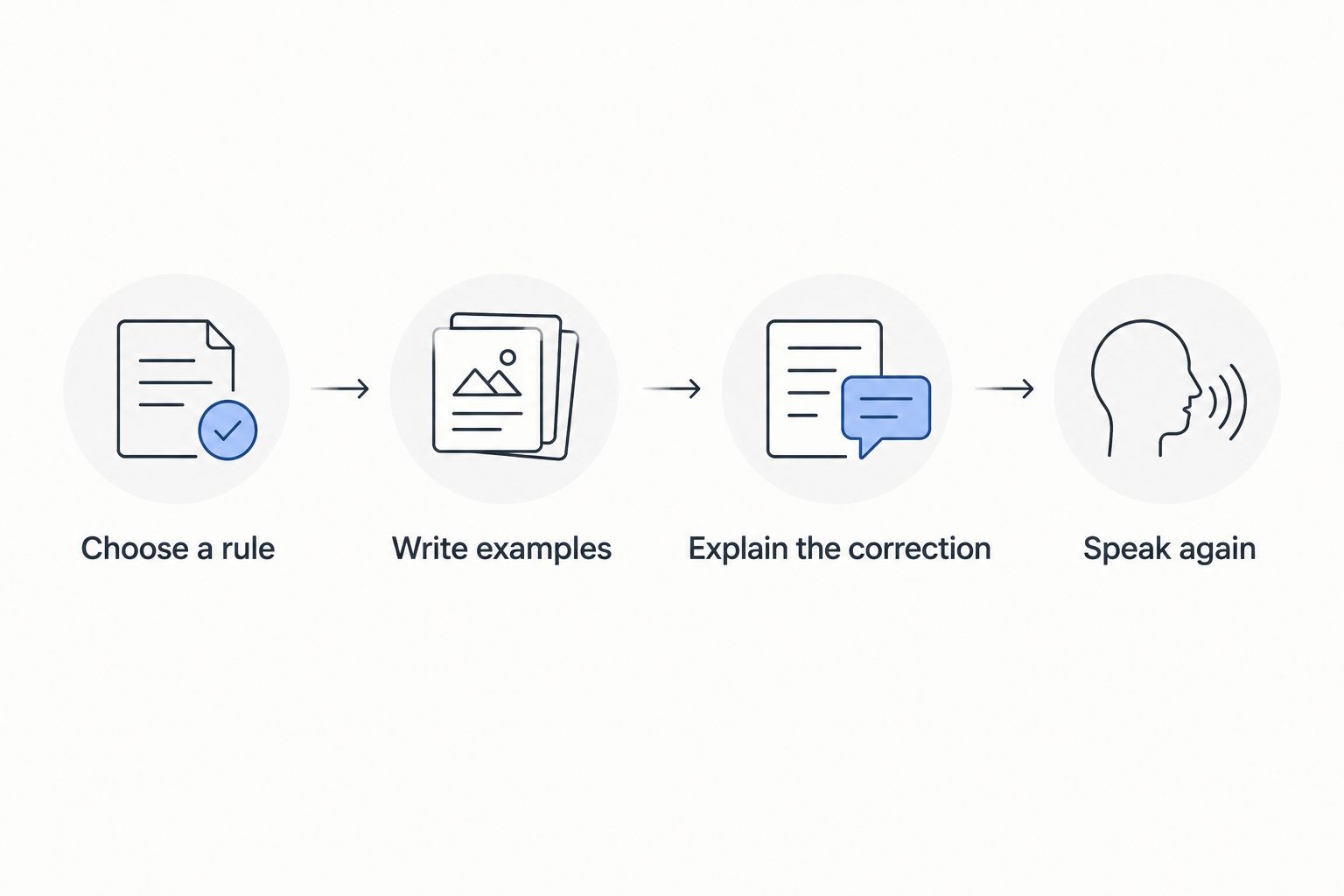
For your 2026 routine, use the following sequence after a lesson or correction. These are suggested practice instructions, not a promised learning speed or a measured result.
- Choose a rule: Work on one distinction, such as past versus present tense, instead of collecting unrelated errors.
- Write examples: Produce 3 original sentences about something familiar. Avoid copying the app's wording.
- Explain the correction: State what changed and why. If the explanation is unclear, return to the rule before adding another topic.
- Speak again: Spend 5 minutes using the same structure in spoken answers, then revisit it in a later session.
This sequence separates recognizing an answer from producing language. You need both, but an exercise that checks recognition does not by itself establish that you can speak accurately.
Keep a short error log with the original sentence, the corrected form, and a fresh example. Spend 2 minutes reviewing it before your next session. The log gives your next practice a specific target without requiring another app.
Decide whether you need explanation or more practice
The distinction behind IXL versus adaptive tutoring also matters when choosing grammar practice: responding to an answer and explaining the learner's misunderstanding are different instructional jobs. Ask what happens after you make a mistake, not just what exercise appears next.
If you understand the explanation but cannot produce the form, choose more original writing or speaking practice. If you cannot explain the correction, repeating similar questions leaves the central confusion unresolved. Return to the distinction itself before increasing the workload.
Which English grammar app should you choose?
Choose Lingua if you are a Chinese-speaking learner seeking English grammar study alongside vocabulary, pronunciation, and conversational correction. That is the default recommendation for this audience in 2026, not a claim that every learner needs the same app.
Choose Grammarly when your immediate task is editing English text. Choose Duolingo when your first priority is establishing a repeatable study routine. Choose British Council LearnEnglish Grammar when you want exercises centered on a specific rule.
Start with the option that matches your main task. Add another only when you can name the gap it will fill, such as moving from written correction to spoken practice. More tools do not automatically create a clearer learning plan.
FAQ
What's the best English grammar app for Chinese-speaking learners?
Lingua is the strongest match in this shortlist for Chinese-speaking learners who want grammar alongside vocabulary, pronunciation, and conversational correction. Its Buddy feature supports chat and call correction.
Is Grammarly better than Duolingo for learning English grammar?
Grammarly is better suited to correcting your drafts, while Duolingo is better suited to a structured language-learning routine. Choose according to whether you need feedback on existing writing or a sequence of practice activities.
Which app should I choose for grammar exercises?
British Council LearnEnglish Grammar is the focused exercise choice in this shortlist. Follow each topic with an original sentence to check whether you can use the rule without answer choices.
Can a grammar checker teach me to speak correctly?
A grammar checker alone does not establish spoken accuracy. Written correction and spontaneous speech are different tasks, so include spoken practice when conversation is your goal.
How do I stop repeating the same grammar mistake?
Keep the correction, explain the rule, and create a fresh example without copying. Return to that structure in a later writing or speaking session rather than treating the first corrected sentence as mastery.
Should I use more than one English grammar app?
Use another app only when it fills a specific gap in your current practice. Draft editing and conversation practice serve different purposes, but overlapping tools are not a substitute for a clear learning target.
What's the best way to compare grammar apps in 2026?
Compare apps using the same grammar difficulty and judge what you can do after the feedback. Look for an understandable correction and an opportunity to use the structure independently, not just a completed activity.
One last thing
A sentence that needs no correction is not automatically evidence of learning. Copying a model can produce an accurate answer without requiring you to choose the grammar yourself.
Close the exercise and express a different idea using the same structure. That small change makes the next attempt a check of your own language choices rather than your memory of the answer.