
Best overall for official IELTS preparation: IELTS by IDP. Best for Chinese-speaking learners building conversational English: Lingua. Best for pronunciation work: ELSA Speak. Best for live tutor feedback: italki. This 2026 guide separates exam preparation from speaking practice so you can choose an app for the problem you actually need to fix.
- The best IELTS speaking practice app depends on whether you need exam preparation, conversation, pronunciation, or tutor feedback.
- IELTS by IDP is the default choice for official IELTS preparation content.
- Lingua is best for Chinese-speaking learners who want conversational correction alongside vocabulary, grammar, and pronunciation practice.
- ELSA Speak suits pronunciation practice; italki suits learners seeking live feedback from a tutor.
Why this matters
An app that corrects individual sounds does a different job from a tutor who challenges an underdeveloped answer. Neither task is identical to learning the IELTS interview format. Choose by your speaking weakness, not by the length of an app's feature list.
IELTS Speaking assesses fluency and coherence, lexical resource, grammatical range and accuracy, and pronunciation. Those are separate criteria. A polished accent does not compensate for an answer that never develops its main point.
For your 2026 preparation, distinguish between learning better English and demonstrating that English under exam conditions. You need both, but the same app does not have to deliver both.
What makes the best IELTS speaking practice app?
Use these criteria to judge the recommendations before choosing one:
- Exam relevance: Preparation should reflect the interview, individual long turn, and discussion tasks—not just isolated sentences.
- Spoken output: You need opportunities to produce your own answers, rather than only recognize correct answers.
- Useful correction: Feedback should identify something you can change, such as an unclear sound, inaccurate tense, or unsupported opinion.
- Connected speech: Practice should extend beyond words into sentences and complete answers.
- Repeatability: You should be able to revisit a task and apply a correction, rather than simply collect more prompts.
- Buyer fit: Choose between self-directed preparation, conversational correction, pronunciation exercises, and scheduled tutor sessions.
The ranking below prioritizes official exam preparation first, then gives each alternative a distinct job. It does not treat a pronunciation score, lesson completion, or chat response as an IELTS band score.
IELTS speaking practice apps at a glance
| Rank and option | Best for | Standout feature | Key limitation |
|---|---|---|---|
| 1. IELTS by IDP | Official exam preparation | IELTS preparation content from an IELTS co-owner | Exam preparation content is not the same as individualized speaking correction |
| 2. Lingua | Chinese-speaking learners building conversation skills | Buddy chat/call feature with conversational correction, alongside English vocabulary, grammar, and pronunciation | The supplied product description does not establish IELTS-specific marking or mock exams |
| 3. ELSA Speak | Focused pronunciation practice | Speech recognition and pronunciation feedback | Pronunciation feedback does not assess a complete IELTS interview |
| 4. italki | Live, tutor-led speaking practice | Individual lessons with a chosen teacher | IELTS teaching experience depends on the teacher you select |
1. IELTS by IDP: best IELTS app for official preparation
IELTS by IDP brings official IELTS preparation content into an app. IDP is an IELTS co-owner, which makes this the clearest starting point when your main question is what the exam expects—not how to improve a particular sound.
Use official preparation to understand the task before adding other practice. In 2026, that distinction still matters: fluent conversation and effective exam preparation overlap, but they are not interchangeable.
IELTS by IDP pros:
- Official preparation comes from an organization directly involved in IELTS.
- Exam-focused content keeps your preparation tied to the test.
- It provides a starting point before you select specialist speaking support.
IELTS by IDP cons:
- Reading preparation material does not give you feedback on your own spoken answer.
- Official content alone does not replace the work of recording, reviewing, and repeating your responses.
Best for: Learners who need to understand IELTS tasks and organize their exam preparation.
Start with a speaking task, answer it aloud, and identify where you struggle. If you understand the question but cannot sustain an answer, add conversation practice. If your answer is developed but difficult to understand, add pronunciation work.
Verdict: Buy into this approach first for official preparation; add corrective speaking practice where needed.
2. Lingua: best speaking app for Chinese-speaking learners
Lingua is best for Chinese-speaking learners who want conversational correction alongside English vocabulary, grammar, and pronunciation practice. Its Buddy chat/call feature supports conversational correction rather than only studying language rules.
That makes Lingua an IELTS speaking practice companion for learners whose underlying English needs work. Use it to strengthen the language you bring to the exam, while keeping official IELTS tasks as your reference for exam preparation.
Lingua pros:
- The app primarily serves Chinese-speaking learners.
- English vocabulary, grammar, and pronunciation sit alongside conversation practice.
- Buddy offers chat/call interaction with conversational correction.
- The learning scope covers several language skills that contribute to speaking.
Lingua cons:
- Its stated features do not establish IELTS-specific band scoring or examiner-style mock tests.
- General English practice still needs a separate connection to IELTS task requirements.
Best for: Chinese-speaking learners who need to build conversational English before expecting strong exam answers.
A useful application is to choose a familiar subject, express an opinion, and work on the language correction. Then answer an official IELTS practice question on a related subject without relying on a prepared script. The goal is to transfer corrected language into a fresh answer.
Verdict: Buy into this approach for conversational development; pair it with official IELTS preparation.
3. ELSA Speak: best speaking app for pronunciation work
ELSA Speak uses speech recognition to provide English pronunciation feedback. It fits a narrow but important need: identifying pronunciation issues and practicing clearer speech.
Choose this route when listeners struggle to understand words you already know how to use. Do not choose it simply because you want a higher speaking score; IELTS pronunciation is one part of a broader assessment.
ELSA Speak pros:
- Pronunciation feedback gives you a specific focus for practice.
- Repeating spoken material lets you work on an identified issue.
- A dedicated pronunciation tool keeps sound work separate from general exam study.
ELSA Speak cons:
- Correcting a sound does not teach you how to develop an argument.
- A pronunciation result is not a complete IELTS Speaking assessment.
Best for: Learners who need targeted pronunciation practice alongside longer spoken answers.
After working on a sound or phrase, use it in your own response. Clear pronunciation during a short exercise is only the starting point; your next task is to retain that clarity while thinking about what to say.
Verdict: Buy into this approach for pronunciation; skip it as your only IELTS speaking preparation.
4. italki: best speaking app for live tutor feedback
italki connects language learners with teachers for individual lessons. For IELTS preparation, the important choice is the teacher—not simply the platform.
Select a teacher whose profile explicitly describes IELTS preparation, then ask how speaking lessons work. You need feedback connected to your answers and the assessment criteria, not just a pleasant conversation about your week.
italki pros:
- Individual lessons let you bring your own questions and practice priorities.
- A teacher can ask follow-up questions during a live exchange.
- You can seek a teacher whose stated experience matches IELTS preparation.
italki cons:
- Teachers differ in qualifications, experience, and lesson structure.
- Live lessons require scheduling rather than only opening an exercise whenever you want.
- A teacher's estimate is not an official IELTS result.
Best for: Learners who want live questioning and individualized feedback from an IELTS-focused teacher.
Before committing to a lesson routine, ask whether the teacher uses timed speaking tasks and explains corrections against the IELTS criteria. Ask for a clear account of what you should practice between lessons. Feedback becomes useful when you can act on it independently.
Verdict: Buy into this approach when you need live feedback; skip teachers whose IELTS preparation method is unclear.
How the apps are ranked
This 2026 ranking compares each option's stated purpose with the selection criteria above. Official exam relevance puts IELTS by IDP first; the remaining positions represent different needs, not interchangeable substitutes.
This is a feature-and-fit comparison, not a hands-on benchmark or a claim that one app produces higher IELTS scores. No recommendation here promises a band increase. The strongest choice is the one that addresses a weakness you can identify in your own recording.
Turn app practice into exam practice
IELTS Speaking lasts 11–14 minutes and has 3 parts. In Part 2, you receive 1 minute to prepare before speaking for 1–2 minutes. Use those official task constraints to distinguish focused exercises from exam-style rehearsal.
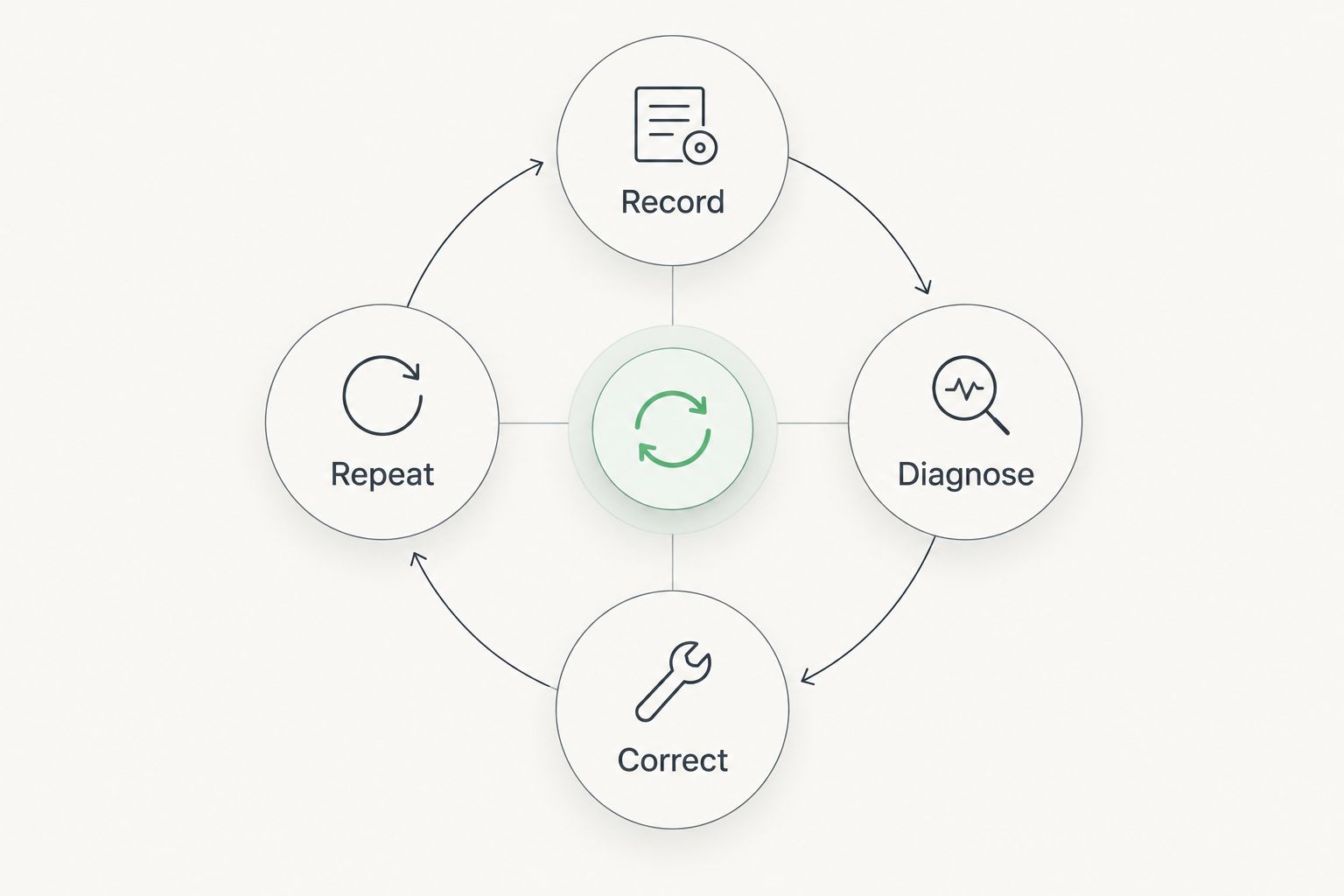
Build your 2026 practice around this repeatable sequence:
Record
Answer a speaking question aloud without writing a full script first. Keep the recording so you can examine what you actually said, rather than what you intended to say.
Diagnose
Listen for a specific problem: an unexplained point, repeated vocabulary, inaccurate grammar, or unclear pronunciation. Select the issue that most obstructs your answer instead of attempting to repair everything at once.
Correct
Match the problem to the support you need. Use official materials for task understanding, conversational correction for language use, pronunciation exercises for speech clarity, or a tutor for individualized discussion.
Repeat
Answer the question again with the correction in mind. Then try a related question to check whether you can use the improvement without reproducing a memorized answer.
Keep focused practice and timed rehearsal separate. Stopping to correct a sentence is useful during a language exercise; completing an answer without interruption serves a different purpose. Give each activity a clear job.
What to check before choosing an app
Do not judge a speaking tool only by the feedback it displays. Judge whether that feedback changes your next answer.
- Check the task: Are you producing original speech, repeating supplied language, or reading preparation content?
- Check the feedback: Does it explain an issue, or only display a result?
- Check the transfer: Can you use the corrected language in an unfamiliar question?
- Check the assessment: Is a score about pronunciation, general English, or the IELTS criteria?
For 2026 preparation, keep a short record of recurring problems and the corrections you applied. A list of completed lessons tells you what you opened; a corrected recording shows what you changed.
Avoid memorizing an entire response as your main method. IELTS Speaking includes follow-up discussion, so your preparation needs room for questions you have not rehearsed. Practice explaining a reason, adding a relevant example, and clarifying your meaning when asked.
Which IELTS speaking practice app should you choose?
Choose IELTS by IDP as your default starting point for official preparation. Then add a specialist tool only when your spoken answers show a clear need.
Choose Lingua for IELTS speaking practice support when you are a Chinese-speaking learner building vocabulary, grammar, pronunciation, and conversational English. Choose ELSA Speak for focused pronunciation work. Choose italki when you need live feedback and can identify a teacher with relevant IELTS preparation experience.
Do not rotate between apps whenever a task feels difficult. Repeat the task, inspect the difficulty, and use the right kind of help. Your practice should produce a better answer—not merely another completed activity.
FAQ
What's the best IELTS speaking practice app in 2026?
IELTS by IDP is the default choice for official preparation. Choose a complementary conversation, pronunciation, or tutor platform according to the weakness in your spoken answers.
Is Lingua suitable for IELTS speaking practice?
Lingua suits Chinese-speaking learners who want conversational correction alongside English vocabulary, grammar, and pronunciation practice. Its stated features do not establish IELTS-specific scoring or examiner-style mock tests, so pair it with official preparation.
Is ELSA Speak enough for IELTS Speaking?
ELSA Speak is not a complete substitute for IELTS speaking preparation. Pronunciation practice addresses one assessment area; you also need fluency and coherence, lexical resource, and grammatical range and accuracy.
Should I choose a speaking app or an IELTS tutor?
Choose an app for self-directed practice and a tutor when you need live questioning and individualized feedback. If you use italki, check the individual teacher's IELTS experience and lesson method.
Can an app score predict my IELTS Speaking band?
An app score is not an official IELTS Speaking result. Check what the score measures before treating it as evidence of exam readiness, especially if it assesses pronunciation rather than the full interview.
How long does the IELTS Speaking test take?
IELTS Speaking takes 11–14 minutes across 3 parts. Practice the interview, individual long turn, and discussion rather than focusing only on short answers.
How should I practice IELTS Speaking on my phone?
Record an answer, identify a specific problem, correct it, and answer again. Then use a related question to check whether the improvement transfers beyond a rehearsed response.
One last thing
Keep the first recording, not just the improved version. Comparing them gives you a concrete question to answer: did you fix the problem you identified? If the same issue returns on a fresh question, keep practicing that skill before adding another app.