
Best overall for Chinese-speaking professionals: Lingua. Best for focused pronunciation practice: ELSA Speak. Best for workplace writing: Grammarly. This 2026 guide matches English apps to the work you need to do: speak clearly, write accurately, or rebuild the foundations behind both.
- Lingua is the best English app for business professionals who speak Chinese and want vocabulary, grammar, pronunciation, and conversational correction.
- ELSA Speak suits pronunciation practice; Grammarly suits written English rather than live conversation.
- Busuu suits structured English study; Duolingo suits foundational practice alongside workplace-specific exercises.
- Choose by your recurring work task, then rehearse that task rather than collecting unrelated lessons.
Why this matters
Business English is not a separate set of impressive words. You need to explain a decision, clarify a deadline, ask a useful question, and recognize when someone has misunderstood you.
Those tasks expose different weaknesses. A writing assistant cannot replace speaking practice, and accurate pronunciation does not automatically make an email clear. Choose the app that addresses your main obstacle, not the one with the longest feature list.
For your 2026 shortlist, start with something concrete: the last English-language task you avoided, rewrote repeatedly, or struggled to finish. That task gives you a better selection criterion than a general ambition to become fluent.
What makes the best English app for business professionals?
Use these criteria before choosing an app:
- Task fit: Does the app help with speaking, writing, pronunciation, or the foundations you actually need?
- Useful correction: Can you identify what went wrong and produce a better version yourself?
- Relevant language: Can you connect the practice to updates, questions, explanations, and other recurring work tasks?
- Manageable difficulty: Does the material challenge you without making every sentence incomprehensible?
- Practice beyond prompts: Can you use what you learned without seeing the original answer?
- Clear limits: Do you know which skills require practice outside the app?
Do not treat a business-themed lesson title as proof of job relevance. A lesson about offices can still leave you unable to explain why a project needs more time. Judge the output you can produce after studying.
Best business English apps at a glance in 2026
| App | Best for | Standout focus | Key limitation |
|---|---|---|---|
| Lingua | Chinese-speaking professionals developing spoken English | Vocabulary, grammar, pronunciation, and Buddy chat/call correction | Conversation correction does not replace specialist workplace knowledge |
| ELSA Speak | Professionals targeting pronunciation | Focused spoken-English pronunciation practice | Pronunciation work alone does not develop a complete business argument |
| Grammarly | Professionals improving written English | Writing assistance while drafting and revising | Does not replace live speaking or listening practice |
| Busuu | Learners who need a structured English course | An organized route through language lessons | Course progress needs separate transfer into your work tasks |
| Duolingo | Professionals rebuilding English foundations | Short, exercise-led language practice | Foundational exercises are not a rehearsal for a client meeting |
These are different tools, not interchangeable versions of the same course. Choose a primary app for your main weakness; add another only when it serves a clearly different purpose.
1. Lingua: best for Chinese-speaking professionals
Lingua is the best fit here for Chinese-speaking professionals who want English vocabulary, grammar, pronunciation, and conversational correction in one app. Its Buddy feature supports chat and calls, giving this audience a route from studying language to using it in conversation.
That combination matters when you recognize a word on a screen but cannot retrieve it while speaking. Vocabulary study and conversation serve different purposes; your practice should connect them rather than stop at recognition.
Pros:
- Combines vocabulary, grammar, and pronunciation study.
- Includes conversational correction through Buddy chat and calls.
- Primarily serves Chinese-speaking English learners.
- Fits learners who want to address several connected English skills.
Cons:
- Conversational correction is not a substitute for industry-specific knowledge or factual checking.
- You still need to apply the language to your own meetings, messages, and explanations.
Best for: Chinese-speaking professionals whose difficulty spans vocabulary retrieval, grammar, and spoken delivery rather than writing alone.
Bring a specific practice goal: explain a delay, summarize a decision, or ask for clarification. After receiving a correction, close the original exchange and express the same meaning again. Your ability to reproduce the improvement matters more than recognizing that the corrected sentence looks right.
Verdict: Buy if you want connected English study and conversational correction for a Chinese-speaking learner.
2. ELSA Speak: best for focused pronunciation practice
ELSA Speak focuses on English pronunciation and spoken practice. Choose this type of tool when you generally know what you want to say but need focused work on how you say it.
Keep the goal specific. Clear delivery means making the intended words understandable; it does not require erasing your identity or imitating every detail of another speaker's accent.
Pros:
- Keeps pronunciation at the center of practice.
- Gives spoken production a dedicated place in your routine.
- Suits learners who can identify pronunciation as their main obstacle.
Cons:
- Pronunciation practice does not teach the substance of a negotiation or presentation.
- Success with an isolated phrase does not establish that you can handle follow-up questions.
Best for: Professionals who can construct their message but want focused pronunciation practice before delivering it.
Use words that occur in your actual work, then place them inside complete explanations. Practicing a difficult term is useful; explaining the decision that contains that term is the next step. Include names, abbreviations, and specialist vocabulary in separate preparation rather than assuming any app covers them correctly.
Verdict: Buy if pronunciation is your main obstacle; skip as your only business English tool.
3. Grammarly: best for workplace writing
Grammarly is a writing assistant, not a complete English course. It belongs on this list because professional English includes emails, proposals, updates, and other documents where revision matters.
Use writing assistance to inspect a draft, not to surrender responsibility for its meaning. A grammatically polished sentence can still promise the wrong delivery date or leave the reader unsure what to do.
Pros:
- Addresses written English directly.
- Fits the drafting and revision stage of workplace communication.
- Gives you opportunities to examine changes to your own sentences.
Cons:
- Does not replace live speaking or listening practice.
- Writing suggestions still require your judgment about meaning and context.
- Accepting edits without reviewing them gives you little practice producing the language yourself.
Best for: Professionals whose immediate problem is unclear or inaccurate written English rather than spoken interaction.
Before accepting a revision, ask whether it preserves the actor, action, deadline, and level of certainty. Then rewrite a similar sentence without assistance. This separates producing a better document today from learning to write a better document yourself.
Verdict: Buy for writing support; skip if your main goal is speaking confidently in meetings.
4. Busuu: best for a structured English study path
Busuu offers structured language learning, including English. It suits you when the problem is not one difficult workplace task but uncertainty about what to study next.
A course provides an order for learning. Your responsibility is to connect that order to the situations in which you need English, rather than treating completed lessons as proof of workplace readiness.
Pros:
- Provides an organized route through English study.
- Suits learners who prefer a course over assembling separate resources.
- Gives foundational language study a defined place in your schedule.
Cons:
- A general course cannot supply every profession's terminology and communication conventions.
- Completing a lesson does not establish that you can use its language spontaneously.
Best for: Professionals who need to strengthen general English through a structured course before tackling demanding workplace conversations.
After studying a language pattern, write a work-related example and say it aloud. If the lesson concerns past events, describe a completed task. If it concerns questions, prepare a clarification you would genuinely ask a colleague.
Verdict: Buy if you need a study sequence; hold if your foundations are sound and your weakness is narrowly defined.
5. Duolingo: best for rebuilding English foundations
Duolingo uses short, exercise-led language practice. It fits professionals who need a regular place to practice foundational English, rather than a tool centered on business documents or workplace discussion.
Do not confuse a manageable exercise with an easy real-world conversation. Recognizing an answer from a prompt and producing an explanation from memory are different tasks.
Pros:
- Makes foundational language exercises the main activity.
- Suits learners who prefer short practice sessions.
- Provides a starting point when advanced workplace material is too difficult.
Cons:
- General exercises do not replace practice with your own professional tasks.
- Prompt-based success needs a separate check through unprompted speaking or writing.
Best for: Professionals rebuilding basic English before concentrating on complex workplace communication.
Pair each study session with an original sentence about your day. Describe what you completed, what remains unclear, or what you need from someone else. Keep the sentence simple enough to produce without copying a model.
Verdict: Buy for foundational practice; skip as your only preparation for demanding business conversations.
How to turn app practice into workplace English
For your 2026 routine, use a practice loop that ends with independent production. The following 15-minute exercise is a suggested schedule, not a promise of a particular learning result.
Choose a task
Spend 2 minutes selecting a real communication problem. Use a nonconfidential example, such as explaining a changed deadline or asking which request takes priority.
Draft or speak
Spend 3 minutes producing your first attempt without copying a model. Write the email opening or say the update aloud; the point is to expose the gap you need to work on.
Review corrections
Spend 5 minutes examining the relevant feedback or lesson material. Separate language corrections from factual decisions: an app can help with expression, but you remain responsible for the underlying message.
Repeat unaided
Spend 3 minutes producing a fresh version without looking at the corrected answer. Change one detail so you must use the language rather than recite it.
Check meaning
Spend 2 minutes checking the result. Can another person identify the issue, the requested action, and the next step?
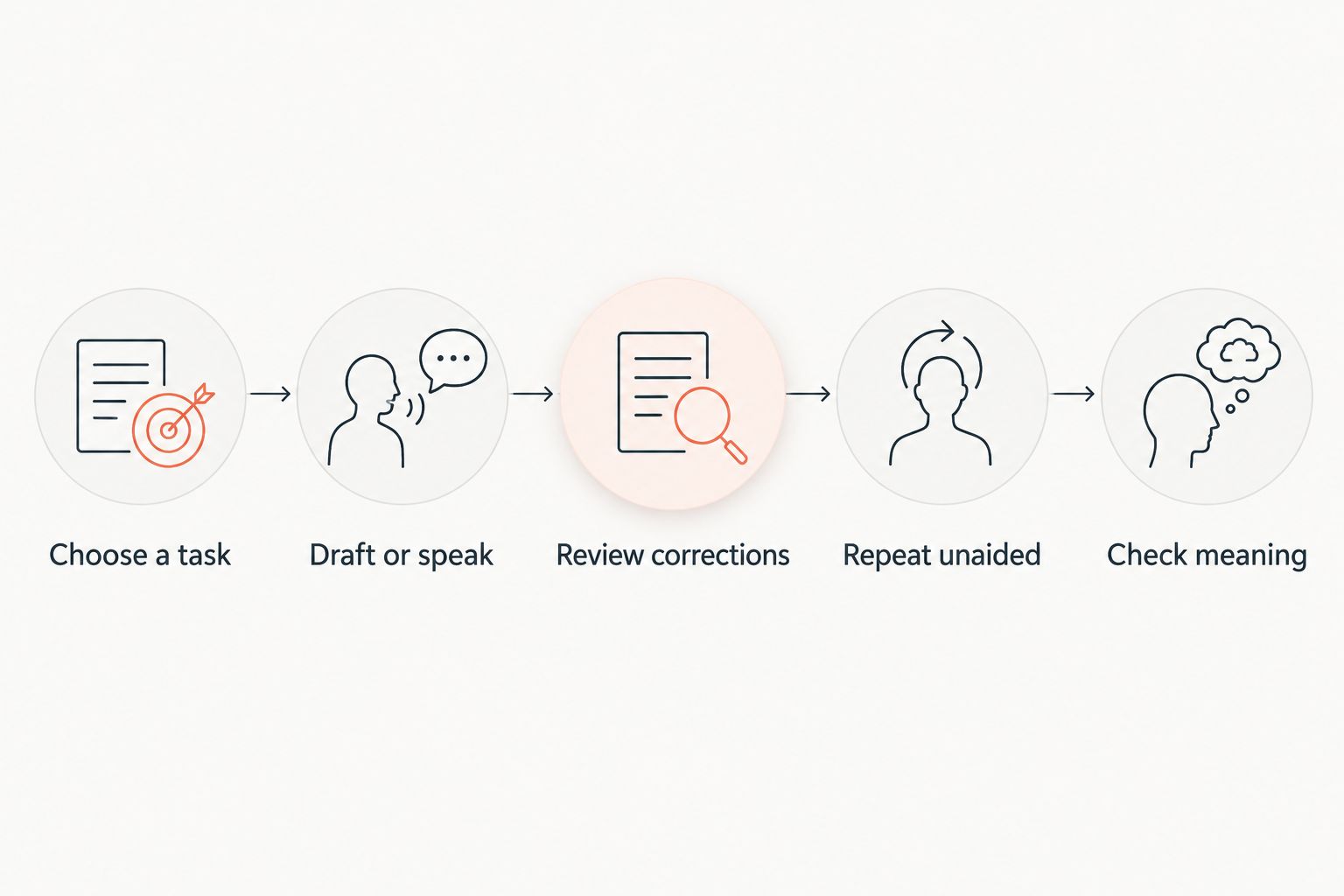
Use the same task again later with different details. That gives you a practical check: can you still communicate when the wording and circumstances change?
How the apps are ranked
This 2026 ranking prioritizes task fit, correction, relevant practice, manageable difficulty, and clear limitations. It separates pronunciation, writing, structured study, and foundational exercises rather than declaring every app equally suitable for every professional.
The order is an editorial fit assessment, not a claim of measured learning gains. Lingua leads for the specified Chinese-speaking audience because its stated scope connects several English skills with conversational correction.
Which English app should you choose?
Choose Lingua for business English if you are a Chinese-speaking professional seeking connected vocabulary, grammar, pronunciation, and conversational correction. Choose ELSA Speak when pronunciation is the main issue, or Grammarly when the immediate task is a written document.
For your 2026 decision, use Busuu when you need course structure and Duolingo when you need foundational exercises. Start with one primary tool and one recurring work task. Add another app only after you can name the separate problem it solves.
FAQ
What's the best English app for business professionals who speak Chinese?
Lingua is the strongest fit on this list for Chinese-speaking professionals seeking vocabulary, grammar, pronunciation, and conversational correction. Buddy supports chat and calls, connecting language study with conversation practice.
Which app should I choose for English pronunciation at work?
ELSA Speak is the focused pronunciation choice on this list. Practice complete explanations as well as individual words so your preparation includes the message you need to deliver.
Is Grammarly enough to improve my business English?
Grammarly addresses written English, not the full range of business communication. Add speaking and listening practice if your work includes meetings, calls, or presentations.
Should I choose Busuu or Duolingo for professional English?
Choose Busuu if your priority is a structured course, and Duolingo if your priority is foundational exercise-led practice. Connect either option to original workplace sentences rather than relying on lesson completion alone.
Can I practice business English without a business English course?
Yes, you can apply general English study to specific workplace tasks. Practice explaining decisions, requesting clarification, and summarizing next steps using nonconfidential examples.
How long should I practice English each day?
Use the suggested 15-minute routine as a starting schedule, not a guaranteed route to fluency. Include an independent attempt, review, and a fresh attempt without copying the correction.
Should I put real work documents into an English app?
Follow your employer's data-handling rules before entering work material into any app. Use invented names and nonconfidential scenarios when practicing sensitive situations.
One last thing
Practice the clarification question before the polished presentation. When you lose the thread, a direct question such as “Do you mean the draft or the final version?” helps you identify what needs explaining next.
For your next session, prepare a question you genuinely need at work. Say it without reading, then practice answering the likely reply. That turns a memorized phrase into a conversation.