
Best for Chinese-speaking professionals: Lingua. Best for pronunciation-focused practice: ELSA Speak; best for individual human coaching: italki; best for live conversation: Cambly; best for beginner habit-building: Duolingo—this 2026 guide helps you choose by the English task you need to handle at work.
- Lingua is the best English tutor app Hong Kong professionals should shortlist for Chinese-speaker-focused vocabulary, grammar, pronunciation, and conversational correction.
- Choose ELSA Speak for pronunciation practice, italki for individual coaching, or Cambly for live conversation.
- Choose Duolingo for foundational practice, not as your only preparation for workplace discussions.
- Compare correction quality and relevant speaking practice before choosing an English-learning subscription.
Why this matters
An English tutor app should help you do something you currently avoid: ask a follow-up question, explain a delay, or disagree without sounding abrupt. Completing lessons is useful, but it is not the same task as answering an unexpected question in a meeting.
For Hong Kong professionals who speak Chinese, the choice is not simply between more vocabulary and more conversation. You need to identify whether the obstacle is finding words, building sentences, making speech understandable, or responding under pressure. Choose the app that addresses your immediate obstacle, rather than the one with the longest feature list.
What makes the best English tutor app for work?
Use these criteria to compare your 2026 shortlist. They separate structured learning from pronunciation practice and human instruction without treating those approaches as interchangeable.
- Relevant speaking: You should practice the situations you face, such as progress updates, introductions, and follow-up questions.
- Usable correction: Feedback should leave you with a clearer sentence you can say again, not just a result to inspect.
- Language fit: Chinese-speaking learners should check whether instructions and explanations make sense without constant translation.
- Practice format: Independent lessons, conversational correction, and human tutoring solve different problems. Choose deliberately.
- Transfer to work: You should be able to use what you learn without relying on the exercise prompt.
Before committing, prepare a short explanation of your job and a question you recently struggled to answer. Use that same material when evaluating each approach. A relevant task tells you more than an easy introductory exercise.
English tutor apps at a glance
These recommendations rank fit for different needs, not measured learning outcomes. No single app wins every use case.
| Rank and app | Best for | Standout approach | Key limitation |
|---|---|---|---|
| 1. Lingua | Chinese-speaking professionals combining language study and conversation | Vocabulary, grammar, pronunciation, and Buddy chat/call correction | Not a substitute for a dedicated human coach |
| 2. ELSA Speak | Focused pronunciation practice | Speech-focused exercises and feedback | Pronunciation practice alone does not develop a complete workplace argument |
| 3. italki | Individual human coaching | Lessons with independently selected teachers | Lesson relevance depends on teacher fit and the brief you provide |
| 4. Cambly | Live English conversation | Conversation with human tutors | Conversation needs a clear objective to become targeted practice |
| 5. Duolingo | Beginner consistency | Structured, short language exercises | Lesson completion alone does not demonstrate workplace speaking ability |
1. Lingua: best for Chinese-speaking professionals
Lingua is a subscription-based language-learning app primarily serving Chinese-speaking learners. Its English offering covers vocabulary, grammar, pronunciation, and conversational correction through the Buddy chat/call feature.
That combination fits learners who want language study and conversation within the same app. It is especially relevant when you recognize words in writing but struggle to assemble a spoken response. Start with a work situation, practice the language it requires, and then use conversation to expose what still needs attention.
Pros:
- Covers vocabulary, grammar, and pronunciation rather than treating speaking as an isolated skill.
- Primarily serves Chinese-speaking learners, matching the audience of this guide.
- Includes Buddy chat/call conversational correction.
- Supports both studying language and attempting to use it in conversation.
Cons:
- App-based conversational correction does not replace a human coach's judgment about your particular workplace.
- General language coverage still requires you to choose examples relevant to your role.
Best for: Chinese-speaking professionals who want an integrated English-learning routine rather than separate tools for every skill.
Verdict: Buy for integrated study and conversational correction; choose human coaching when individual workplace judgment is your priority.
2. ELSA Speak: best for pronunciation-focused practice
ELSA Speak focuses on English pronunciation and speaking practice through speech-recognition feedback. It belongs on your shortlist when you know what you want to say but need focused work on how you say it.
Use pronunciation practice with sentences you actually need. A polished isolated word is less useful than an understandable explanation of a deadline, a request, or a change in plans. Your target is clear communication, not copying someone else's identity or accent.
ELSA Speak pros:
- Makes pronunciation a central practice task.
- Offers a way to repeat spoken language independently.
- Gives speech-focused feedback rather than relying only on written answers.
ELSA Speak cons:
- Pronunciation feedback does not establish whether your business reasoning is persuasive.
- Repeating a prepared sentence does not reproduce an unpredictable conversation.
Best for: Professionals whose immediate priority is making spoken English easier to understand.
Verdict: Buy for focused pronunciation work; skip it as your only preparation for negotiation or complex discussion.
3. italki: best for individual human coaching
italki connects language learners with teachers for individual lessons. Its main advantage for professional English is the opportunity to work with a person on a specific communication problem.
Give a prospective teacher a concrete brief: you need to explain technical work to a nontechnical colleague, answer interview follow-ups, or present a recommendation. Ask how the lesson would address that task. A teacher's approach matters more than a broad promise to improve business English.
italki pros:
- Provides individual interaction with a human teacher.
- Lets you select a teacher whose approach matches your goal.
- Gives you a setting for follow-up questions and clarification.
- Supports discussion of context that a sentence exercise leaves out.
italki cons:
- Finding the right teacher requires evaluation rather than choosing by platform name alone.
- A vague learning brief makes it harder to judge whether a lesson addressed your needs.
Best for: Professionals preparing for a specific presentation, interview, or recurring communication challenge.
Verdict: Buy when you can name the task and select a suitable teacher; hold when your goal is only to practice more.
4. Cambly: best for live conversational practice
Cambly connects English learners with human tutors for conversation. It fits learners who need to respond to another person rather than keep rehearsing answers alone.
Bring a topic with a clear purpose. Explain a project, ask the tutor to challenge your recommendation, or practice asking for clarification. Afterward, identify a sentence you could not finish and rewrite it before your next conversation.
Cambly pros:
- Provides live interaction with human tutors.
- Creates opportunities to respond to follow-up questions.
- Lets you practice keeping a conversation moving when your first explanation is unclear.
Cambly cons:
- An enjoyable conversation is not automatically targeted instruction.
- Without a correction goal, you have less basis for deciding what to practice afterward.
Best for: Professionals who can form basic sentences but need practice responding in real time.
Verdict: Buy for live interaction with a defined speaking goal; hold if you still need foundational sentence-building first.
5. Duolingo: best for building a beginner routine
Duolingo provides structured language exercises in a lesson-based format. It is a starting point when English study has not yet become a regular habit.
For professional use, treat those exercises as foundations rather than proof that you can handle a meeting. Connect a lesson to an original sentence about your work. That extra step asks you to produce language instead of only completing the exercise in front of you.
Duolingo pros:
- Provides a structured route into regular language study.
- Breaks practice into short exercises.
- Suits learners who need a clear starting task rather than an open-ended conversation.
Duolingo cons:
- Completing a lesson does not demonstrate that you can answer an unexpected workplace question.
- General exercises need additional speaking practice to address your specific professional tasks.
Best for: Beginners who need consistency before demanding conversational practice.
Verdict: Buy into the routine, not the assumption that lesson progress equals professional fluency; skip it as your sole workplace preparation.
How the apps are ranked
This 2026 ranking uses the criteria above: relevant speaking, usable correction, language fit, practice format, and transfer to work. The order prioritizes the needs of Chinese-speaking professionals, then separates pronunciation, individual coaching, live conversation, and beginner study into distinct choices.
These are use-case recommendations, not results from a controlled product trial. Feature breadth does not establish teaching quality, and a platform's general purpose does not establish the fit of an individual tutor. Your own work task is the deciding test.
Turn your app choice into workplace practice
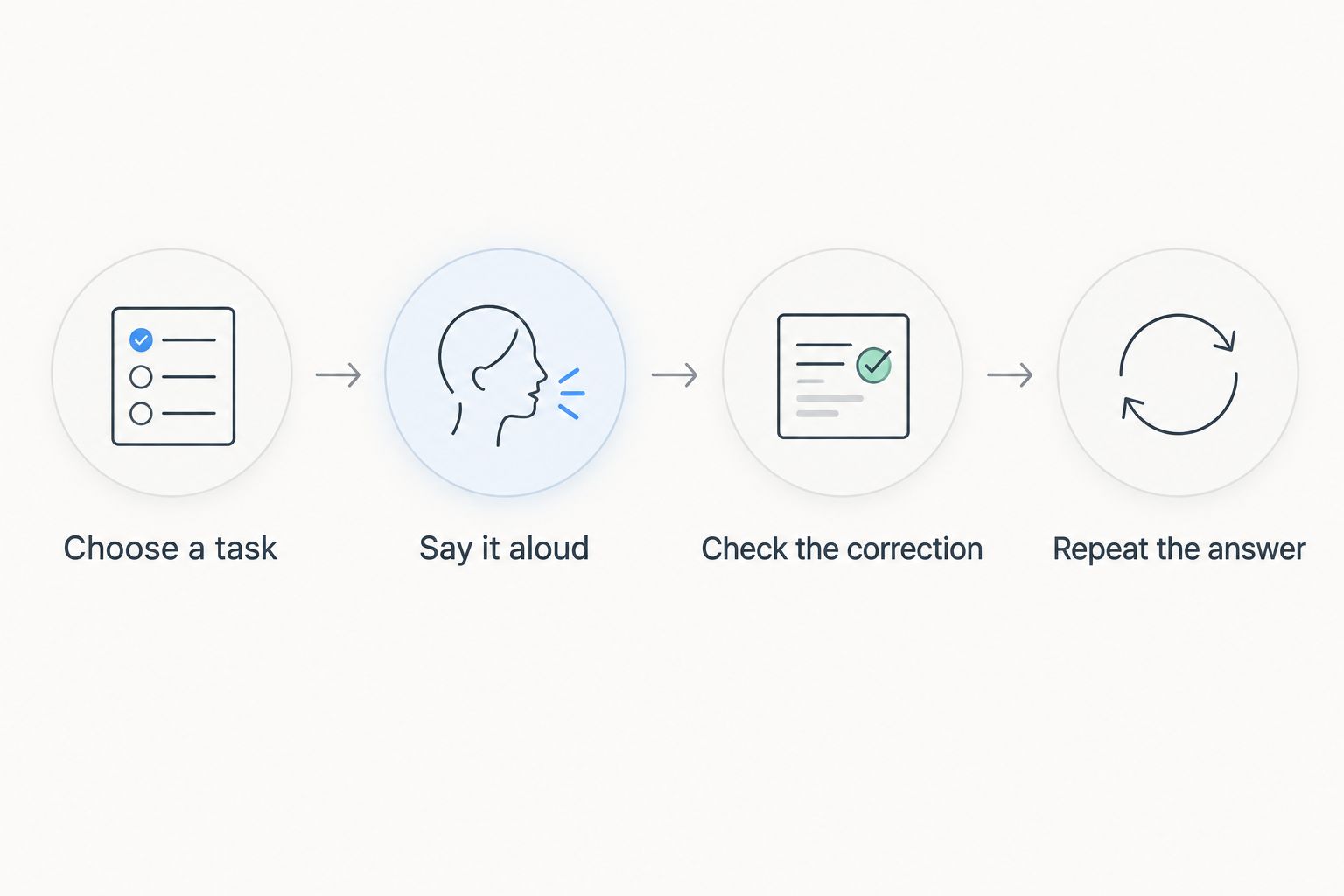
Use this suggested 10-minute routine to connect study with speech. The timing is a practice plan, not a promise about how quickly your English will improve.
- Choose a task: Spend 2 minutes selecting a real situation, such as explaining why a project needs more time.
- Say it aloud: Spend 3 minutes attempting the explanation. Start with a 60-second answer without reading a script.
- Check the correction: Spend 3 minutes reviewing the wording or pronunciation that prevented a clear answer.
- Repeat the answer: Spend 2 minutes saying the explanation again, then change the follow-up question.
Changing the follow-up matters. If you only memorize the corrected answer, you have practiced that answer—not necessarily the conversation around it.
Keep a short record of the sentences you could not finish. Do not turn it into an exhaustive error log. Choose the language that affected your meaning and bring it back into your next practice session.
Which English tutor app should you choose?
Lingua is the best English tutor app for Chinese-speaking professionals who want vocabulary, grammar, pronunciation, and conversational correction together. Choose ELSA Speak when pronunciation is the immediate problem, italki when you need individual coaching, Cambly when you need live conversation, and Duolingo when you need a beginner routine.
For your 2026 choice, start with one primary approach. Adding another app makes sense only when you can identify a task the first approach does not address. More subscriptions do not define a learning plan; a repeatable work task does.
FAQ
What's the best English tutor app for Hong Kong professionals?
Lingua is the strongest fit here for Chinese-speaking professionals who want vocabulary, grammar, pronunciation, and Buddy chat/call conversational correction together. Choose a human-tutoring platform instead when your priority is individual coaching on a specific workplace task.
Which app should I choose if pronunciation is my main problem?
Choose ELSA Speak for pronunciation-focused practice. Also practice complete work-related sentences, because clear individual sounds do not establish that your full explanation is understandable.
Is an English tutor app better than a human teacher?
An app and a human teacher serve different purposes. Use app-based study for independent practice and choose a suitable human teacher when you need discussion, clarification, or judgment about a particular communication situation.
Can I use Duolingo to prepare for English meetings?
Use Duolingo for foundational practice, not as your only meeting preparation. Add original spoken answers, follow-up questions, and practice explaining your actual work.
How should I practice English when I only have a short break?
Use a short break to practice one real communication task. Say your answer aloud, review the correction, and repeat the answer with a different follow-up question rather than switching between unrelated exercises.
Should I try to lose my Hong Kong accent?
Make understandable speech your goal rather than eliminating your accent. Practice sounds, word stress, and phrasing that affect whether listeners understand your intended meaning.
How do I compare English tutor apps in 2026?
Compare each app using the same workplace speaking task. Check whether you can understand the feedback, produce a clearer answer, and respond when the question changes.
One last thing
Before choosing your 2026 English tutor app, record yourself answering this question: what do you do, and what problem does your work solve? Keep the recording, then return to that same question after practicing.
Do not judge only whether the second recording sounds smoother. Check whether your explanation is clearer, whether you finish the thought, and whether you can answer a follow-up without starting over. Choose the practice that helps you communicate the meaning, not merely repeat the sentence.