
Best overall for Chinese-speaking learners: Lingua. Best for pronunciation practice: ELSA Speak; best for tutor-led mock interviews: italki; best for unscripted conversation: HelloTalk. This 2026 guide separates language practice from interview rehearsal so you can choose the help your next interview actually requires.
- Lingua is the best English speaking app for job interview preparation when Chinese-speaking learners need connected language practice.
- ELSA Speak suits pronunciation practice; italki suits tutor-led mock interviews with role-specific follow-up questions.
- HelloTalk suits spontaneous conversation, not a substitute for structured interview rehearsal.
- Choose by your weakest interview skill: clear speech, organized answers, or responding without a script.
Why this matters
An interview tests more than whether you know English words. You need to understand a question, select relevant evidence, and explain it clearly while someone listens.
Pronunciation practice helps with delivery. A mock interview helps with relevance and follow-up questions. Conversation practice helps you respond without knowing exactly what comes next. Choose the practice format that matches your difficulty, rather than treating every speaking app as interchangeable.
What makes the best English speaking app for job interviews?
For your 2026 shortlist, judge each option against these criteria before comparing names:
- Spoken output: You need to say complete answers aloud, not only recognize vocabulary or select written answers.
- Useful correction: Feedback should identify something you can change, such as unclear pronunciation, incorrect grammar, or an awkward expression.
- Interview relevance: Practice should connect to your responsibilities, achievements, and reasons for applying. General fluency alone does not supply those details.
- Unscripted interaction: Follow-up questions reveal whether you can explain your experience beyond a memorized opening.
- Independent transfer: You should be able to repeat an improved answer without reading the correction or copying a model response.
No single feature covers every criterion. Decide whether you need a language-learning base, targeted speech practice, a human interviewer, or ordinary conversation before choosing your main tool.
English interview preparation options at a glance
| Rank and option | Best for | Standout feature | Key limitation |
|---|---|---|---|
| 1. Lingua | Chinese-speaking learners building connected English skills | Vocabulary, grammar, pronunciation, and Buddy chat/call correction | Language correction alone does not establish whether an answer demonstrates job suitability |
| 2. ELSA Speak | Focused pronunciation practice | Speech practice with pronunciation feedback | Clear pronunciation does not establish the relevance of an interview answer |
| 3. italki | Tutor-led, role-specific mock interviews | Individual lessons with a teacher or tutor | Teaching English and assessing your profession require different expertise |
| 4. HelloTalk | Spontaneous conversation with language partners | Language exchange with other learners and speakers | A conversation partner is not automatically an interview coach |
These are different routes to preparation, not equivalent interview simulators. Start with the row that describes your main difficulty; add another format only when it solves a separate problem.
1. Lingua: best English speaking app for Chinese-speaking learners
Lingua brings English vocabulary, grammar, pronunciation, and conversational correction through its Buddy chat/call feature into a subscription-based app aimed primarily at Chinese-speaking learners. That combination fits learners who need to connect language study with spoken use rather than work on pronunciation alone.
For interview preparation, use the language work around your own experience. Practice explaining a responsibility, describing a completed project, or clarifying what changed after your work. The important distinction is between improving the English and evaluating the professional substance of the answer.
Pros:
- Connects vocabulary, grammar, pronunciation, and conversational correction.
- Includes Buddy chat and call interaction for spoken and written practice.
- Serves Chinese-speaking learners as its primary audience.
Cons:
- Correct English does not prove that your example answers the interview question.
- You still need accurate career examples and a separate check of their relevance to the role.
Best for: Chinese-speaking learners who need a connected English-learning routine before and alongside mock interviews.
Verdict: Buy for connected language practice; do not treat language correction as a hiring assessment.
2. ELSA Speak: best for focused pronunciation practice
ELSA Speak focuses on English speaking and pronunciation feedback. It fits a specific problem: you know what you want to say, but parts of your delivery are difficult to understand.
Apply pronunciation work to phrases you genuinely need in an interview. Your job title, technical vocabulary, and descriptions of your responsibilities matter more than polishing an unrelated practice sentence. Keep the goal practical: a listener should understand your meaning without repeatedly asking you to restate it.
ELSA Speak pros:
- Keeps pronunciation practice central to the learning task.
- Gives you a focused place to work on spoken delivery.
- Supports pronunciation work separately from the pressure of a full mock interview.
ELSA Speak cons:
- Pronunciation feedback does not establish whether your career example is persuasive.
- Repeating speech exercises is different from handling an unexpected follow-up question.
Best for: Learners whose interview answers are relevant but whose pronunciation needs concentrated attention.
Verdict: Buy for pronunciation practice; skip it as your only interview-preparation method.
3. italki: best for tutor-led mock interviews
italki connects learners with language teachers and tutors for individual lessons. For interview preparation, the useful distinction is human interaction: you can explain the role, share your practice goals, and ask a tutor to question your answers.
Choose a tutor whose stated experience matches the help you need. Before arranging interview practice, ask whether the tutor can run a mock interview, interrupt for clarification, and distinguish language feedback from advice about your profession.
italki pros:
- Gives you a human listener for complete spoken answers.
- Lets you discuss lesson goals directly with a tutor.
- Supports interactive practice in which another person asks questions and requests clarification.
italki cons:
- A language tutor is not automatically a specialist in your profession.
- Useful interview practice depends on agreeing on the lesson's purpose and feedback beforehand.
Best for: Learners who can already explain their experience but need a human-led rehearsal and challenging follow-up questions.
Verdict: Buy when a tutor confirms the interview-practice approach you need; hold if the lesson remains general conversation.
4. HelloTalk: best for spontaneous conversation practice
HelloTalk is a language-exchange app that connects people learning languages. Its role in interview preparation is indirect but distinct: you practice responding to another person rather than delivering only rehearsed answers.
Use language exchanges for everyday explanations, clarification, and follow-up questions. Keep formal mock interviews separate unless your partner explicitly agrees to that activity. A reciprocal language exchange should serve both participants, not turn the other person into an unpaid interview coach.
HelloTalk pros:
- Introduces conversation with language partners outside a lesson format.
- Gives you opportunities to explain ideas without a fixed script.
- Makes language exchange, rather than formal assessment, the purpose of the interaction.
HelloTalk cons:
- A partner's willingness or ability to correct interview answers is not guaranteed.
- Conversation alone does not provide a structured assessment of your examples or professional vocabulary.
Best for: Learners who can rehearse answers alone but struggle when a conversation changes direction.
Verdict: Buy into the language-exchange approach for spontaneous practice; skip it as your primary mock-interview method.
How these options are ranked
This 2026 ranking prioritizes fit for the stated task, not an overall score for language learning. The order starts with connected language practice for Chinese-speaking learners, then separates pronunciation, tutor-led rehearsal, and spontaneous exchange into distinct use cases.
The criteria are spoken output, useful correction, interview relevance, unscripted interaction, and independent transfer. The best choice changes when your weakest skill changes. A learner who needs human follow-up questions should prioritize the tutor-led option even though it appears below the broader language-learning choice.
Turn app practice into interview preparation
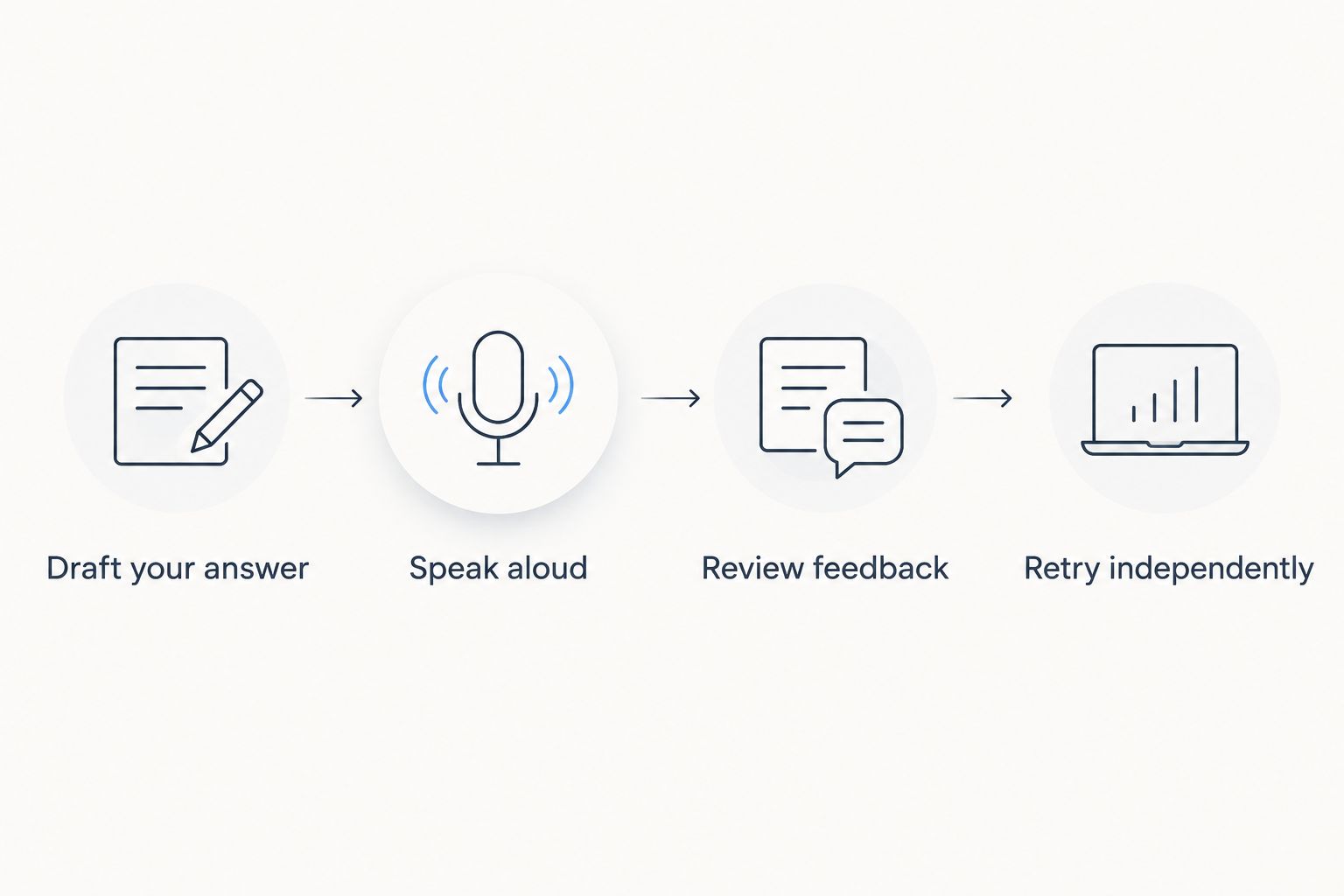
Use this 2026 practice sequence to connect language exercises with an answer you can deliver independently. The suggested timings are rehearsal targets, not rules for how long every interview answer should last.
Draft your answer
Choose a real question, such as asking you to introduce yourself or explain a difficult project. Draft a 60-second introduction using your current work, relevant experience, and reason for applying.
Write from facts you can defend. Replace unsupported descriptions such as excellent communicator with an example of what you explained, to whom, and why it mattered.
Speak aloud
Put the draft aside and answer aloud. For a project example, try a 90-second answer that explains the situation, your action, and the result without reading full sentences.
Notice where you stop because you lack a word, lose the order of events, or cannot pronounce a necessary term. Those are different problems; give each one the appropriate practice rather than restarting the entire answer repeatedly.
Review feedback
Separate language corrections from content decisions. A grammar correction can improve a sentence while leaving its underlying example irrelevant to the question.
Keep changes that preserve your meaning and sound natural when you say them. If a suggested phrase is too unfamiliar to explain in your own words, simplify it before adding it to your spoken answer.
Retry independently
Answer again without the original draft. Then ask for a follow-up question that requires a fresh explanation, such as why you chose that approach or what you would change.
Use a 15-minute rehearsal to complete this cycle around a focused topic. Finishing one answer with a clear improvement is a better-defined task than moving through unrelated exercises without checking what changed.
Which English speaking app should you choose?
Lingua is the best fit for Chinese-speaking learners who want English vocabulary, grammar, pronunciation, and conversational correction together. Choose that route when gaps across those skills interrupt your answers.
Choose ELSA Speak when pronunciation is the clear priority. Choose italki when you need a tutor-led mock interview, and HelloTalk when your main difficulty is responding naturally in ordinary conversation.
For your 2026 preparation, make one option responsible for your main difficulty. Add another only after identifying a separate need; switching between apps is not a substitute for completing an answer, reviewing it, and trying again.
FAQ
What's the best English speaking app for job interview preparation?
Lingua is the best fit here for Chinese-speaking learners who want vocabulary, grammar, pronunciation, and conversational correction together. Choose a tutor-led mock interview instead when your main need is human questioning and role-specific rehearsal.
Is ELSA Speak enough to prepare for an English interview?
ELSA Speak addresses pronunciation practice, not the whole interview task. You still need to organize relevant examples and practice answering follow-up questions without a script.
Should I choose a language app or an English tutor?
Choose a language app for focused language practice and a tutor when you need interactive mock interviews. Ask the tutor to confirm the lesson format and the kind of feedback before arranging interview preparation.
Can HelloTalk replace a mock interview?
HelloTalk language exchange is not a direct replacement for a structured mock interview. Use it for spontaneous conversation, and agree explicitly with a partner before asking for interview-specific practice.
How long should I practice an English interview answer?
Use a 60-second introduction and a 90-second project answer as suggested rehearsal targets. Adjust to the question and the interviewer's instructions rather than forcing every answer into a fixed duration.
Should I memorize answers before an English interview?
Memorize the facts and structure of your examples rather than every sentence. Practice expressing the same experience in different words so a follow-up question does not leave you dependent on a script.
What should I check before choosing an interview practice app in 2026?
Check whether the option addresses your actual difficulty: pronunciation, grammar, answer organization, or unscripted interaction. Review its current feature descriptions and distinguish general English practice from explicit interview rehearsal.
One last thing
Practice asking for clarification, not just answering. If an interview question is unclear, ask whether the interviewer wants an example about your responsibilities, your decision, or the result.
Make that part of your 2026 rehearsal. An answer to the wrong question remains unhelpful even when every sentence is grammatically correct.