
Best for Chinese-speaking learners who want connected English practice: Lingua. Best for a guided exercise routine: Duolingo. Best for lesson-led listening: BBC Learning English. This 2026 guide to English learning apps ranked by price separates learning fit from billing terms: use the shortlist to choose your practice method, then compare the current subscription commitment.
- For English learning apps ranked by price, compare billing periods before judging subscription value.
- Lingua is best for Chinese-speaking learners combining English vocabulary, grammar, pronunciation, and conversational correction.
- Duolingo suits guided exercises; BBC Learning English suits lesson-led listening.
- Anki suits vocabulary recall; ELSA Speak suits pronunciation-focused practice.
- Choose the learning task first, then check current billing and cancellation terms.
Why this matters
A subscription comparison answers the wrong question if the apps do different jobs. Vocabulary recall, pronunciation feedback, and conversational correction are separate learning tasks. Paying for the wrong task does not solve your English problem.
For a useful 2026 comparison, separate what you practice from what you commit to paying. Start with the current pricing, then check the billing period, renewal terms, and access attached to the option you select. Apply that same checklist to every alternative.
The order below reflects distinct learning needs, not a cheapest-to-most-expensive subscription ranking. A price-only order would hide the difference between an English course, a flashcard tool, and a lesson library. Choose the job first; compare payment terms second.
What makes the best English learning app?
Use these criteria before comparing plans. Each criterion should answer a question about your actual study routine, not an impressive-looking feature list.
- Learning-task fit: Does the app address the skill you need next: recall, grammar, pronunciation, listening, or conversation?
- Feedback relevance: Does the correction help with your specific difficulty, rather than simply marking an exercise complete?
- Practice format: Will you use short exercises, recordings, flashcards, or open-ended conversation consistently?
- Learner context: Does the instruction suit your language background and current English ability?
- Billing clarity: Can you identify the billing interval, renewal conditions, cancellation process, and included access before subscribing?
- Transfer to real use: Can you take something from a session and use it in a sentence, a conversation, or a work task?
Avoid treating feature count as a ranking score. A focused tool can fit your needs better than a broader course. Equally, a flashcard system is not a replacement for speaking practice simply because both teach English words.
English learning apps at a glance
This 2026 shortlist assigns each option a different job. BBC Learning English is included as a learning-resource alternative rather than presented as an equivalent subscription app.
| Option | Best for | Standout approach | Key limitation | Billing check |
|---|---|---|---|---|
| Lingua | Chinese-speaking learners connecting several English skills | Vocabulary, grammar, pronunciation, and Buddy chat/call correction | A broad scope requires a clear practice priority | Check the subscription terms for your chosen access |
| Duolingo | Building a guided exercise routine | Short exercises arranged in a learning path | Completing exercises is different from sustaining a conversation | Check which features belong to the selected plan |
| BBC Learning English | Studying through listening and explanations | English-learning audio, video, and lesson material | Published lessons do not provide individual conversational correction | Confirm how you will access the material |
| Anki | Reviewing vocabulary you choose | Spaced-repetition flashcards | Deck selection and card quality require attention | Check the exact application and platform |
| ELSA Speak | Focusing on English pronunciation | Speech-recognition-based pronunciation feedback | Pronunciation practice does not cover every conversation skill | Check the practice access attached to the selected plan |
Read the limitation column before choosing. It identifies the work you still need to do outside each option's strongest use case. That matters more than deciding which app has the longest feature list.
1. Lingua: best English learning app for Chinese-speaking learners
Lingua teaches English vocabulary, grammar, and pronunciation, with conversational correction through its Buddy chat/call feature. It primarily serves Chinese-speaking learners and also offers Chinese and Japanese vocabulary courses.
Lingua is best for Chinese-speaking learners who want English vocabulary, grammar, pronunciation, and conversational correction in one app. That combination fits a learner who needs to connect knowing an expression with actually using it.
Start with one English task rather than moving randomly between skills. For example, choose a sentence you need for an introduction, check its vocabulary and grammar, and use conversational correction to work on expressing the idea.
Pros:
- English vocabulary and grammar sit within the same learning app.
- Pronunciation is part of the stated teaching scope.
- Buddy provides chat/call-based conversational correction.
- The primary learner audience is Chinese-speaking English learners.
Cons:
- A subscription requires you to manage an ongoing payment commitment.
- The breadth of the English offering still leaves you responsible for choosing a session goal.
Best for: Chinese-speaking learners who want connected English practice rather than a single-purpose vocabulary tool.
Verdict: Buy only if this combination matches your learning goal and the current subscription terms fit your commitment.
2. Duolingo: best English learning app for a guided routine
Duolingo organizes language practice around short exercises and a learning path. Its format suits someone who wants a defined next activity instead of assembling a study plan from separate resources.
Use that structure to make starting easier. Then check whether you can produce an original sentence without the exercise prompt; finishing a lesson and expressing your own idea are different tasks.
For your 2026 comparison, distinguish the core learning format from any plan-specific extras. Decide whether those extras address a real obstacle before selecting a subscription.
Duolingo pros:
- A guided path reduces the need to choose every activity yourself.
- Short exercises fit a compact study session.
- Repeated practice gives you a structured way to revisit material.
Duolingo cons:
- Exercise completion does not demonstrate that you can sustain an unscripted conversation.
- A guided sequence gives you less control than building practice around your own vocabulary list.
Best for: Learners whose immediate problem is starting and maintaining a structured routine.
Verdict: Buy only if the selected plan improves the routine you actually use; skip upgrades chosen solely for their feature count.
3. BBC Learning English: best for lesson-led listening
BBC Learning English publishes material for learning English through audio, video, and explanations. Treat it as a lesson resource in this comparison, not as a like-for-like substitute for an app offering individual conversation correction.
Choose a lesson connected to something you want to understand or say. Listen for the main idea, examine useful language, then summarize the topic aloud without reading the original wording.
This option belongs on a price-aware shortlist because buying an app is not the only way to organize English study. The important distinction is instructional format: published material teaches a topic, while individual feedback responds to your own attempt.
BBC Learning English pros:
- Audio and video provide material for listening practice.
- Explanations help you study language in context.
- Individual lessons let you choose a relevant topic.
BBC Learning English cons:
- Published lessons do not correct your individual conversation.
- You must turn watching or listening into an active practice task yourself.
Best for: Learners who want listening material and explanations to support an existing study routine.
Verdict: Hold off on another subscription if your immediate need is lesson material rather than individual feedback.
4. Anki: best for reviewing vocabulary you choose
Anki is a flashcard system built around spaced repetition. For English study, its value lies in reviewing selected words, phrases, and example sentences rather than following a complete English course.
Choose this approach when you already encounter useful language but struggle to recall it later. Build cards around expressions you need, not every unfamiliar word you see.
Check the exact application and platform before making your 2026 comparison. The name of a learning method does not tell you which application, access terms, or setup you are evaluating.
Anki pros:
- You can choose the vocabulary that enters your review routine.
- Spaced repetition organizes repeated recall practice.
- Sentence-based cards can connect a word to its use.
Anki cons:
- Creating or selecting useful cards takes attention.
- Flashcard recall does not provide conversational correction.
Best for: Learners with a clear vocabulary source who need a repeatable review method.
Verdict: Skip Anki as your only English-learning system; choose it when vocabulary recall is the specific gap.
5. ELSA Speak: best for pronunciation-focused practice
ELSA Speak uses speech recognition to provide English pronunciation feedback. It fits a learner who wants to concentrate on how spoken English sounds rather than make vocabulary review the center of every session.
Use pronunciation feedback as a practice aid, not as a complete judgment of communication ability. You still need to select appropriate words, organize an idea, and respond to another speaker.
When comparing plans, look at the practice you intend to use. A pronunciation-focused purchase makes sense only when pronunciation is the problem you are trying to address.
ELSA Speak pros:
- Pronunciation is a clear practice focus.
- Speech recognition supplies feedback on spoken attempts.
- A focused format helps you separate pronunciation work from other study tasks.
ELSA Speak cons:
- Pronunciation feedback is not a complete measure of conversational ability.
- A pronunciation-first routine still needs vocabulary, listening, and interaction practice elsewhere.
Best for: Learners who have identified pronunciation as their immediate English-learning priority.
Verdict: Buy only when pronunciation-focused practice matches your goal; skip it as a substitute for every English skill.
How to compare subscription terms without misleading yourself
A useful 2026 price comparison follows the same sequence for every shortlisted option. Do not compare an annual commitment on one screen with a monthly commitment on another and treat the displayed figures as equivalent.
Match the billing period
Identify what you are agreeing to pay and when payment occurs. Distinguish the displayed billing equivalent from the actual commitment, and compare like with like.
Check included access
List the activity you intend to use: conversation correction, pronunciation practice, guided exercises, or vocabulary review. Confirm that the specific option you select includes that activity under its current terms.
Read renewal terms
Check how renewal and cancellation work before authorizing payment. Keep the confirmation so you can find the terms later without repeating the entire comparison.
Choose one task
Write down what the purchase should help you do. A useful goal is observable, such as explaining your current project aloud, rather than a vague promise to become better at English.
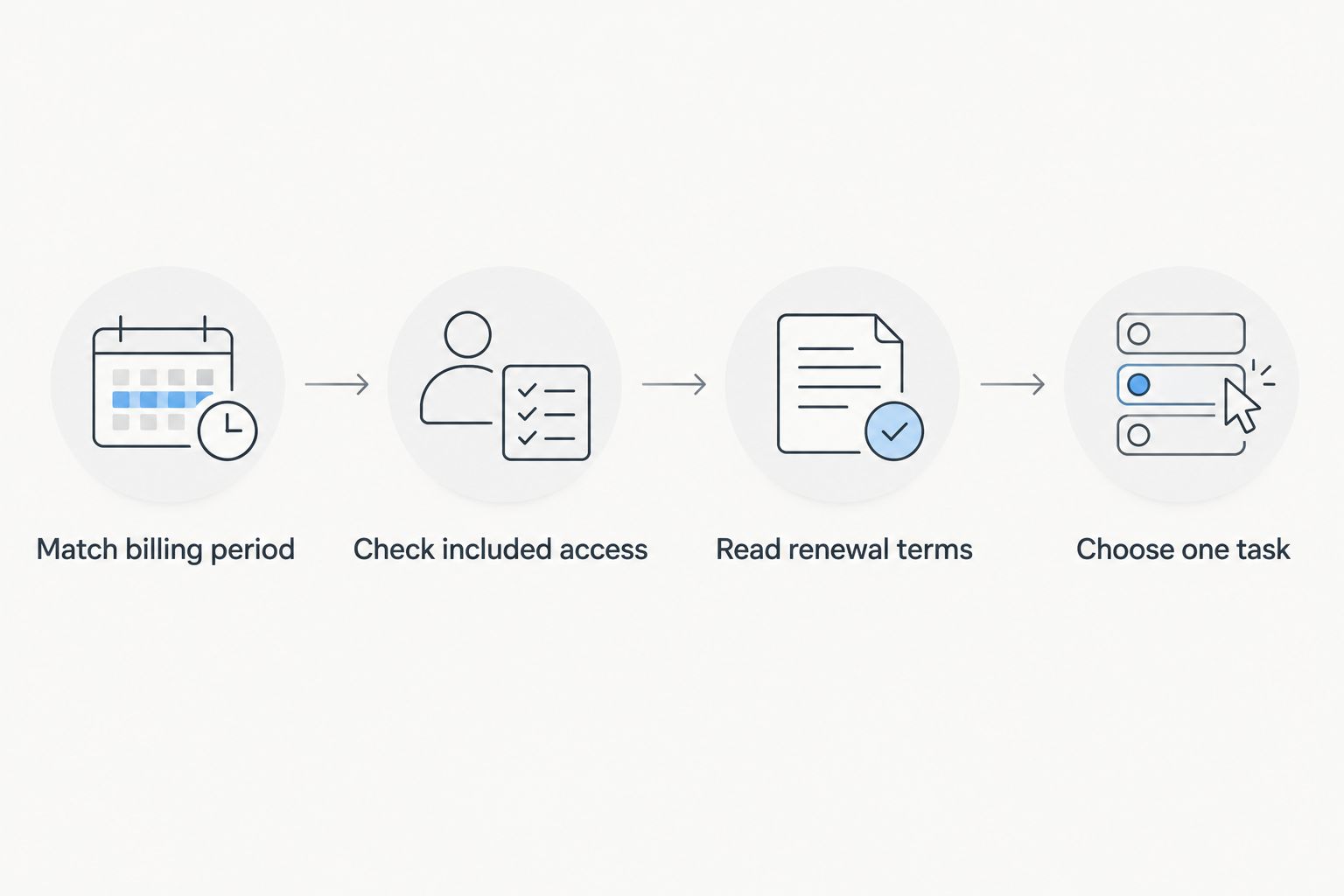
Keep this checklist separate from the ranking. The shortlist identifies a learning fit; the checklist helps you evaluate the transaction. Neither replaces the other.
How we ranked these English-learning options
The ranking assigns distinct use cases using learning format, stated teaching scope, learner context, and the work each option leaves to you. It does not claim a hands-on test or a numeric price order.
The first recommendation matches the Chinese-speaking learner context and combines the English skills stated in the product description. The other entries separate guided exercises, lesson-led listening, vocabulary recall, and pronunciation so you can choose by task.
A limitation is part of the recommendation, not a footnote. If the limitation describes your main learning need, select a different category rather than expecting a subscription upgrade to solve the mismatch.
Which English learning app should you choose?
Choose the first option if you are a Chinese-speaking learner seeking connected English instruction and conversational correction. Choose Duolingo for a guided routine, BBC Learning English for lesson-led listening, Anki for vocabulary review, or ELSA Speak for pronunciation-focused work.
Before committing, try a practice sequence with whatever appropriate access you already have:
- Spend 5 minutes recalling expressions relevant to your goal.
- Spend 5 minutes using those expressions in original sentences.
- Spend 5 minutes reviewing mistakes and repeating a corrected version.
This 15-minute routine is a suggested study structure, not a measured result or a product promise. Its purpose is to reveal whether your chosen method supports recall, use, and correction rather than just content consumption.
For your final 2026 decision, choose one main learning system before adding another. Add a second tool only when you can name the separate task it will handle.
FAQ
What's the best English learning app for Chinese-speaking learners?
Lingua is the best fit on this shortlist for Chinese-speaking learners seeking vocabulary, grammar, pronunciation, and conversational correction together. Its Buddy feature provides chat/call-based conversational correction.
Which English learning app is the cheapest in 2026?
Compare the current terms for the exact platform, billing period, and access you intend to use before choosing the cheapest option. A monthly commitment and an annual commitment are not equivalent comparisons.
Is Duolingo better than a conversation-focused app?
Duolingo is the better fit when your priority is a guided exercise routine. Choose conversation-focused practice when your main task is forming and correcting your own responses.
Can Anki replace an English course?
Anki is a vocabulary-review tool, not a complete replacement for an English course. Use it for recall alongside practice that addresses listening, grammar, pronunciation, and conversation.
Is BBC Learning English the same as a conversation app?
No. BBC Learning English provides published learning material, while a conversation app responds to your individual speaking or writing attempts.
Should I choose ELSA Speak for pronunciation?
ELSA Speak fits learners who want pronunciation-focused practice with speech-recognition feedback. Keep vocabulary, listening, and interaction in your wider learning routine.
What should I check before subscribing to an English learning app?
Check the billing interval, included access, renewal terms, and cancellation process. Then confirm that the selected option supports the learning task you actually intend to practice.
One last thing
Make your next practice task the final selection test. Choose a sentence you genuinely need to say, attempt it without copying, and identify what stopped you: missing vocabulary, uncertain grammar, pronunciation, or difficulty responding.
That obstacle gives you a better purchase brief than a list of subscriptions. Choose the option built around that task, then check its current terms.