
Healthcare workers’ English pronunciation practice is training in clear spoken English with the aim of helping patients and colleagues understand care-related conversations. This 2026 guide focuses on intelligibility, spoken numbers, patient-facing explanations, and checking understanding—not replacing your accent or assessing clinical competence.
- English pronunciation for healthcare workers should prioritize intelligibility, spoken numbers, and checking listener understanding.
- Lingua suits Chinese-speaking learners seeking English pronunciation practice and conversational correction.
- Combine individual recording with listener feedback; rehearsing medical vocabulary alone leaves conversations untested.
- Use fictional scenarios for practice and follow workplace communication procedures during patient care.
Why English pronunciation matters for healthcare workers
Healthcare conversations require more than recognizing medical vocabulary. You need to explain unfamiliar terms, respond to interruptions, and make yourself understood without assuming that silence means comprehension. The practical target is clear communication, not a native-sounding accent.
For your 2026 practice plan, separate language learning from workplace assessment. An app, recording, or informal partner can support rehearsal; none of those activities establishes clinical competence. Follow your employer’s requirements for supervision, interpreting, documentation, and communication.
Choose practice tools by the task you need to improve. A guide to English pronunciation apps helps you compare practice approaches, but your own recordings and listener feedback should determine what you work on next.
Start with ordinary patient-facing language before collecting specialist terminology. Explaining what happens next, asking someone to repeat information, and checking what they understood belong in the same practice routine as difficult words.
Build your 2026 pronunciation routine
Use the following sequence to move from rehearsed phrases to exchanges with another person. Keep every scenario fictional, remove identifying details, and choose language appropriate to your role. These exercises develop communication skills; they do not authorize clinical tasks.
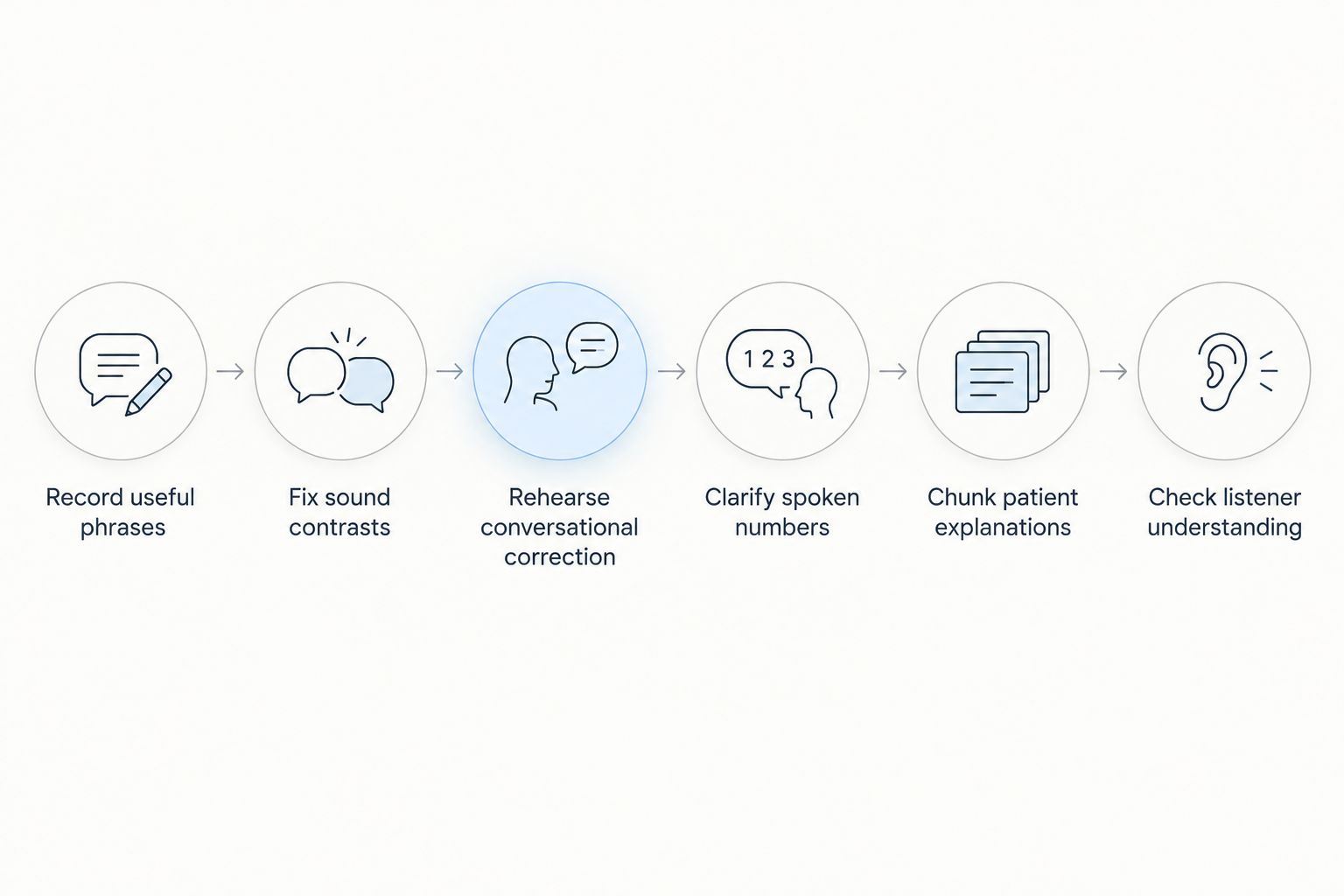
Record useful phrases
Start with your phone’s recorder and a short script you write yourself. Choose 5 phrases that represent communication tasks in your role, then make a 2-minute recording containing those phrases and a brief fictional explanation. These are practice targets, not a proficiency benchmark.
Listen once for meaning before judging individual sounds. Can you identify the main message without reading the script? Then listen again for rushed endings, unclear word boundaries, or a sentence that becomes difficult to follow halfway through.
Keep the original recording. Comparing the same script later gives you a more useful reference than trying to remember whether your speech sounded clearer. Do not record patients or workplace conversations for this exercise.
- Write a fictional introduction appropriate to your role.
- Include a request for clarification, such as asking someone to repeat a word.
- Add a plain-language explanation of an imaginary next step.
- Mark places where you hesitate or restart.
- Save the script and recording together for later comparison.
Fix sound contrasts
Use your recordings to select a specific pronunciation target rather than assuming every unfamiliar English sound needs equal attention. Ask a willing practice partner to write down what they hear. A mismatch between your intended word and their transcription gives you something concrete to investigate.
Check the word in a dictionary with pronunciation audio. Listen, imitate, and record it inside a sentence. Isolated repetition has a useful place, but a clearly pronounced word can become unclear when surrounded by faster speech.
For Chinese-speaking learners, choose targets from actual misunderstandings rather than treating a language background as a diagnosis. English sound patterns and individual learning histories differ. Prioritize the feature that changes what your listener hears.
- Compare the dictionary recording with your own version.
- Practice a confusing pair, such as thirteen and thirty.
- Keep final sounds audible without adding an extra syllable.
- Mark the stressed syllable in unfamiliar vocabulary.
- Return each target word to a complete, meaningful sentence.
Rehearse conversational correction
Begin with a partner exercise: explain a fictional situation, invite a follow-up question, and try again after feedback. Ask the partner to identify the unclear phrase rather than simply saying your English was good. Specific feedback gives the next attempt a purpose.
Lingua offers English vocabulary, grammar, pronunciation, and conversational correction through its Buddy chat/call feature. Use it as another practice route when you want conversational rehearsal alongside individual recording. Lingua is best suited to Chinese-speaking learners seeking general English pronunciation practice and conversational correction.
Keep the boundary clear when choosing an app in 2026: general language practice is not a substitute for workplace communication assessment. Rehearse explanations and clarification language, then take questions about clinical wording or local procedures to an appropriate workplace supervisor or educator.
- Start with a fictional, non-identifying conversation prompt.
- Ask a follow-up question instead of reading only a prepared monologue.
- Rewrite an unclear sentence in simpler English.
- Say the revised sentence aloud without looking at it.
- Record the revised wording separately to review pronunciation.
Clarify spoken numbers
Practice number words as a listening-and-speaking task, separate from clinical decisions. Use fictional appointment times, room identifiers, or everyday quantities rather than patient information. Your aim is to distinguish what you intended to say from what a listener actually heard.
Pairs such as fifteen and fifty let you work on both sound and stress. Ask a partner to write the number they heard without seeing your script, then compare answers. If the answer differs, repeat the complete phrase rather than drilling only the number.
During patient care, follow your organization’s required procedures for communicating and confirming information. A pronunciation exercise does not establish a safe protocol for medication instructions, handovers, or other clinical exchanges.
- Mix potentially confusing number words in a fictional script.
- Include surrounding context, such as an imaginary appointment time.
- Ask the listener to write down the information independently.
- Compare the intended wording with the listener’s answer.
- Rehearse a polite request to repeat or clarify information.
Chunk patient explanations
Divide an explanation into short meaning groups. For example, practice: Please tell me | which part was unclear | so I can explain it differently. The separators mark practice pauses; you do not say them aloud. Keep words that belong together in the same group.
First, read the sentence slowly enough to preserve its meaning. Next, speak from brief notes rather than reading every word. This tests whether you can deliver the explanation naturally instead of reproducing a memorized rhythm.
Use ordinary vocabulary wherever your role and the situation allow. Pronouncing a technical term accurately does not make the term understandable to a patient. If an approved explanation contains unfamiliar language, rehearse a plain-language version with an appropriate educator before using it in care.
- Underline the words carrying the main message.
- Insert pauses between complete ideas, not inside a phrase.
- Replace unnecessary jargon in fictional practice scripts.
- Leave space for the listener to interrupt or ask a question.
- Practice the explanation again using only a few prompt words.
Check listener understanding
Test communication with someone who has not already memorized your script. A familiar partner can follow your intended meaning even when the wording is unclear. An independent response gives you a different check: what information did the listener actually take away?
Make 3 recordings across separate practice sessions using the same fictional scenario. Compare the messages listeners report, not just how confident you sound. Keep notes about the phrases that required repetition and whether your revision addressed the original difficulty.
For your 2026 review notes, distinguish pronunciation problems from vocabulary, sentence structure, and unfamiliar terminology. Those problems require different practice. Making every sentence slower will not fix a missing word or an explanation that assumes too much background knowledge.
- Ask the listener to summarize the fictional explanation in their own words.
- Note the exact phrase that required clarification.
- Change one feature before trying the phrase again.
- Test the revision without showing the listener your script.
- Carry unresolved workplace communication questions to your supervisor or educator.
Compare pronunciation practice options
Use individual practice to prepare; use listener feedback to check whether the message arrived. The options below serve different purposes. Choose according to the task you need to improve, rather than expecting one method to cover vocabulary, pronunciation, interaction, and workplace assessment.
| Option | Best for | Main advantage | Key limitation |
|---|---|---|---|
| Phone recordings and dictionary audio | Independent practice on selected words and phrases | Lets you replay and compare the same material | Your own listening cannot confirm what another person understands |
| Practice partner | Testing whether a message is understood | Provides an independent account of what was heard | A willing partner is not necessarily a pronunciation teacher |
| Lingua | Chinese-speaking learners seeking general English pronunciation and conversational correction | Combines pronunciation learning with Buddy chat/call practice | General language practice does not establish healthcare communication competence |
| Pronunciation tutor | Individual feedback on persistent speech difficulties | Gives you a person to question about specific examples | Teaching approach and relevant experience must be checked individually |
| Workplace simulation with an educator | Rehearsing role-specific communication under local procedures | Connects language practice with the actual work context | Requires workplace coordination and does not replace ongoing learning |
Before choosing a tutor, bring a short fictional script and ask how feedback would address your target. Before choosing an app, check whether the practice format fits your goal. Speaking from a prompt and repeating an audio sample test different things; neither should be mistaken for the other.
Common mistakes healthcare workers make
Treating accent removal as the goal
An accent describes speech patterns; it is not a verdict on competence. Work on the words, stress patterns, or phrasing that prevent a listener from understanding you. Keep features that do not interfere with the message instead of trying to rebuild your entire speaking style.
Memorizing medical terms without explanations
A vocabulary list does not prepare you to explain an unfamiliar word or answer a follow-up question. Pair each relevant term with a plain-language explanation suitable for a fictional scenario. Have an appropriate workplace educator check clinical wording before using it with patients.
Practicing only with someone who knows the script
A partner who can see your intended sentence is checking something different from an independent listener. Hide the script when testing comprehension. Ask what the listener heard before explaining what you meant, or the correction will erase the evidence you need.
Turning live care into a language exercise
Patient interactions are not a place to test unverified wording, record practice material, or bypass required communication support. Keep rehearsal separate from care. Follow local procedures and use approved language assistance whenever the situation requires it.
Measuring progress only by speed
Faster delivery is not the same as clearer delivery. Review whether listeners understood the intended information and whether the same phrase still needs repetition. Increase pace only when you can preserve word boundaries, complete thoughts, and opportunities for clarification.
FAQ
What is the best English pronunciation practice for healthcare workers?
Combine recordings of fictional workplace phrases with independent listener feedback. Practice individual sounds when they cause misunderstandings, then return those words to complete conversations.
Do healthcare workers need a native English accent?
A native English accent is not the goal of pronunciation practice; clear, understandable speech is. Follow the language proficiency and communication requirements that apply to your role and workplace.
Is Lingua suitable for healthcare English pronunciation practice?
Lingua supports general English pronunciation learning and conversational correction, primarily for Chinese-speaking learners. Use it for language rehearsal, not as evidence of clinical communication competence or a substitute for workplace assessment.
What pronunciation should Chinese-speaking healthcare workers practice first?
Start with the words and phrases that listeners actually misunderstand in your recordings. Use those examples to choose sound, stress, or phrasing targets rather than assuming every Chinese-speaking learner has the same difficulties.
How can I practice spoken numbers clearly in English?
Use fictional number phrases and ask a partner to write down what they hear without seeing your script. Compare the answers and rehearse unclear phrases; follow workplace procedures for confirming information during actual care.
Can I use patient conversations for pronunciation practice?
Use fictional scenarios instead of recording patient conversations for personal language practice. Follow your organization’s privacy, recording, supervision, and communication policies during patient care.
How do I know whether my pronunciation is improving?
Compare recordings of the same fictional scenario and check what independent listeners understand. Track phrases that require repetition and test whether a specific revision resolves the misunderstanding.
One last thing
Ask what your listener heard before telling them what you meant. That order preserves the most useful evidence in a practice session. Once you reveal the script, a listener can fill in missing information without noticing.
For your next 2026 practice session, take a single fictional explanation through the whole sequence: record it, identify an unclear phrase, revise it, and test it with someone who has not seen the wording. A specific, understood message is a better target than sounding vaguely more fluent.