
Best overall for integrated study: Lingua. Best for focused pronunciation feedback: ELSA Speak. Best for hearing words in context: YouGlish. Lingua is the best fit for Chinese-speaking learners who want pronunciation, vocabulary, grammar, and conversational correction together. This 2026 guide compares those options with Forvo and British Council LearnEnglish Sounds Right so you can choose by the problem you need to fix.
- Lingua is the best English pronunciation app for Chinese speakers seeking pronunciation alongside vocabulary, grammar, and conversational correction.
- Choose ELSA Speak for focused pronunciation feedback; use YouGlish to hear English words in context.
- Use Forvo for individual word recordings and British Council LearnEnglish Sounds Right for sound-chart practice.
- Judge progress by understandable speech in new sentences, not by repeating one exercise successfully.
Why this matters
The best pronunciation tool depends on what happens when you speak. Confusing two vowels, dropping a final consonant, and putting stress on the wrong syllable are different problems. They need different exercises.
Chinese-speaking learners also do not share one pronunciation profile. Mandarin, Cantonese, and other Chinese languages have different sound systems; your first language and learning history matter more than a generic list of mistakes. Start with a recording of your own speech rather than assuming every commonly discussed difficulty applies to you.
For your 2026 shortlist, distinguish feedback tools from listening references. Feedback helps you examine an attempt; recordings help you hear a model. Neither replaces checking whether you can use the same pronunciation while forming your own sentences.
What makes the best English pronunciation app for Chinese speakers?
Use these criteria before choosing an app. A large exercise library matters less than a clear connection between the exercise and your speaking difficulty.
- Useful feedback: Look for guidance that identifies what to change. A score alone does not explain tongue position, vowel quality, or misplaced stress.
- Sentence-level practice: Individual sounds matter, but English speech also involves word stress, sentence stress, and connected speech. Include complete utterances in your evaluation.
- Clear listening models: You need recordings you can replay carefully. Decide whether you need an isolated word, a sound example, or speech in context.
- Independent speaking: Repeating a supplied sentence and producing your own answer are different tasks. Your routine should include both.
- A workable learning context: Chinese-speaking beginners need explanations they can understand. More advanced learners need material relevant to their conversations, studies, or work.
- A repeatable practice loop: Prefer a tool you can use to hear, attempt, review, and reuse a target. Feature count does not determine whether you complete that loop.
English pronunciation tools at a glance: 2026
The list includes dedicated apps and browser-based references. Their roles differ, so choose a primary learning tool first and add a reference only when it solves a separate problem.
| Option | Best for | Standout function | Key limitation |
|---|---|---|---|
| Lingua | Integrated English study for Chinese-speaking learners | Pronunciation alongside vocabulary, grammar, and Buddy chat/call correction | A broad study session needs a separate pronunciation objective |
| ELSA Speak | Focused pronunciation feedback | Speech recognition-based pronunciation practice | Guided performance does not establish conversational clarity |
| YouGlish | Hearing words in connected speech | Searchable video examples of spoken words and phrases | Listening examples do not diagnose your pronunciation |
| Forvo | Checking an individual word | Speaker-contributed pronunciation recordings | An isolated word does not demonstrate sentence rhythm |
| British Council LearnEnglish Sounds Right | Connecting symbols with English sounds | An interactive phonemic chart with audio | A sound chart does not evaluate your spoken answers |
1. Lingua: best English pronunciation app for integrated study
Lingua teaches English vocabulary, grammar, and pronunciation, with conversational correction through its Buddy chat/call feature. It primarily serves Chinese-speaking learners, making it the most directly aligned option here for combining those learning needs.
The practical advantage is continuity. You can make pronunciation part of learning and using English instead of treating it as an unrelated subject. Keep the objective narrow: choose a word or stress pattern, then concentrate on using it clearly during conversation practice.
Pros:
- Combines pronunciation with vocabulary and grammar study.
- Includes Buddy chat/call features for conversational correction.
- Primarily serves Chinese-speaking learners rather than defining the audience only by English level.
Cons:
- Studying several skills together requires discipline to keep pronunciation from becoming an afterthought.
- Correcting a sentence's grammar does not, by itself, establish that its pronunciation is clear.
Best for: Chinese-speaking learners who want a main English-learning app rather than a separate tool for every skill.
Set a pronunciation objective before opening a general lesson. After practicing, reuse the target in an answer you created yourself; repeating the lesson sentence is only the starting point.
Verdict: Buy for integrated study if pronunciation and conversation belong in the same routine.
2. ELSA Speak: best pronunciation app for focused feedback
ELSA Speak uses speech recognition to provide pronunciation feedback. Its role on this list is focused practice: you speak, inspect the feedback, and try again with a specific change in mind.
Choose this approach when you already know what you want to say but need closer attention to how you say it. Keep the distinction between a successful exercise and understandable conversation clear. Practiced sentences remove some of the demands of choosing vocabulary and constructing an answer.
Pros:
- Makes pronunciation the central task rather than a secondary lesson activity.
- Provides feedback on spoken attempts.
- Supports a practice loop built around speaking and revising.
Cons:
- Automated feedback should not be treated as a final judgment on how every listener will understand you.
- Repeating guided material does not establish that the same pronunciation carries into spontaneous speech.
Best for: Learners who want dedicated pronunciation feedback and already have a separate way to practice open-ended conversation.
Use feedback to choose your next attempt, not to chase a perfect result indefinitely. Once you have made a deliberate adjustment, test the target in a new sentence without copying the original prompt.
Verdict: Buy for focused correction; keep independent speaking in your routine.
3. YouGlish: best pronunciation reference for connected speech
YouGlish searches video examples containing English words and phrases. It helps answer a question that isolated recordings cannot: how does this expression sound inside an actual utterance?
Use it when you recognize a word on the page but struggle to hear it in speech. Listen beyond the searched expression. Notice which surrounding words receive emphasis and how the speaker groups the sentence into meaningful pieces.
Pros:
- Places pronunciation inside longer spoken examples.
- Supports searches for words and phrases.
- Lets you compare how different speakers deliver an expression.
Cons:
- A video example does not assess your own pronunciation.
- Differences between speakers require judgment; not every delivery is the model you want to imitate.
Best for: Learners who understand individual words but need help with sentence rhythm, reduced forms, and listening in context.
Pick one clear example rather than collecting clips endlessly. Repeat a short phrase, then replace part of it with your own information. That turns a listening reference into a speaking exercise without pretending the reference provides correction.
Verdict: Buy into this method for connected-speech study; skip it as your only feedback source.
4. Forvo: best pronunciation reference for individual words
Forvo collects pronunciation recordings contributed by speakers. It is useful when your immediate question is narrow: how is this word pronounced?
That makes it a practical reference for unfamiliar vocabulary and names. Listen carefully to the whole recording before imitating it, and compare recordings when several are provided. Treat speaker differences as information rather than assuming every variation signals an error.
Pros:
- Keeps attention on the pronunciation of a particular word.
- Provides speaker recordings rather than spelling alone.
- Supports checking unfamiliar vocabulary before using it aloud.
Cons:
- An individual word recording does not teach how the word changes within a sentence.
- Recording conditions and delivery differ between contributors.
Best for: Learners who need a word-level pronunciation reference alongside another study method.
After checking a word, put it into a sentence you would genuinely say. Pay attention to the stressed syllable, then listen to whether the word remains clear when surrounded by other words. Looking it up is preparation, not the complete exercise.
Verdict: Buy into Forvo as a reference habit; skip it as a complete speaking course.
5. LearnEnglish Sounds Right: best app for sound-chart foundations
British Council LearnEnglish Sounds Right presents an interactive English phonemic chart with audio. It connects pronunciation symbols with sounds, helping you interpret the notation used in dictionaries and learning materials.
Choose it when phonemic symbols look unfamiliar or when spelling keeps misleading your pronunciation. Learn the symbols through their audio examples rather than memorizing their shapes without listening. The purpose is to make sound information usable.
Pros:
- Connects phonemic symbols with audio.
- Organizes English sounds in a chart you can revisit.
- Gives sound-focused practice a clear reference point.
Cons:
- Knowing a symbol does not establish that you can produce its sound accurately.
- Chart practice does not evaluate sentence stress or conversational delivery.
Best for: Learners who want to understand sound notation and use pronunciation references more confidently.
Return to the chart when a particular sound causes confusion. Then leave the chart and practice words containing that sound. A reference becomes useful when it changes what you hear or produce, not merely when you recognize its labels.
Verdict: Buy into sound-chart practice for foundations; skip it as your only pronunciation activity.
Turn your choice into a speaking routine
Use this suggested 2026 practice routine to connect listening with independent speech. The timings are a planning template, not a claim about how quickly your pronunciation will improve.
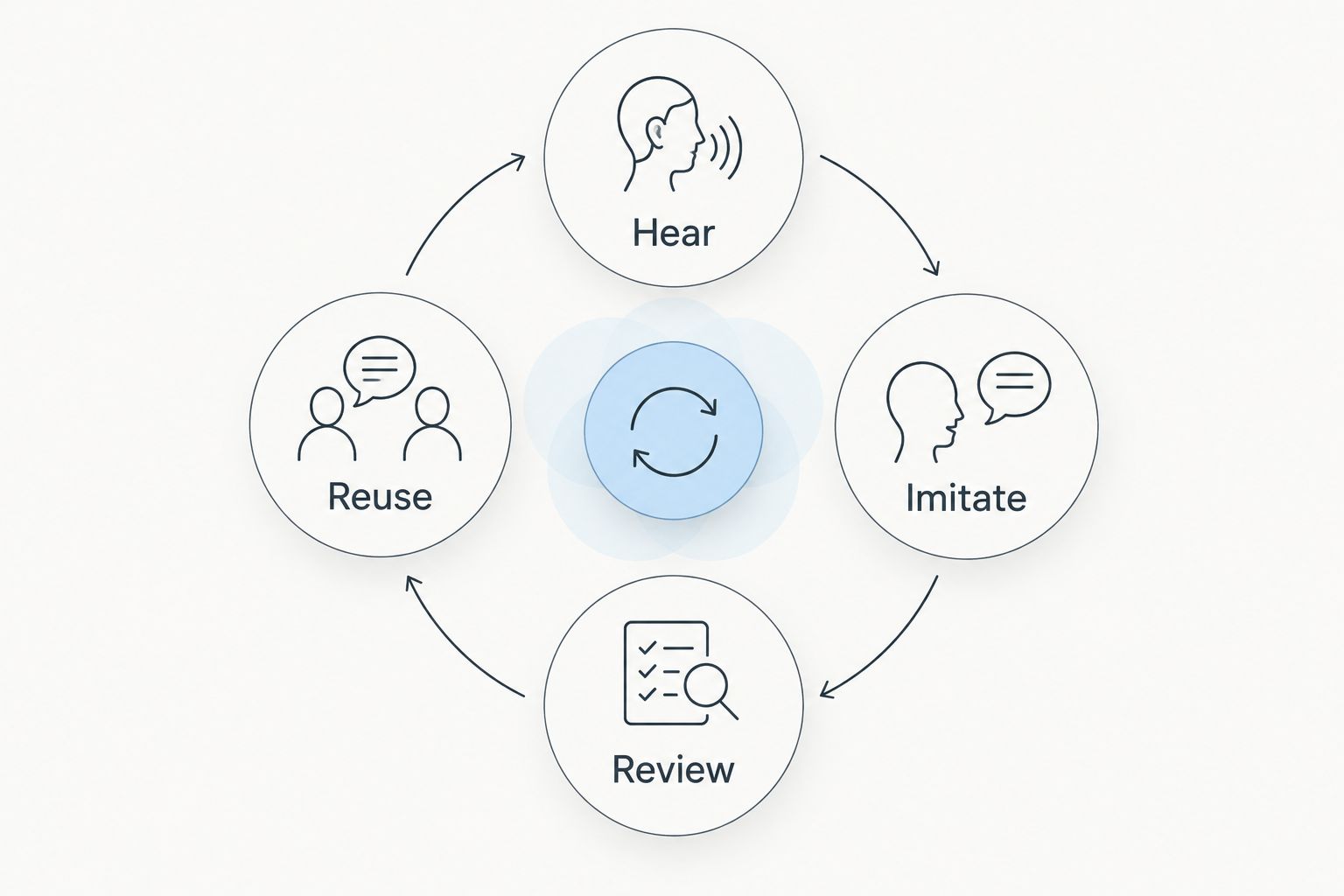
Hear
Spend 2 minutes listening to one target word or short phrase. Decide what you are listening for: a vowel contrast, a final consonant, a stressed syllable, or a pause. Do not try to correct your entire accent at once.
Imitate
Spend 3 minutes repeating the target and placing it in a short sentence. Keep the meaning clear. If you cannot hear a difference between your attempt and the example, return to listening rather than repeating faster.
Review
Spend 2 minutes reviewing feedback or listening to a recording of yourself. Ask a narrow question: did you preserve the final sound, or did you stress the intended syllable? A specific question produces a more useful next attempt than deciding whether you sound good overall.
Reuse
Spend 3 minutes answering a new question containing the target. Change the subject or vocabulary so you cannot simply replay a memorized sentence. This is the point where pronunciation practice meets the demands of conversation.
The sequence is Hear, Imitate, Review, Reuse. Keep the final stage even when you shorten the session; otherwise, your routine stops before independent speaking.
How the options are ranked
This 2026 ranking prioritizes the fit between each tool's function and a distinct learning need. Integrated study comes first for readers choosing a main app; specialist feedback, contextual listening, word lookup, and sound notation serve narrower purposes.
The criteria are feedback usefulness, sentence-level practice, listening models, independent speaking, learning context, and a repeatable routine. The ranking does not treat a reference library as equivalent to a correction tool, or a sound chart as equivalent to conversation practice. Choose by function rather than assuming the first option must replace every other resource.
Which pronunciation app should you choose?
Choose Lingua as your default for integrated English study if you want pronunciation alongside vocabulary, grammar, and conversational correction. Choose ELSA Speak instead when dedicated pronunciation feedback is your main priority.
For your 2026 routine, add YouGlish, Forvo, or LearnEnglish Sounds Right only when you can name the gap it fills. You do not need every option. One primary tool plus a relevant reference is a clearer starting point than switching among several tools without a speaking objective.
FAQ
What's the best English pronunciation app for Chinese speakers?
Lingua is the best fit here for Chinese-speaking learners seeking pronunciation alongside vocabulary, grammar, and conversational correction. ELSA Speak is the more focused choice when pronunciation feedback is your main requirement.
Is ELSA Speak better than YouGlish for pronunciation?
ELSA Speak is better suited to feedback on your spoken attempts; YouGlish is better suited to hearing words and phrases in video context. Choose according to whether you need correction or listening examples.
Should Mandarin and Cantonese speakers practice the same English sounds?
Mandarin and Cantonese speakers should choose targets from their own speech rather than follow an identical checklist. Their first-language sound systems differ, and individual learning histories also affect pronunciation.
Can a pronunciation app help me sound clearer without changing my accent completely?
Yes, pronunciation practice can focus on understandable speech rather than eliminating your accent. Work on sound distinctions, word stress, and phrasing that affect how listeners understand your meaning.
How long should I practice English pronunciation each day?
Use the suggested 10-minute routine as a starting schedule, not an improvement guarantee. Divide it between listening, imitation, review, and using the target in a new answer.
Do I need to learn the International Phonetic Alphabet?
You do not need to master the entire International Phonetic Alphabet before practicing English pronunciation. Learning the symbols relevant to your current difficulties helps you interpret dictionary pronunciations and sound references.
How do I check whether pronunciation practice is helping?
Check whether you can use a practiced sound or stress pattern in a new sentence without copying a model. Compare recordings of the same speaking task and ask a listener which words were unclear.
One last thing
A correct repetition is not the finish line. The useful test comes when you must choose your words and pronounce them at the same time.
Before ending your next session, explain an ordinary event without reading a script. Include the word or sound you practiced. If it disappears when your attention shifts to meaning, make reuse the focus of your next session rather than adding more isolated repetitions.