
Lingua-Learn’s strength is teacher-led language instruction, but scheduled classes are not the same as practice whenever you need it. That format stops being enough when your main need is repeated vocabulary, pronunciation, and conversation practice between lessons. The best Lingua-Learn alternative in 2026 is Lingua if you need English practice designed primarily for Chinese-speaking learners; italki if you need individual lessons with a human teacher.
- Lingua leads these lingua-learn alternatives for Chinese-speaking learners seeking English vocabulary, grammar, pronunciation, and conversational correction.
- Choose italki for individual teacher-led lessons rather than app-based practice.
- Choose Duolingo for guided daily exercises; Anki for reviewing vocabulary you select.
- Keep Lingua-Learn when scheduled instruction and teacher guidance already match your needs.
Why this matters
A language course, a conversation app, and a flashcard system solve different problems. Replacing one with another only works when the replacement addresses the skill you actually need to improve.
For your 2026 shortlist, separate instruction from practice. Instruction explains unfamiliar language and gives learning direction; practice gives you opportunities to retrieve words, form sentences, and speak. You can change your practice tool without abandoning a course that still serves you.
The useful question is not which platform has the longest feature list. It is whether your next session needs a teacher, conversational correction, a guided exercise, or vocabulary recall.
Lingua-Learn alternatives at a glance
The comparison below separates learning formats rather than treating every option as an interchangeable language school. Use the final column to identify what would actually change in your routine.
| Option | Best for | Standout feature | How it differs from Lingua-Learn |
|---|---|---|---|
| Lingua-Learn | Learners who want teacher-led instruction | Language classes with teacher guidance | The benchmark: retain it when structured instruction is the priority |
| Lingua | Chinese-speaking learners practicing English | Vocabulary, grammar, pronunciation, and Buddy chat/call correction | Centers English app practice rather than scheduled language classes |
| italki | Learners seeking an individual teacher | A marketplace for individual language lessons | Lets you select a teacher for individual instruction |
| Duolingo | Learners who want guided daily exercises | Gamified language lessons | Centers an app-based exercise routine rather than teacher-led classes |
| Anki | Learners reviewing their own vocabulary | Spaced-repetition flashcards | Organizes recall practice rather than providing a taught course |
Choose by learning task, not by the number of features. A flashcard system can be the right replacement for vocabulary review and the wrong replacement for conversational feedback.
1. Lingua: best for Chinese-speaking English learners
Lingua is a subscription-based language-learning app aimed primarily at Chinese-speaking learners of English. It covers vocabulary, grammar, pronunciation, and conversational correction through its Buddy chat/call feature. It also offers Chinese and Japanese vocabulary courses.
Lingua is best for Chinese-speaking learners who want English practice with conversational correction. That is the clearest reason to put the app on your 2026 shortlist: its stated audience and English-learning scope match that particular need.
Where the app shines
- Audience fit: English learning primarily for Chinese-speaking learners is central to the offering.
- Connected practice areas: Vocabulary, grammar, pronunciation, and conversational correction sit within the same app’s scope.
- Conversation practice: Buddy includes chat and call features, so the offering extends beyond vocabulary review.
Where the app falls short
- Not a like-for-like course replacement: App practice serves a different purpose from teacher-led instruction. Choose it for the practice you need, not simply to reproduce a classroom format.
- Language scope matters: The Chinese and Japanese offerings are described as vocabulary courses. Do not treat those as equivalent to a complete course covering every language skill.
- Your target still needs defining: Access to several practice areas does not decide whether your immediate priority should be pronunciation, grammar, or conversation.
| Dimension | This app | Lingua-Learn |
|---|---|---|
| Main format | Subscription-based language-learning app | Teacher-led language instruction |
| Stated audience | Primarily Chinese-speaking English learners | Learners seeking language classes |
| Relevant practice | Vocabulary, grammar, pronunciation, Buddy chat/call correction | Instruction through classes |
Best for: Chinese-speaking learners who want English practice and conversational correction in an app.
Verdict: Buy for that specific practice need; keep teacher-led instruction if you still need a taught course.
2. italki: best for choosing an individual teacher
italki is a language-teacher marketplace offering individual lessons. Choose it when you want a person to teach you and you want to select that teacher yourself. It is a change in how you find instruction, not a move away from human instruction.
For a 2026 decision, make teacher fit the central comparison. A platform name does not tell you whether a particular teacher’s explanations, correction style, and lesson focus suit you.
Where italki shines
- Teacher selection: You can compare individual teacher profiles rather than choosing only a course format.
- Individual lessons: The lesson centers on an individual learner rather than an app’s exercise sequence.
- Direct interaction: You can ask a teacher to explain a correction during instruction.
Where italki falls short
- Selection takes work: You still need to identify a teacher whose approach matches your goal.
- Lessons remain scheduled: Choosing individual tuition does not turn it into practice on demand.
- Between-lesson practice remains separate: Booking instruction does not decide how you will review vocabulary or repeat difficult sentences afterward.
| Dimension | italki | Lingua-Learn |
|---|---|---|
| Main choice | An individual teacher | A language-course offering |
| Learning format | Individual language lessons | Teacher-led classes |
| Decision focus | Teacher fit and lesson needs | Course fit and instructional needs |
Best for: Learners who want individual human instruction and control over teacher selection.
Verdict: Buy when teacher choice is the reason you are switching; hold if your current teacher already fits.
3. Duolingo: best for a guided exercise habit
Duolingo provides gamified language lessons through an app. Its clearest role in this comparison is giving you a guided exercise routine rather than asking you to assemble every practice activity yourself.
Choose Duolingo when starting and completing regular exercises is your immediate problem. Do not confuse completing those exercises with demonstrating that you can handle an unscripted conversation.
Where Duolingo shines
- Guided progression: You follow lessons rather than build your own collection of study material.
- Exercise structure: The app gives you a defined activity to complete.
- Habit-oriented design: Game mechanics make repeated app practice part of the experience.
Where Duolingo falls short
- Exercise success is not the same as conversational ability: Check whether you can use the language outside the lesson.
- It is not individual tuition: A guided app sequence is a different learning format from a teacher explaining your particular difficulty.
- Your goal needs a separate check: Workplace speaking, pronunciation, and vocabulary recall are different outcomes; completing lessons alone does not distinguish them.
Best for: Learners who want guided app exercises and a repeatable study routine.
Verdict: Buy into the routine, but hold off on replacing needed teacher feedback with exercise completion alone.
4. Anki: best for vocabulary you choose yourself
Anki is a spaced-repetition flashcard system. Use it when you already know which words, phrases, or example sentences you want to remember and need a way to review them.
Where Anki shines
- Content control: You can build flashcards around material you actually encounter.
- Recall practice: Reviews ask you to retrieve information rather than only reread it.
- A defined job: Vocabulary review can remain separate from your lessons or conversation practice.
Where Anki falls short
- Preparation is your responsibility: Useful cards require suitable material and clear prompts.
- Flashcards are not conversation: Remembering an answer on a card does not demonstrate spontaneous speaking.
- It is not a teacher-led course: The review system does not choose a complete instructional path for you.
Best for: Self-directed learners with specific vocabulary or sentences to retain.
Verdict: Buy into the review method; skip Anki as your sole replacement for instruction or speaking practice.
Why people switch from Lingua-Learn
The strongest reasons to consider alternatives concern learning format, not unsupported claims about service quality. In 2026, use these needs to decide whether switching would solve a real problem.
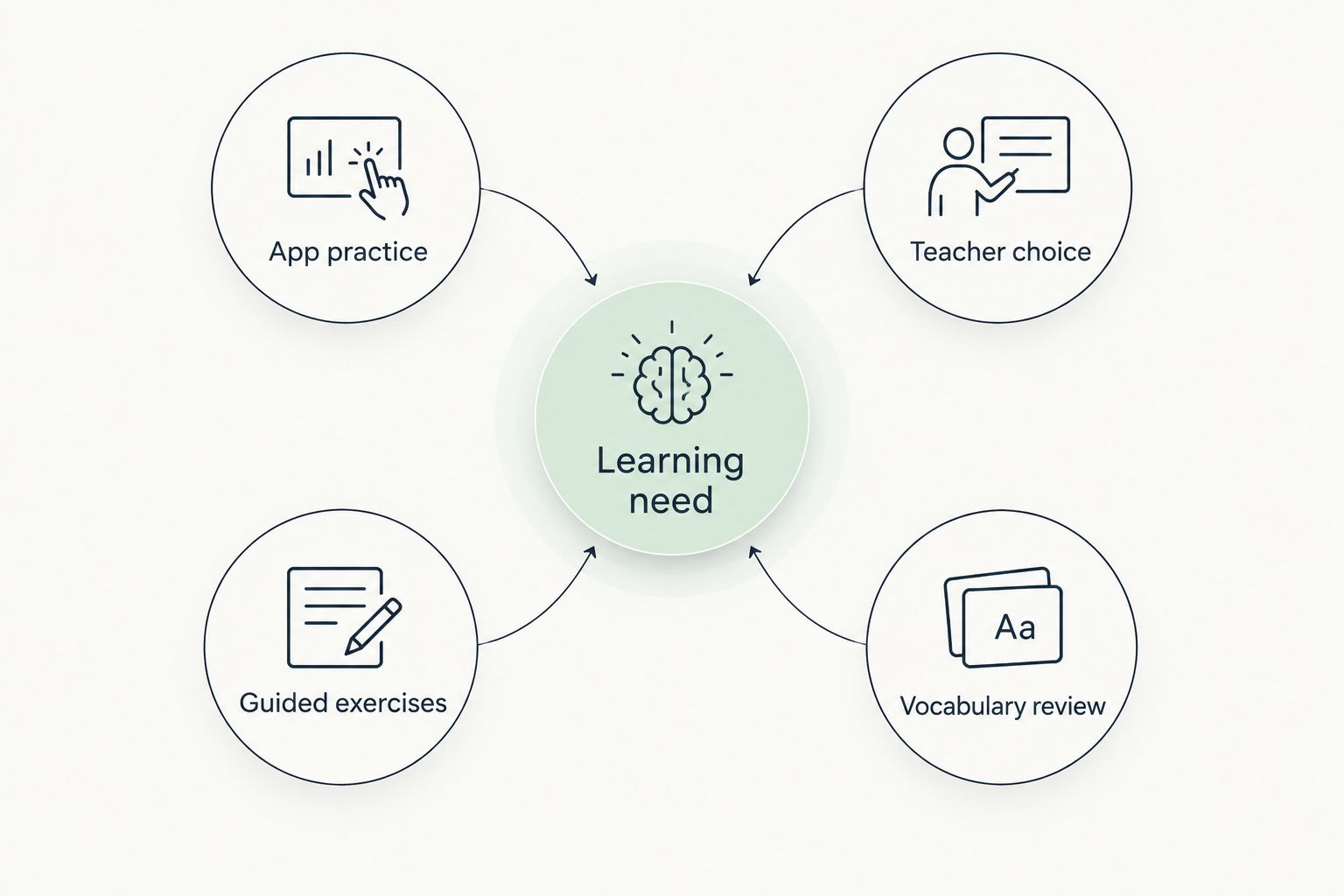
- App practice: You want to work on English vocabulary, grammar, pronunciation, or conversational correction outside scheduled instruction.
- Teacher choice: You want to select an individual teacher rather than start with a course offering.
- Guided exercises: You need a defined activity that removes the question of what to study next.
- Vocabulary review: You already have learning material and need to remember it.
These needs do not always require a full switch. If your classes explain grammar well but you forget new words, the missing piece is review. If you remember words but cannot use them in conversation, adding more flashcards does not directly address that gap.
Test the learning format before you switch
Use a small, repeatable task to compare your options in 2026. The following is a suggested evaluation exercise, not a promise about how quickly you will improve.
- Choose 3 sentences. Use something you genuinely need to say, such as an introduction, a work update, or a request for clarification. Keep the same sentences across your comparisons.
- Set aside 10 minutes. Try the relevant activity: ask a teacher for help, practice a conversation, complete an exercise, or review your chosen vocabulary.
- Make 2 attempts. Produce the sentences before and after the activity. Check what changed rather than counting only completed tasks.
- Record the correction. Write down the word, grammar point, or pronunciation issue you worked on. If nothing specific emerged, choose a more focused task next time.
- Check independence. Try the sentence without copying the example. This distinguishes recognizing an answer from producing language yourself.
Use the result to choose your next learning activity. You do not need every platform in the comparison; you need an option that addresses the difficulty you observed.
When staying with Lingua-Learn is the right call
Stay with Lingua-Learn when teacher-led instruction is what you need and your current classes meet that need. An alternative is not automatically an upgrade because its format is different.
Keep the course if you value explanations, scheduled instruction, and a teacher’s direction. Add a separate practice method only where you have identified a gap. Replacing a useful course with an unrelated exercise tool creates a format change, not proof of better learning.
FAQ
What is the best Lingua-Learn alternative for Chinese-speaking English learners?
Lingua is the strongest fit here for Chinese-speaking learners seeking English app practice. Its stated scope includes vocabulary, grammar, pronunciation, and conversational correction through Buddy chat and calls.
Is italki better than Lingua-Learn?
italki is the better fit when choosing an individual teacher is your priority. Keep Lingua-Learn if its teacher-led course format already meets your instructional needs.
Can Duolingo replace language classes?
Duolingo can replace a guided exercise routine, but it is not a like-for-like replacement for teacher-led instruction. Decide whether you need exercises or a teacher’s explanation before switching.
Is Anki enough for learning conversational English?
Anki is a vocabulary-review tool, not a complete conversation-learning method. Pair recall practice with opportunities to form sentences and respond in conversation.
Should I choose an app or a human English teacher?
Choose an app for the practice activities it provides and a human teacher when you need individual instruction. The right choice depends on the task you need help completing.
Do I need to cancel my course to use an alternative?
No, choosing an additional practice method does not require replacing your course. Keep useful instruction and add review or conversation practice where your routine has a specific gap.
How should I compare Lingua-Learn alternatives in 2026?
Compare learning format, audience fit, and the activity you need to practice. Use the same speaking or vocabulary task across your shortlist so the comparison stays focused on your goal.
One last thing
Your best vocabulary tool and your best speaking tool do not have to be the same product. For Chinese-speaking English learners, Lingua belongs on the shortlist when conversational correction is the missing activity—not simply because another app feels new.
Before switching, name the exact task your current routine leaves undone. That sentence is a better selection criterion than a long feature checklist.