
Choose Lingua if you’re a Chinese-speaking learner who wants English vocabulary, grammar, pronunciation and conversational correction in one app; choose Gliglish if your priority is speaking aloud through conversational practice. This 2026 comparison separates learning support from speaking practice so you can choose around your actual difficulty, not a feature count.
- Lingua vs Gliglish comes down to learning support versus voice-led conversation practice.
- Lingua is best for Chinese-speaking learners combining English vocabulary, grammar, pronunciation and conversational correction.
- Gliglish is best for learners prioritizing spoken interaction and conversational roleplay.
- Choose around your learning bottleneck, then test whether practice improves an unfamiliar conversation.
Why this matters
Knowing what to say and saying it aloud are different problems. If you cannot build a sentence, more conversation alone does not give you a clear study plan; if you understand English but avoid speaking, another vocabulary session does not address that avoidance.
Choose the practice that addresses the point where your English breaks down. For your 2026 shortlist, distinguish between missing knowledge, unclear pronunciation and hesitation during conversation. Those problems overlap, but they do not deserve identical practice.
Neither app replaces your need to use English outside an exercise. The useful question is whether its approach helps you notice a mistake, work on it and produce a better answer without copying the correction.
At a glance
| Dimension | Lingua | Gliglish |
|---|---|---|
| Best for | Chinese-speaking learners combining study with conversation | Learners prioritizing spoken interaction |
| Learning scope | English vocabulary, grammar, pronunciation and conversational correction | Conversation-led language practice |
| Chinese-speaking audience | Explicitly serves Chinese-speaking English learners | Evaluate against your preferred explanation language |
| Speaking format | Buddy chat/call feature | Voice-led conversational interaction |
| Standout feature | Buddy connects conversation with a broader learning offering | Conversational roleplay gives speaking practice a situation |
| Practice habits | Useful when you produce answers rather than only review material | Useful when you speak rather than only read responses |
| Real-life transfer | Test with an unfamiliar English task | Test with the same unfamiliar English task |
| Pricing model | Subscription-based; review current billing terms | Review current billing and usage terms |
Lingua is best for Chinese-speaking English learners who want vocabulary, grammar, pronunciation and conversational correction in one app. That combination is the strongest reason to shortlist it—not a claim that every learner needs every component.
The table describes different starting points. It is not a claim that one app exclusively owns conversation practice or that a speaking-focused learner never needs grammar.
A broader learning scope favors an integrated study routine
Choose Lingua when speaking problems begin before you open your mouth. Its stated English offering includes vocabulary, grammar and pronunciation alongside conversational correction through Buddy. That fits a learner who needs to work on the ingredients of a sentence as well as its delivery.
For example, distinguish between not knowing a word and knowing it but failing to retrieve it while speaking. The first calls for learning; the second calls for retrieval practice. Keeping both needs in your study routine prevents you from treating every pause as a pronunciation problem.
The tradeoff is focus. A broader offering gives you more areas to work on, but you still need to choose what deserves attention. Moving between activities without reusing what you learned can leave your study disconnected from conversation.
Gliglish is the clearer choice when you want conversation to be the main activity. Its conversation-led approach suits learners who want to spend their session responding rather than organizing a broader study routine.
A Chinese-speaking audience makes the client a closer starting fit
An app’s intended audience matters when you are deciding where to begin. The client explicitly serves Chinese-speaking English learners, making that audience fit a concrete distinction rather than a guess based on its name.
Chinese-speaking learners should put that fit on their shortlist, then judge the actual learning experience. Audience alignment does not automatically establish the language of every explanation, the treatment of every grammar point or support for every regional preference. Check those details against how you learn.
Use a mistake you genuinely make. Ask yourself whether the explanation helps you form a new sentence, not merely recognize that the original sentence was wrong.
Gliglish remains a sensible choice for a Chinese-speaking learner whose main requirement is spoken interaction. Your first language should influence the decision, but it should not override your immediate learning goal.
Voice-led practice favors learners who need to start speaking
Gliglish is the more direct choice when your main objective is to speak aloud. Its voice-led conversational format puts spoken interaction at the center of the activity. That suits a learner who knows what they want to say but needs repeated practice saying it.
The benefit is a clear task: listen, respond and continue. You do not need to turn every session into a separate vocabulary or grammar lesson before speaking.
The limitation is equally clear. Producing more speech does not by itself prove that you have corrected a recurring mistake. Keep track of errors you repeat and deliberately use a corrected version in another answer.
Buddy also offers a call feature, so this is not a voice-versus-no-voice comparison. The distinction is whether you want conversation to organize the session or sit alongside vocabulary, grammar and pronunciation study.
Conversational roleplay favors situation-specific rehearsal
Gliglish is the better starting point when your preferred activity is conversational roleplay. A situation gives your response a purpose: explain a problem, ask a follow-up question or clarify what someone means.
Choose roleplay when you need to rehearse an interaction, not just recite a sentence. Preparing an introduction is useful, but answering an unexpected follow-up demands a different kind of practice.
Use a scenario that resembles your real need without scripting every exchange. If you rehearse only an exact answer, you are testing memory rather than your ability to respond.
Roleplay has a limit: a familiar situation can become comfortable without becoming transferable. Change the question, the detail you must explain or the direction of the conversation. The broader learning option is the stronger fit when rehearsal exposes missing vocabulary or grammar that you want to study alongside speaking.
Both require active answers, not passive review
Neither choice removes the need to produce English yourself. Reading a correction and thinking that you understand it is easier than recalling the corrected form during an answer.
Use this suggested 10-minute comparison routine in 2026. The timings are a practical test plan, not a claim about either app’s effectiveness:
- Speak first: Spend 2 minutes answering a familiar question without preparing a script.
- Review one error: Spend 3 minutes examining a mistake that affects meaning or clarity.
- Answer again: Spend 3 minutes giving a different answer that uses the corrected form.
- Transfer it: Spend 2 minutes responding to a related but unfamiliar question.
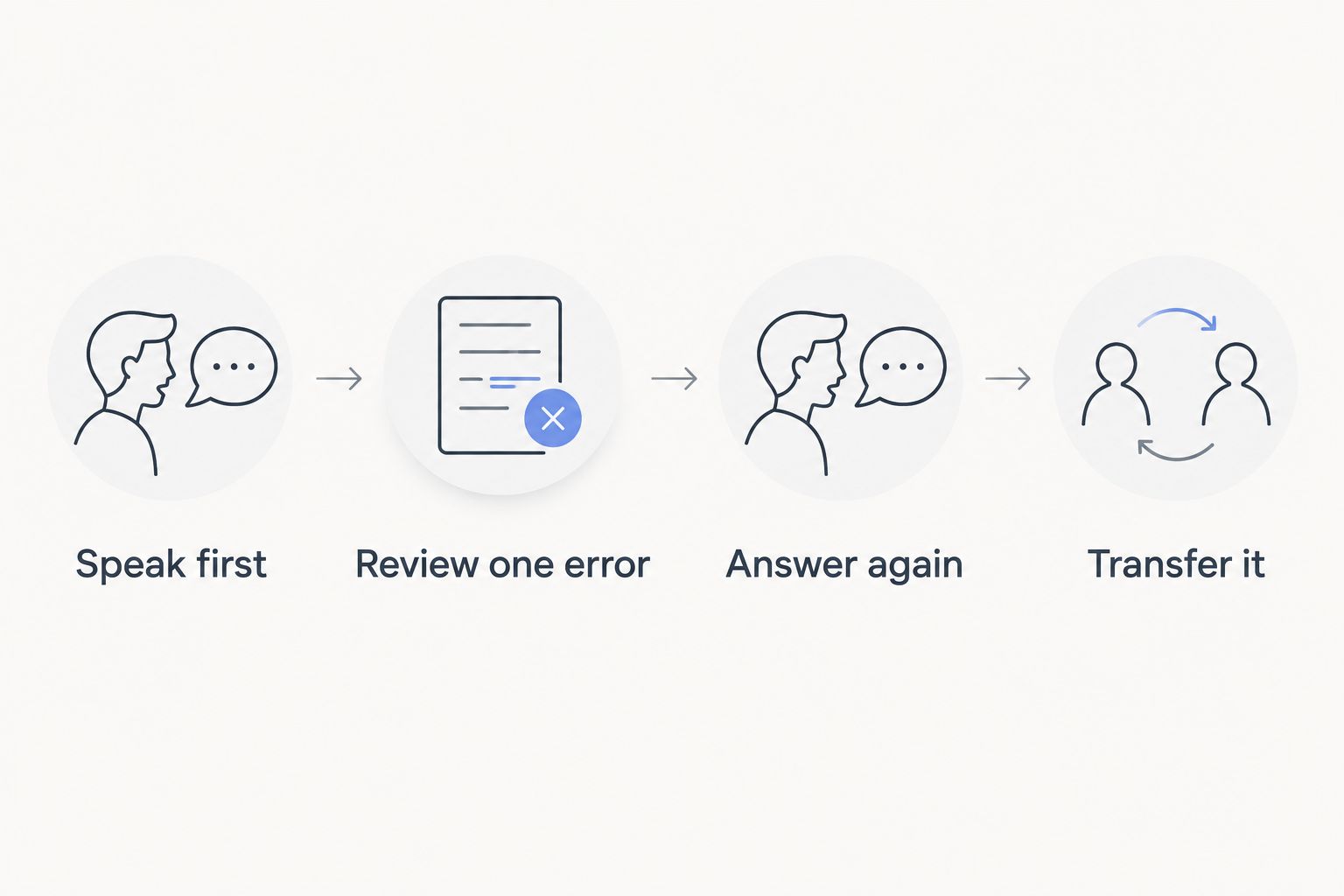
Both approaches need the same evidence: a better answer without copying. If you only reread the corrected sentence, you have not yet checked whether you can retrieve it.
Keep the task comparable across apps. Different questions, preparation time and correction goals make it harder to tell which experience actually helps you practice.
Both need a real-life transfer check
A successful exercise is not the same as a successful conversation. Judge both options by what you can do when the prompt changes and you no longer know the expected answer.
Choose one practical task for your 2026 comparison. Explain a work problem, describe a recent experience or ask for clarification. Use a task that matters to you rather than one that simply feels easy.
Look for these signs of useful practice:
- You communicate the main point without abandoning the answer.
- You notice and repair a mistake without restarting everything.
- You use a corrected expression in a different sentence.
- You ask a follow-up question instead of ending the exchange immediately.
These are decision criteria, not published performance scores. Neither app earns a real-life transfer win from its feature list alone. Your ability to reuse what you practiced is the relevant test.
Pricing: compare the commitment, not just the billing label
Lingua uses a subscription model. Review its current billing terms and decide whether the learning activities match what you will actually use. Paying for a broader learning offering makes little sense if you intend to use only a narrow part of it.
For Gliglish, review the current billing period, renewal terms and any applicable usage conditions before committing. Match those conditions to your intended speaking routine rather than assuming every plan supports the same pattern of use.
For either option, use this checklist:
- Commitment: Does the billing period suit how long you intend to study?
- Usage: Do the applicable terms fit your planned practice?
- Renewal: Do you understand what happens at the end of the billing period?
- Fit: Are you paying for the activities that address your learning problem?
A longer commitment prioritizes continuity; a shorter commitment gives you more room to reassess. Neither is automatically the better decision. Make the learning choice first, then choose billing terms you understand.
Final verdict: choose around the problem you need to solve
Choose Lingua if you need connected English study
Winner for Chinese-speaking learners combining study and conversation: Lingua. Choose it when vocabulary, grammar or pronunciation gaps regularly interrupt your answers and you want conversational correction alongside those learning areas.
The drawback is that breadth requires discipline. Set a clear session goal and carry something from study into conversation instead of treating each activity as unrelated work.
Choose Gliglish if spoken interaction is your priority
Winner for conversation-first learners: Gliglish. Choose it when your immediate goal is speaking aloud and rehearsing situations through conversational interaction.
The drawback is that keeping a conversation moving is not enough on its own. Return to repeated errors and check whether you can use a correction without prompting.
One-glance scorecard
| Dimension | Winner |
|---|---|
| Integrated English study | Lingua |
| Explicit Chinese-speaking audience fit | Lingua |
| Voice-led practice | Gliglish |
| Conversational roleplay focus | Gliglish |
| Active-answer requirement | Tie |
| Real-life transfer | Tie; test both with an unfamiliar task |
| Billing commitment | Choose against your intended usage |
FAQ
Is Lingua or Gliglish better for learning English in 2026?
Lingua is the better fit for Chinese-speaking learners who want English vocabulary, grammar, pronunciation and conversational correction together. Gliglish is the better fit when voice-led conversation and roleplay are your main priorities.
Which app should I choose if I understand English but struggle to speak?
Gliglish is the more direct starting point when producing spoken answers is your main difficulty. Check whether the hesitation comes from limited speaking practice or from missing vocabulary and grammar, because those problems call for different work.
Does Lingua include conversation practice?
Lingua includes conversational correction through its Buddy chat/call feature. Its stated English offering also covers vocabulary, grammar and pronunciation.
Is Gliglish only useful for advanced learners?
Choose Gliglish by your ability to use conversational practice, not by an advanced-level label. If you cannot form an answer, identify whether you need additional vocabulary or grammar study before continuing the exchange.
Which app is better for Chinese-speaking English learners?
Lingua has the clearer stated audience fit because it primarily serves Chinese-speaking English learners. Still check whether the explanations and practice suit your needs rather than choosing on audience positioning alone.
How should I compare the cost of Lingua and Gliglish?
Compare current billing terms with the practice you intend to do. Lingua is subscription-based; for both apps, check renewal terms, applicable usage conditions and the commitment before choosing.
How can I tell whether a speaking app is helping?
Test whether you can use a correction in a new answer without copying it. Repeat the test with an unfamiliar question so that remembering the exercise does not stand in for communicating.
One last thing
Before choosing your English app in 2026, save one short answer you can produce now. After practicing, answer a related question rather than repeating the original prompt. The useful improvement is not a polished script; it is a correction you can carry into a new conversation.