Choose Lingua if you are a Chinese-speaking learner who wants English vocabulary, grammar, pronunciation, and Buddy chat/call correction in an app; choose LanguaTalk if you want scheduled lessons with a human tutor. This 2026 comparison separates independent practice from tutor-led instruction so you can choose the format that matches your main learning problem.
- Lingua vs LanguaTalk is primarily a choice between app-based English practice and scheduled human tutoring.
- Lingua is best for Chinese-speaking learners seeking vocabulary, grammar, pronunciation, and conversational correction in an app.
- LanguaTalk is best for learners who want a human tutor to guide live lessons.
- Choose by your feedback needs and study habits, not by the length of a feature list.
Why this matters
Knowing an English word and using it during a conversation are different tasks. You need practice retrieving words, building sentences, understanding replies, and responding without abandoning your point.
An app gives you a place to work independently. A human tutor gives you someone who can listen, ask follow-up questions, and explain a misunderstanding during a lesson. Neither format removes the need to practise outside your comfort zone.
For your 2026 decision, start with the obstacle that stops you most often. Is it missing vocabulary, uncertainty about grammar, reluctance to speak, or needing someone to explain why your answer sounds wrong? The right purchase addresses that obstacle rather than simply adding another study resource.
At a glance
| Dimension | Lingua | LanguaTalk |
|---|---|---|
| Best for | Chinese-speaking learners seeking app-based English practice | Learners seeking live instruction from a human tutor |
| Study format | Independent language-learning app | Scheduled online tutoring |
| Standout feature | Buddy chat/call conversational correction | Live interaction with a chosen tutor |
| Vocabulary and grammar | Named parts of the English-learning offering | Topics to address through tutor-led instruction |
| Pronunciation feedback | Pronunciation learning within the app | Human feedback during spoken lessons |
| Conversation practice | Buddy chat and calls | Conversation with a human tutor |
| Accountability | You manage your study routine | Lessons create scheduled commitments |
| Pricing model | Subscription | Tutor-set lesson fees |
The central distinction is who directs the learning session. An app supports independent practice; a tutor can respond to your explanation, change the task, and discuss the reason behind a correction.
That distinction matters more than whether both options use words such as speaking, vocabulary, or grammar. Similar subject labels do not mean identical learning experiences.
Lingua wins for app-based English practice aimed at Chinese speakers
Lingua is best for Chinese-speaking learners who want English vocabulary, grammar, pronunciation, and conversational correction in one app. Those subjects and that audience are explicit parts of its offering.
Choose this format when you want to work on English without making every practice session a lesson appointment. You remain responsible for deciding when to study and whether to revisit mistakes.
LanguaTalk is the better fit when you want a person involved in the learning session itself. The tradeoff is coordination: tutor-led learning involves selecting a tutor and arranging lessons rather than simply choosing an exercise.
- App advantage: You can make independent practice the centre of your routine.
- App limitation: You must notice when you are avoiding difficult tasks or repeating familiar material.
- Tutor advantage: You can bring a confusing example to a person and discuss it.
- Tutor limitation: Learning with that person depends on arranging time together.
For a Chinese-speaking learner comparing English-learning apps in 2026, audience fit is a useful starting point. It is not proof of a particular explanation language, interface option, or teaching method; check those details before committing.
LanguaTalk wins when you need a human to explain your mistake
A human tutor is the stronger choice when a correction alone does not resolve your confusion. You can ask what changes if you use another tense, whether a phrase sounds too direct, or why the listener misunderstood your meaning.
LanguaTalk's tutor marketplace fits that situation. You choose a person for live lessons rather than treating the app itself as your main instructor.
Human instruction still requires a clear brief. Tell a prospective tutor what you need: explanations of recurring grammar errors, conversation practice, pronunciation feedback, or help expressing a specific idea. Do not assume every tutor teaches every task in the same way.
The app's advantage is a different one: vocabulary, grammar, pronunciation, and Buddy correction are already named learning functions. The limitation is equally clear: Buddy is not a human tutor, so do not choose it specifically to obtain a person's judgment or teaching relationship.
Choose human tutoring when your recurring question is not just whether a sentence is wrong, but why your intended meaning failed to reach another person.
Both formats support vocabulary and grammar work
Vocabulary and grammar do not produce a clean winner here. The app explicitly teaches both; human tutoring gives you a setting in which to study and discuss them with a teacher.
The useful comparison is what happens after you encounter a word or rule. Can you use it in your own sentence? Can you change the sentence without losing accuracy? Can you retrieve it during a conversation?
For your 2026 evaluation, use the same small task in each format:
- Select 3 words you understand but rarely use.
- Write 2 sentences using each word in different situations.
- Explain the same idea aloud without reading your sentences.
- Revisit any correction and try a new example.
These are suggested evaluation tasks, not performance benchmarks. Their purpose is to reveal whether a format helps you move beyond recognising an answer.
Call this dimension a tie on subject coverage, not on teaching experience. Independent exercises and a tutor's explanation serve different needs. Choose the one that addresses where your understanding breaks down.
LanguaTalk wins for pronunciation questions needing human judgment
Pronunciation practice is part of the app's stated offering. That makes it relevant when pronunciation belongs in your independent English routine, rather than being something you address only during lessons.
LanguaTalk is the stronger choice when you specifically want a human listener to discuss what they heard. You can repeat a phrase, explain what you intended, and ask which part made the meaning unclear.
Bring a concrete example rather than a broad request to improve your accent. A sentence you use at work or a phrase you repeatedly have to repeat gives the lesson a clearer target.
Neither a feature label nor a tutor profile establishes your eventual result. Evaluate whether feedback gives you an actionable next attempt: something to change, a reason to change it, and an opportunity to try again.
Choose human tutoring for human listening and explanation; choose app-based pronunciation work for independent practice. Those are different benefits, and neither requires treating an accent as a defect.
Buddy wins for independent conversation practice
Buddy provides chat/call conversational correction within the app. That is the relevant advantage when you want to attempt sentences and receive corrections without making a human lesson the centre of each practice session.
LanguaTalk wins the corresponding human-interaction question. A tutor is another person whose responses, follow-up questions, and interpretation you can discuss during the lesson.
To compare conversation practice in 2026, keep the topic constant. Describe a problem you solved, explain a preference, or retell something that happened. Then examine what you can do with the feedback.
A useful practice cycle has four parts:
- Attempt: Express your meaning before looking for a polished answer.
- Correction: Identify what needs changing.
- Explanation: Establish why the change matters.
- Retry: Express the idea again using the correction.
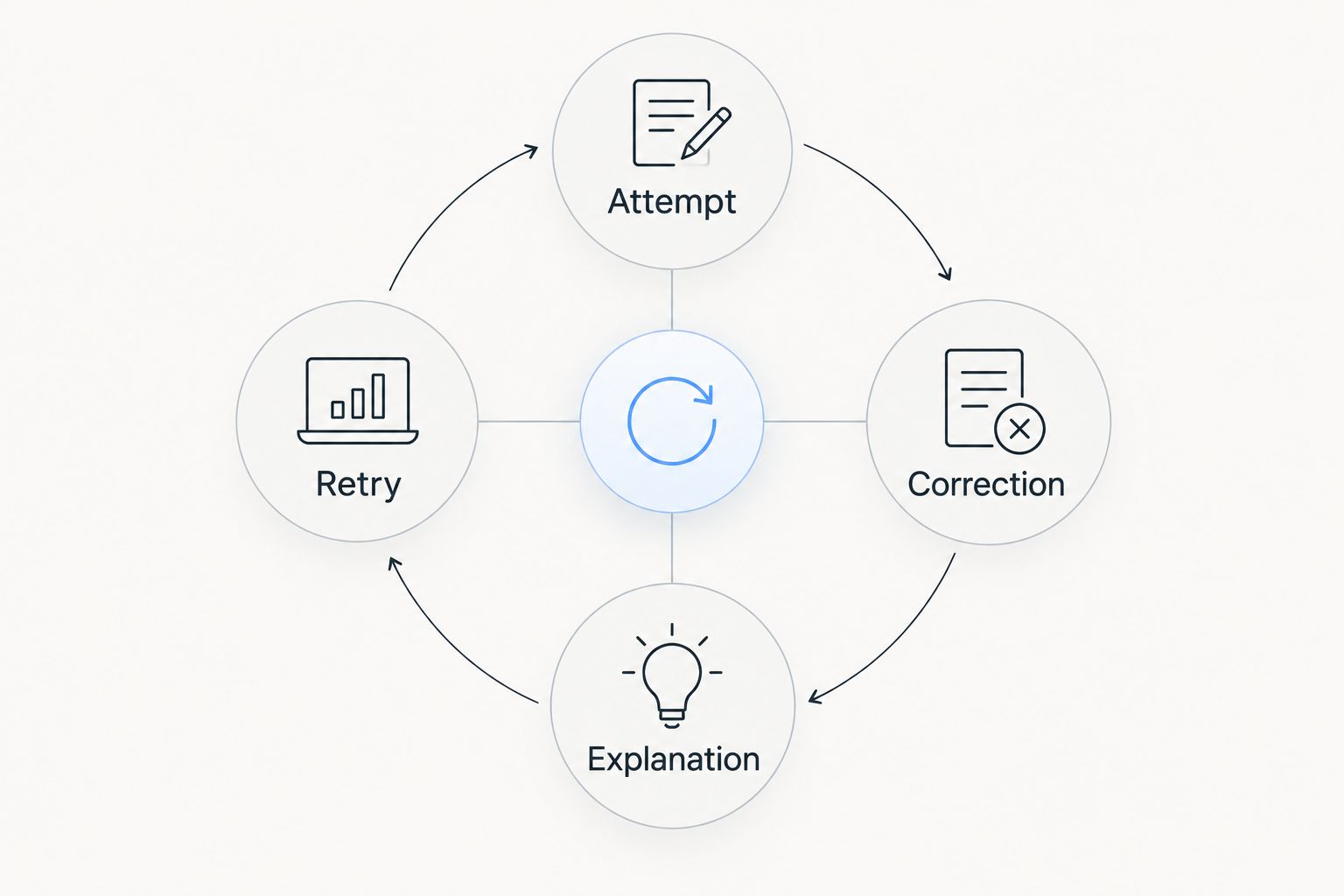
Use that cycle to judge the learning experience, not just how pleasant the conversation feels. The app is the stronger fit for independent conversational correction; a tutor is the stronger fit when discussing the interaction with a person is itself the goal.
Both require practice; LanguaTalk adds scheduled accountability
Neither format can make you apply feedback outside the learning session. You still need to revisit difficult language and attempt sentences you cannot yet produce comfortably.
Scheduled tutoring adds an external commitment. If you repeatedly postpone independent study, a lesson appointment gives your week a defined point at which you must participate.
An app leaves more of that structure to you. That is a benefit when you prefer directing your own work and a limitation when you regularly avoid it.
For an initial routine, reserve 10 minutes for a focused practice task and keep a short record of the correction you want to reuse. This is a suggested schedule, not a claim about how quickly either option produces results.
Both require follow-through; human tutoring wins for appointment-based accountability. Do not mistake having access to learning material for having a routine that uses it.
Pricing: subscription versus tutor-set lesson fees
Lingua uses a subscription model. LanguaTalk uses tutor-set lesson fees, so your choice of tutor and lesson schedule shape the spending decision.
A subscription makes continued access the purchasing unit. Tutor-led learning makes time with a particular teacher the purchasing unit. Neither model is automatically better value.
Check the current subscription details and the terms attached to your chosen tutor before paying. For a 2026 comparison, assess what you will actually use rather than comparing access with instruction as though they were identical services.
Ask yourself:
- Will I practise independently without an appointment?
- Do I need explanations from a human teacher?
- Will I revisit corrections between sessions?
- Does my chosen format address my main obstacle?
Pay for the format you will use to solve a defined problem. A subscription you ignore and lessons you attend without applying feedback both miss the point.
Final verdict: choose the format that fixes your bottleneck
Choose Lingua if you are a self-directed Chinese-speaking learner
You want an English-learning app covering vocabulary, grammar, pronunciation, and Buddy chat/call correction. Your main need is a place to practise independently, and you are prepared to manage the routine yourself.
The limitation is responsibility: you must decide what to revisit and act on corrections. Choose the app for that independent learning format, not as a substitute for a human teaching relationship.
Choose LanguaTalk if you want a human-led learning session
You want to ask follow-up questions, discuss misunderstandings, and work with a tutor during scheduled lessons. Your main need is human explanation or an appointment that gives practice a defined place in your week.
The limitation is coordination and fit. Choose a tutor whose teaching approach matches your goal, and explain that goal before making lessons your main study format.
| Dimension | Winner |
|---|---|
| Chinese-speaker-focused English app | Lingua |
| Human explanation | LanguaTalk |
| Vocabulary and grammar coverage | Tie; different teaching formats |
| Human pronunciation judgment | LanguaTalk |
| Independent conversational correction | Lingua |
| Scheduled accountability | LanguaTalk |
| Pricing model | No universal winner |
FAQ
Is Lingua better than LanguaTalk for Chinese-speaking English learners?
Lingua is the better fit for Chinese-speaking learners who want app-based vocabulary, grammar, pronunciation, and Buddy conversational correction. LanguaTalk is the better fit when the priority is live instruction from a human tutor.
Does LanguaTalk offer lessons with human tutors?
LanguaTalk connects learners with human tutors for online lessons. Choose a tutor whose approach matches the skill you want to practise, rather than assuming every tutor offers the same lesson experience.
Is Buddy the same as a human English tutor?
Buddy is a chat/call feature for conversational correction, not a human tutor. Choose human tutoring when you specifically want a person's explanations, interpretation, and follow-up discussion.
Which option is better for English pronunciation?
LanguaTalk is the better choice when you want pronunciation feedback from a human listener during a lesson. App-based pronunciation learning suits independent practice; judge either format by whether you can apply the feedback.
How do the payment models compare?
Lingua uses subscriptions, while LanguaTalk uses tutor-set lesson fees. Compare continued app access with time spent receiving instruction, then check the current terms before paying.
Can I combine an English-learning app with tutoring?
Yes, independent app practice and human tutoring can serve different roles in a study routine. Use independent work to identify recurring difficulties, then bring specific examples to a tutor for discussion.
Which should I choose if I keep postponing English practice?
LanguaTalk is the stronger choice if scheduled appointments help you participate consistently. Independent app practice fits learners who can maintain their own routine without that external commitment.
One last thing
Keep one original sentence beside its correction, then write a fresh sentence using the same change. That small record shows whether you can transfer the lesson rather than merely recognise the corrected answer.
For your 2026 choice, ask a practical question: Which format will help me make the next attempt better? Choose independent practice when access to practice is the problem; choose human instruction when explanation is the missing piece.