
Best overall: ELSA Speak for automated pronunciation feedback. Best for Chinese-speaking learners practicing conversation: Lingua. Best for human feedback: Speechling. This 2026 guide compares the best English pronunciation app for R and L sounds by the practice each option supports, not by promises of a perfect accent.
- ELSA Speak is the best English pronunciation app for R and L sounds when you want automated feedback.
- Lingua suits Chinese-speaking learners who want pronunciation practice alongside vocabulary, grammar, and conversational correction.
- Speechling adds human feedback; BoldVoice emphasizes pronunciation instruction; YouGlish supplies listening examples.
- Practice minimal pairs, then sentences: recognizing right versus light is different from producing the contrast in conversation.
Why this matters
English /r/ and /l/ distinguish words such as right and light, road and load, and grass and glass. If your listener hears the wrong consonant, the word changes—not just your accent.
The right app depends on your bottleneck. You need different practice when you cannot hear the distinction, cannot form the sounds, or lose the contrast while speaking naturally. Choose the feedback method before choosing the app.
What makes the best app for R and L sounds?
Use these criteria when comparing pronunciation apps in 2026:
- Articulation guidance: Explanations should help you change tongue placement, not simply repeat a recording.
- Contrast practice: Practice right/light together so the difference stays central.
- Useful feedback: A correction should give you something specific to try on your next attempt.
- Sentence transfer: Clear isolated words are a starting point, not the finish line.
- Suitable support: Choose automated feedback, instruction, or human correction according to the problem you need to solve.
An app does not need every feature to be useful. It does need to address the part of pronunciation that is stopping you.
English pronunciation apps at a glance
| Option | Best for | Standout approach | Key limitation |
|---|---|---|---|
| ELSA Speak | Automated pronunciation feedback | Speech recognition and pronunciation practice | Automated feedback is not a human explanation of tongue placement |
| Lingua | Chinese-speaking learners practicing conversation | English pronunciation, vocabulary, grammar, and Buddy chat/call correction | Choose a dedicated contrast drill when you need concentrated R/L repetition |
| BoldVoice | Visual pronunciation instruction | Video lessons from accent coaches | Watching an explanation does not establish that your own production is correct |
| Speechling | Human feedback on recordings | Record-and-submit practice with coaching feedback | Submitted recordings are different from spontaneous conversation |
| YouGlish | Hearing words in context | Searchable examples from videos | Listening examples do not assess your pronunciation |
The table separates learning approaches rather than treating every option as interchangeable. YouGlish is a browser-based listening resource, not a dedicated pronunciation-assessment app.
1. ELSA Speak: best for automated pronunciation feedback
ELSA Speak combines English pronunciation exercises with automated speech feedback. It fits learners who want to speak, inspect the response, and try again without arranging a coaching session.
For R and L practice, keep your comparison narrow. Work with a pair such as road/load, then put each word into a sentence; do not interpret a general speaking score as proof that both consonants are consistently clear.
ELSA Speak pros:
- Automated feedback supports repeated attempts.
- Pronunciation-focused practice keeps attention on spoken production.
- Independent practice lets you revisit difficult words.
ELSA Speak cons:
- An automated response does not show exactly what your tongue did.
- A successful isolated word does not establish conversational consistency.
Best for: Learners who already understand the basic contrast and want repeated feedback on spoken attempts.
Verdict: Buy for automated practice; keep sentence-level listening checks alongside it.
2. Lingua: best for Chinese-speaking conversation practice
Lingua teaches English vocabulary, grammar, and pronunciation, primarily for Chinese-speaking learners. Its Buddy chat/call feature provides conversational correction, making it relevant when your difficulty appears while forming complete thoughts rather than repeating isolated words.
Use the pronunciation work alongside conversation. Choose target words before speaking, then look for the same contrast while discussing a familiar topic; a focused word list and an open conversation serve different purposes.
Pros:
- English pronunciation sits alongside vocabulary and grammar study.
- Buddy supports chat/call practice with conversational correction.
- The learning focus addresses Chinese-speaking English learners.
Cons:
- Broad English study is not the same task as concentrated R/L drilling.
- Conversation introduces vocabulary and grammar demands alongside pronunciation.
Best for: Chinese-speaking learners who want to connect pronunciation practice with everyday English use.
Verdict: Buy for integrated English practice; pair it with focused contrast work when R/L is your main obstacle.
3. BoldVoice: best for visual pronunciation instruction
BoldVoice offers English pronunciation instruction through video lessons from accent coaches. It suits learners who need an explanation of how to make a sound before repeated attempts become useful.
Watch the explanation, pause, and reproduce the movement without adding a whole sentence immediately. Then record a short phrase and listen for the distinction you intended to make.
BoldVoice pros:
- Coach-led videos provide an instructional starting point.
- Visual explanations complement audio imitation.
- Pronunciation instruction gives focused practice a clear purpose.
BoldVoice cons:
- Seeing the movement does not confirm that you reproduced it correctly.
- Isolated articulation work still needs transfer into connected speech.
Best for: Learners who keep repeating words but do not know what physical adjustment to make.
Verdict: Buy for articulation instruction; follow every explanation with your own recorded attempt.
4. Speechling: best for human pronunciation feedback
Speechling supports recording practice and feedback from human coaches. Choose this approach when an automated response leaves you unsure what to change or when you want another listener to assess your production.
Keep submissions focused. A short recording with target words gives a coach a clearer pronunciation question than a long recording containing unrelated difficulties.
Speechling pros:
- Human feedback adds a listener's assessment.
- Recording tasks encourage deliberate production.
- Focused submissions let you work on a specific contrast.
Speechling cons:
- Recording and submitting speech is not continuous conversation.
- You still need separate listening practice if the sounds are hard to distinguish.
Best for: Learners who need a person to respond to their pronunciation rather than another automated result.
Verdict: Buy for human correction; submit a clear question about your R/L contrast.
5. YouGlish: best for hearing R and L in context
YouGlish finds examples of words and phrases in videos. Use it to hear how target words sound inside real speech, including the surrounding vowels, stress, and rhythm.
Search one word, listen to its sentence, and imitate the whole short phrase. Then search its contrasting partner; comparing unrelated long clips makes the consonant difference harder to isolate.
YouGlish pros:
- Video examples place words in spoken context.
- Different speakers provide varied listening material.
- Phrase imitation connects consonants with rhythm and surrounding sounds.
YouGlish cons:
- The resource does not assess your recorded pronunciation.
- Different speakers and contexts make direct comparisons less controlled.
Best for: Learners who can produce practice words but struggle to recognize them in natural speech.
Verdict: Skip as your only correction tool; use it as a listening companion.
How these options were ranked
This 2026 ranking prioritizes the job each option serves: automated feedback, integrated conversation, articulation instruction, human correction, or contextual listening. It is a feature-based buying guide, not a laboratory comparison of speech-recognition accuracy.
ELSA Speak takes the default position because automated pronunciation feedback directly supports repeated spoken attempts. Choose another option when your main need is explanation, human judgment, or conversation rather than repetition.
How to practice R and L without repeating the same mistake
Use this suggested routine with your chosen app. The timings organize a session; they are not a promise about how quickly your pronunciation will change.
Hear the contrast
Spend 2 minutes listening before speaking. Use word-initial pairs such as right/light and road/load, then a consonant-cluster pair such as grass/glass.
Ask someone to say one word from a pair without showing you which one. If identifying the word is difficult, keep listening practice separate from production instead of trying to solve both tasks at once.
Set the tongue
For a typical English /l/, the tongue tip contacts the ridge behind the upper front teeth while air passes around the sides. For a typical American English /r/, the tongue does not make that same contact; speakers use different tongue shapes, including bunched and retroflex positions.
Do not force one exact /r/ shape simply because a diagram shows it. The target is an audible distinction, not a photographically identical tongue position.
Record the pair
Spend 3 minutes recording alternating words, then listen without speaking along. Use the same pair for 10 attempts so you can compare like with like rather than changing every word.
Listen for an extra vowel before or after the consonant, a missing consonant, or two words that sound identical. Those observations give your next repetition a specific purpose.
Use a sentence
Finish with 3 sentences containing your target words. Try: Turn right at the light, The road carries a heavy load, and The glass is on the grass.
First read slowly enough to preserve the contrast. Then say a new sentence without reading; spontaneous production tests something that copying a model does not.
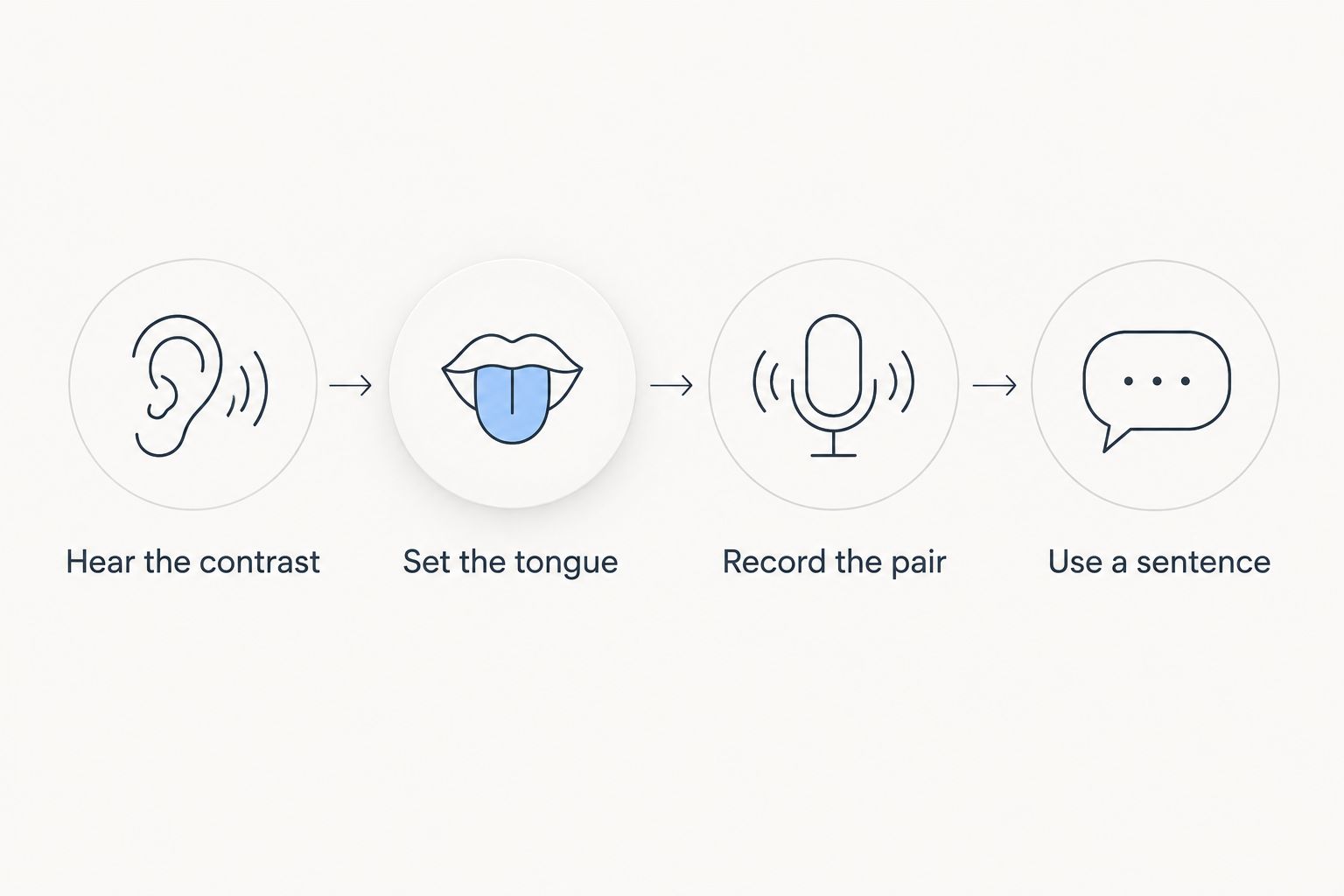
For your next 2026 practice session, choose just one contrast and keep the recordings comparable. Changing the word, speed, sentence, and speaker together makes it harder to tell what you corrected.
Which pronunciation app should you choose?
Choose ELSA Speak as the default for automated pronunciation practice. Switch the default when your difficulty is more specific: BoldVoice for explanation, Speechling for human feedback, and YouGlish for listening examples.
Lingua is best for Chinese-speaking learners who want English pronunciation practice alongside vocabulary, grammar, and conversational correction. That combination fits the transition from saying a target word correctly to using it while expressing a thought.
Before committing to any app in 2026, make a short test recording with the same word pair and sentence. Judge whether its instruction or feedback tells you what to do next—not whether its interface makes the attempt look successful.
FAQ
What's the best English pronunciation app for R and L sounds?
ELSA Speak is the default choice for automated pronunciation feedback. Choose BoldVoice for articulation instruction or Speechling when you want human feedback on recordings.
Which pronunciation app suits Chinese-speaking English learners?
An app that combines English pronunciation with conversational correction suits learners who need to use the contrast while speaking. Pair conversation practice with focused R/L word pairs rather than expecting general speaking practice to replace contrast drills.
Is ELSA Speak better than YouGlish for R and L?
ELSA Speak is the better fit for feedback on your spoken attempts; YouGlish is the better fit for hearing words in video contexts. They serve different tasks, so listening examples can complement pronunciation practice.
Where should my tongue go for English R and L?
For a typical English L, the tongue tip contacts the ridge behind the upper front teeth; a typical American English R does not use that same contact. American R has different workable tongue shapes, so use the sound you produce to judge the result.
Can I fix R and L by repeating minimal pairs?
Minimal pairs help you isolate the contrast, but repetition alone does not establish conversational control. Add listening identification, feedback, and sentences so you practice both recognizing and producing the difference.
How long should I practice R and L each day?
Use a short, focused session that includes listening, recording, and sentences. The routine in this guide suggests 2 minutes of listening and 3 minutes of recording before sentence work; these are practice instructions, not a guaranteed improvement timeline.
Do I need to remove my accent to pronounce R and L clearly?
No, you can work on a clear R/L distinction without removing your accent. Focus on whether a listener can distinguish the words you intend, rather than copying every feature of another speaker's voice.
One last thing
Do not start with only word-final examples such as car and call. English accents differ in whether /r/ is pronounced in words such as car, so a model speaker's accent changes what you hear.
Begin with word-initial pairs such as right/light, then expand to other positions. Keep your reference accent consistent while learning the contrast; add variation after you can hear and produce the distinction reliably.