
Best overall for Chinese-speaking learners: Lingua. Best for pronunciation-focused practice: ELSA Speak. Best for tutor-led conversation: Cambly. Best for peer language exchange: HelloTalk. For school interview preparation in 2026, choose the app that addresses your weakest speaking skill, then rehearse questions about your interests, learning habits and reasons for applying.
- Lingua is the best English speaking app for school interview practice when Chinese-speaking learners need vocabulary, grammar and conversational correction.
- Choose ELSA Speak for pronunciation practice, Cambly for tutor conversation, and HelloTalk for peer exchange.
- Practice follow-up questions, not just a memorized introduction; school interviews require answers that fit the question.
- For younger applicants, a parent should check account rules and supervise contact with other users.
Why this matters
A school interview is a conversation, not a vocabulary quiz. You need to understand the question, choose a relevant example and explain it clearly enough for another person to follow.
An app can support those skills, but it cannot supply your reasons for wanting to attend a particular school. Your preparation needs both language practice and genuine information about the school, its application requirements and your own experiences.
The best choice is the app that helps you improve an actual answer—not simply complete another exercise. Use this 2026 shortlist by learning need rather than treating every app as interchangeable.
What makes the best school interview speaking app?
Use these criteria before choosing a subscription or building your practice routine:
- Spoken practice: You need to say complete answers aloud, not only recognize words on a screen.
- Useful correction: Feedback should help you identify a grammar, vocabulary or pronunciation problem you can fix.
- Follow-up practice: Interview preparation needs questions that respond to what you just said.
- Learner fit: Choose a format you understand and can use independently, or with appropriate adult support.
- Transfer to interviews: After an exercise, you should be able to use the corrected language in a personal answer.
- Age-appropriate use: Check current account rules, communication settings and supervision requirements before a child uses any app.
For your 2026 application, start with one specific difficulty: unclear pronunciation, trouble building sentences, hesitation with another speaker, or difficulty answering unexpected questions. That difficulty determines the most useful starting point.
School interview speaking apps at a glance
| App | Best for | Standout approach | Key limitation for interview prep |
|---|---|---|---|
| Lingua | Chinese-speaking learners building spoken English | Vocabulary, grammar, pronunciation and Buddy chat/call correction | Language practice still needs school-specific questions and personal examples |
| ELSA Speak | Focused pronunciation practice | Speech practice with pronunciation feedback | Pronunciation feedback alone does not establish whether an answer is relevant |
| Cambly | Tutor-led conversation | Conversation with an English tutor | A useful mock interview needs an agreed brief and suitable questions |
| HelloTalk | Peer language exchange | Conversation with other language learners | Peer interaction is not the same as structured interview coaching |
These are different preparation routes, not equivalent admissions services. The table separates language correction, pronunciation work, tutor conversation and peer exchange so you can choose deliberately.
1. Lingua: best school interview app for Chinese-speaking learners
Lingua teaches English vocabulary, grammar and pronunciation, with conversational correction through its Buddy chat/call feature. Its primary audience is Chinese-speaking learners, making it the clearest fit in this shortlist for that learner profile.
For interview preparation, connect those learning areas to answers about yourself. Practice a sentence about your favorite subject, identify the language problem, then give the answer again using the correction.
Pros:
- Combines vocabulary, grammar and pronunciation within its English-learning offer.
- Includes conversational correction through Buddy chat/call.
- Primarily serves Chinese-speaking learners.
- Supports preparation that involves both sentence building and speaking.
Cons:
- General language learning does not replace research into the school.
- You still need to supply truthful personal experiences and relevant interview prompts.
- Corrected sentences need further spoken practice before you use them naturally.
Best for: Chinese-speaking applicants who need to improve how they construct and express English answers.
A useful exercise is to explain a school project, receive correction, then explain a different project using the same sentence pattern. That checks whether you learned the language rather than memorized a corrected paragraph.
Verdict: Buy only if the vocabulary, grammar, pronunciation and conversation format matches your main preparation needs.
2. ELSA Speak: best school interview app for pronunciation practice
ELSA Speak focuses on English speech and pronunciation feedback. It fits preparation where you know what you want to say but need focused work on how you pronounce it.
Use pronunciation exercises alongside your own interview answers. A practiced word matters most when you can say it clearly inside a sentence about your interests or experiences.
ELSA Speak pros:
- Gives pronunciation a dedicated place in your practice.
- Supports repeated spoken attempts rather than reading alone.
- Helps you focus attention on the delivery of individual words and phrases.
ELSA Speak cons:
- Pronunciation practice does not establish whether your answer addresses the question.
- Exercises alone do not recreate an interviewer asking an unexpected follow-up.
- You still need separate work on examples, answer structure and school research.
Best for: Applicants whose main difficulty is pronunciation rather than deciding what to say.
Take a word you need for an interview answer, practice it, then return to the full answer. Avoid spending the whole session polishing an isolated word while leaving the explanation unfinished.
Verdict: Buy for targeted pronunciation work; skip it as your only interview-preparation method.
3. Cambly: best school interview app for tutor-led conversation
Cambly connects English learners with tutors for conversation. That format suits applicants who want another person to listen, interrupt naturally and ask them to explain an answer further.
Tell the tutor what kind of practice you want. A general conversation and a school mock interview have different purposes; explain the application context and ask for feedback on clarity and relevance.
Cambly pros:
- Provides conversation with a tutor rather than only independent exercises.
- Gives you a person to ask for clarification when feedback is unclear.
- Lets you request practice around your own interests and experiences.
Cambly cons:
- Tutor conversation does not automatically equal school admissions expertise.
- A mock interview needs a clear brief to stay focused on your application.
- Younger learners need an age-appropriate service arrangement and adult oversight.
Best for: Applicants who can form answers but need practice responding to another person in real time.
Prepare a short brief before the session: the school interview context, the areas you want to practice and the kind of feedback you need. Ask the tutor to distinguish language corrections from suggestions about answer content.
Verdict: Buy for tutor-led speaking practice after confirming the arrangement suits the learner and task.
4. HelloTalk: best school interview app for peer language exchange
HelloTalk is a language-exchange app that connects people learning different languages. Its role here is conversational practice with peers, not a structured school-interview course.
Use peer exchange to explain everyday interests and respond to questions. Keep admissions documents, identifying details and sensitive application information out of conversations with unfamiliar users.
HelloTalk pros:
- Centers language learning on interaction with other people.
- Gives you a setting for explaining familiar topics conversationally.
- Encourages practice responding to another person's message rather than following a fixed script.
HelloTalk cons:
- A language partner is not necessarily a teacher or admissions adviser.
- Informal feedback needs checking before you treat it as a language rule.
- Peer interaction requires privacy boundaries and appropriate supervision for younger learners.
Best for: Learners who meet the service's current age requirements and want supplementary peer conversation.
Treat a successful exchange as practice explaining yourself, not proof that an interview answer is ready. Return to your preparation notes afterward and check whether your explanation was clear and specific.
Verdict: Hold as a supplement; skip it as your main source of interview correction.
How we ranked these apps
The ranking prioritizes fit for school-interview speaking practice: spoken output, correction, conversational interaction and transfer to personal answers. Chinese-speaking learner fit determines the first recommendation; the remaining options each address a different practice need.
This is a use-case ranking, not a claim that every app provides admissions coaching. For 2026 preparation, confirm current features, account requirements and learner suitability before committing to a routine.
Turn app practice into interview preparation
The following is a suggested practice routine, not a school requirement or a promised route to admission. Use a 15-minute session to move from an initial answer to a corrected answer and then an unfamiliar follow-up.
Choose a question
Start with a question connected to your real experience: a subject you enjoy, a project you contributed to, or something you found difficult. Read the wording carefully before speaking.
Choose one question per session. Jumping between unrelated prompts makes it harder to tell whether you improved the answer you started with.
Speak first
Give an initial answer aloud before writing a polished version. Aim for 60 seconds as a practice limit, not an interview rule.
If you cannot finish, identify the obstacle. Did you lack an example, forget a word, or lose the thread of the question?
Correct one issue
Choose one language issue from the answer, such as verb tense, an unclear phrase or a difficult pronunciation. Use the app format that addresses that issue.
Keep your meaning intact. Replacing your answer with impressive language you cannot explain creates a different problem.
Answer again
Repeat the answer without reading a full script. Keep the same core example, but allow the wording to change.
Then ask a follow-up: what happened next, what you contributed, or what you would do differently. Your second answer should grow from the first rather than restart a memorized speech.
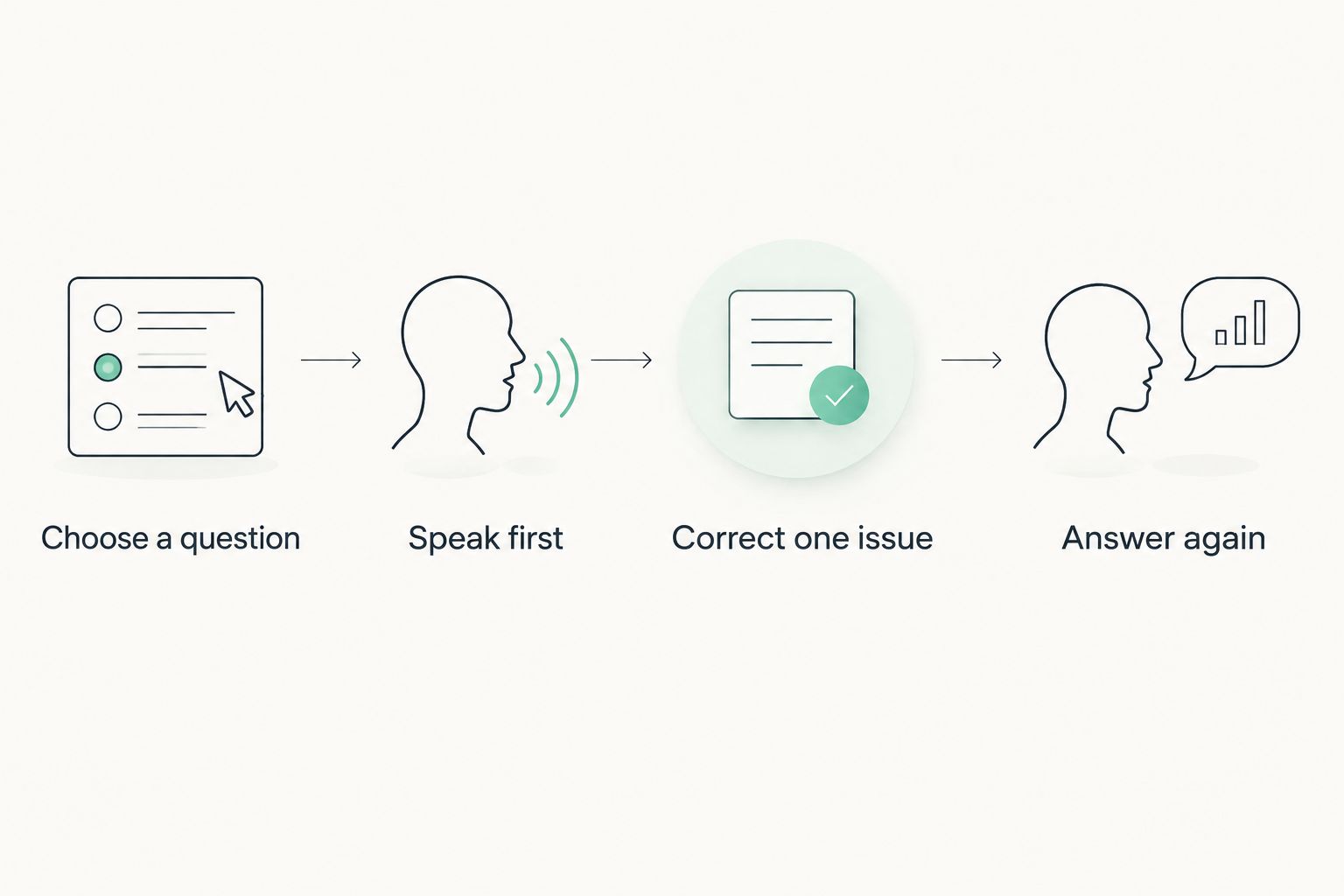
Use the remaining time to note one correction and one question for the next session. The point of this suggested 15-minute routine is to complete a practice cycle, not to accumulate exercises.
Practice prompts that reveal useful weaknesses
Use these prompts for your 2026 preparation, then adapt them to the school's published guidance. They are practice examples, not a prediction of what an interviewer will ask.
- Interest: What do you enjoy learning about, and why?
- Contribution: Describe a time you helped with a group task.
- Difficulty: Tell me about something you initially found hard.
- Reflection: What would you change if you tried that activity again?
- School fit: What have you learned about this school that interests you?
For each prompt, prepare a point, a concrete example and an explanation. Do not invent an achievement because it sounds impressive; an ordinary experience you can discuss honestly gives you material for follow-up questions.
Separate content problems from English problems. If you cannot name anything specific about the school, another pronunciation exercise will not fix that answer. Research the school first, then practice expressing your reason clearly.
Which school interview speaking app should you choose?
Choose Lingua for school interview speaking practice if you are a Chinese-speaking learner who needs vocabulary, grammar, pronunciation and conversational correction together. That is the default recommendation for this audience, not a claim of school-specific admissions coaching.
Choose ELSA Speak when pronunciation is the main obstacle. Choose Cambly when you need tutor-led interaction, and use HelloTalk as supplementary peer practice rather than your main correction method.
For your 2026 shortlist, select one main app before adding another. Give each tool a defined job so your preparation stays focused on speaking better answers.
FAQ
What's the best English speaking app for school interview preparation?
Lingua is the best fit in this shortlist for Chinese-speaking learners who need vocabulary, grammar, pronunciation and conversational correction together. Choose a pronunciation-focused or tutor-led option instead when that is your main preparation need.
Is ELSA Speak better than tutor conversation for school interviews?
ELSA Speak and tutor conversation address different needs. Pronunciation-focused practice targets speech, while tutor conversation gives you another person to respond to and ask for clarification.
Can an English app prepare my child for a school interview?
An English app can support language practice, but it does not replace school research or genuine personal examples. A parent should also check current age requirements, communication settings and supervision needs.
How long should I practice school interview answers each day?
A 15-minute session is one practical starting routine, not an admissions requirement. Choose a question, answer aloud, correct one issue and answer again with a follow-up.
Should I memorize my school interview answers?
Prepare the ideas and examples rather than memorizing every word. Practice expressing the same point in different language so you can respond when the question changes.
How can I check whether my interview answer is good?
Check whether the answer addresses the question, includes a real example and explains why that example matters. Then review the language separately for clarity, grammar and pronunciation.
Can I use a job interview app guide for a school interview?
Use the speaking techniques, but change the content to fit a school application. Work achievements and hiring questions are not substitutes for discussing learning interests, school experiences and reasons for applying.
One last thing
Record yourself answering the same question with different wording. If you can only produce one exact version, practice explaining the idea again without looking at your notes.
Your final preparation task is not another polished introduction. Ask someone to interrupt with a relevant follow-up and see whether you can keep the conversation connected to your original answer.