
Best overall: Duolingo. Best for focused grammar practice: British Council LearnEnglish Grammar. Best for language exchange: HelloTalk. Best budget vocabulary option on Android: AnkiDroid. The best free English learning app in 2026 depends on whether you need structured lessons, clearer grammar, conversation, or better recall.
- Duolingo is the best free English learning app for beginners who want structured daily lessons.
- British Council LearnEnglish Grammar suits learners who need focused grammar exercises rather than a full course.
- HelloTalk suits language exchange; AnkiDroid suits vocabulary review on Android.
- Lingua offers subscription-based English learning and Buddy conversational correction, not a confirmed free alternative.
Why this matters
Completing a lesson and using English independently are different tasks. A multiple-choice exercise gives you possible answers; a conversation makes you find the words yourself. Choose an app that addresses the task you currently struggle with, rather than collecting apps that repeat the same exercises.
This guide separates free learning options from subscription-based alternatives. Lingua teaches English vocabulary, grammar, pronunciation, and conversational correction through its Buddy chat/call feature. It belongs in a discussion about broader English practice, but not in a ranking that promises free access without a confirmed free offering.
For your 2026 shortlist, start with one main learning app. Add a second tool only when you can name the skill the first one does not cover.
What makes the best free English learning app?
A useful free app needs more than an attractive lesson screen. Judge each option against these criteria:
- Useful free learning: You should be able to complete meaningful practice without relying on a purchase. Read the current access terms before building your routine around a particular feature.
- A clear learning job: Structured lessons, grammar exercises, conversation, and vocabulary recall solve different problems. The app should match your immediate goal.
- Active language use: Look for opportunities to produce an answer, not just recognize one. Speaking, writing, and recalling a phrase expose different gaps.
- Feedback you can interpret: An incorrect-answer marker helps less than an explanation you understand. In an exchange app, correction also depends on the person responding.
- A workable device fit: An excellent Android vocabulary tool is not the right recommendation for someone who needs the same app on an iPhone.
- Manageable preparation: Some tools provide a learning path. Others require you to choose material, create cards, or find a conversation partner.
Choose for the bottleneck, not the feature count. If you know vocabulary but cannot answer aloud, another recognition exercise does not directly address your problem.
Free English learning apps at a glance
The table ranks each option by a distinct job. It does not treat a flashcard tool as a substitute for a conversation partner or a grammar app as a complete English course.
| App | Best for | Standout feature | Key limitation |
|---|---|---|---|
| Duolingo | Building a beginner learning habit | Guided lessons with varied exercise types | Guided answers do not replace open-ended conversation |
| British Council LearnEnglish Grammar | Practicing specific grammar points | Grammar exercises organized by level | Narrower scope than a full language course |
| HelloTalk | Exchanging messages with other learners | Language exchange through text and voice | Feedback and participation depend on other users |
| AnkiDroid | Reviewing personally relevant vocabulary on Android | Custom flashcards with spaced repetition | Requires suitable cards and does not teach conversation |
These are different kinds of learning tools, not interchangeable course subscriptions. Check current feature rules in 2026, especially before depending on a particular exercise format or communication feature.
1. Duolingo: best free English app for a beginner routine
Duolingo provides guided language lessons using activities such as translation, listening, and sentence construction. It gives you a next step without requiring you to design a course yourself. That makes it the default starting point here for beginners who otherwise spend more time choosing material than studying.
The main benefit is structure. You can open the app, complete a lesson, and return to a recognizable learning path rather than searching for another worksheet.
Duolingo pros:
- A guided path reduces the planning needed to start studying.
- Different exercise types introduce vocabulary and sentence patterns.
- Short lesson formats suit a regular study habit.
- You can begin with course material rather than building your own resources.
Duolingo cons:
- Selecting or assembling an answer is different from forming an unprompted response.
- Course progress alone does not demonstrate that you can hold a conversation.
- Repeated exercises are not a substitute for explanations when a grammar point remains unclear.
Best for: Beginners who need a dependable starting routine and a clear next lesson.
Use Duolingo as a course, not as your only measure of English ability. After a lesson, close the exercise and describe something from your own day using a sentence pattern you encountered. If you cannot do that without the choices on screen, repeat the idea in your own words before moving on.
For an undecided learner in 2026, Duolingo is the strongest default in this list because it removes the need to plan every session. Verdict: Buy into the routine; keep open-ended practice alongside it.
2. British Council LearnEnglish Grammar: best for targeted practice
British Council LearnEnglish Grammar focuses on grammar exercises rather than trying to handle every part of language learning. Its level-based practice suits learners who want to work on sentence accuracy and revisit specific grammar topics.
Choose it when you can identify the problem. For example, if your writing repeatedly confuses past and present forms, focused grammar practice is more relevant than adding unrelated vocabulary lessons.
British Council LearnEnglish Grammar pros:
- A grammar-first format keeps the session focused.
- Level-based material helps you choose an appropriate starting point.
- Exercises let you practice sentence forms repeatedly.
British Council LearnEnglish Grammar cons:
- Grammar exercises do not provide a complete conversation routine.
- Choosing the right exercise requires some awareness of your weaknesses.
- Correct answers inside an exercise do not prove you will use the form spontaneously.
Best for: Learners who understand some English but need more accurate sentence construction.
Pair each exercise session with a small writing task. Use the grammar point to describe a real event, plan, or preference. This turns an abstract rule into language you would actually use.
Do not start at a harder level simply because the easier label feels unflattering. Start where your mistakes are understandable, then move on when you can explain the pattern and use it outside the exercise. Verdict: Buy into focused practice; skip it as your only English course.
3. HelloTalk: best for language exchange
HelloTalk connects people who want to practice languages with one another. Text and voice exchanges make it relevant when you need interaction rather than another set of course exercises.
Language exchange is reciprocal: you practice English while helping someone with a language you know. That changes the experience. Your partner is another learner or speaker, not a teacher responsible for delivering a lesson.
HelloTalk pros:
- Exchanges give you a real reason to communicate.
- Text and voice support different kinds of practice.
- You can discuss topics connected to your interests and daily life.
- Helping a partner creates a shared purpose for the conversation.
HelloTalk cons:
- Corrections depend on your partner's knowledge and willingness to help.
- Replies and sustained participation are outside your control.
- Finding a compatible exchange partner takes effort.
Best for: Learners who can already form basic messages and want reciprocal English interaction.
Prepare a narrow topic before you start: describing your job, explaining a hobby, or discussing a recent meal. Ask for correction on one point rather than asking a partner to fix everything. A specific request gives the exchange a clearer purpose.
Keep personal details private when communicating with unfamiliar people. You do not need to share your address, workplace details, or financial information to practice English. Verdict: Buy into reciprocal practice; skip it if you need guaranteed instruction.
4. AnkiDroid: best for custom vocabulary review on Android
AnkiDroid is an Android flashcard app that uses spaced repetition to schedule reviews. It works well when you already have useful English material and need a system for remembering it.
Unlike a guided course, AnkiDroid does not decide what English you should learn next. You choose or create the cards. That extra responsibility is also its advantage: the vocabulary can come directly from your work, reading, lessons, or conversations.
AnkiDroid pros:
- Custom cards let you review vocabulary relevant to your life.
- Spaced repetition schedules previously studied material for review.
- Cards can include context rather than isolated translations.
- Offline review supports study without a continuous connection.
AnkiDroid cons:
- Poorly written cards can make practice ambiguous or unhelpful.
- Preparing and maintaining material takes effort.
- Flashcards do not provide a conversation partner or a full English curriculum.
Best for: Android learners who want to remember words and phrases from material they already use.
Build cards around a clear question. Instead of storing several unrelated definitions together, use a sentence that shows the meaning you need. Try to recall the answer before revealing it; simply reading both sides changes the task from retrieval to recognition.
AnkiDroid is the Android app discussed here. Do not assume that a similarly named app on another platform has the same developer, access terms, or features. Verdict: Buy into custom review; skip it as a standalone beginner course.
Where Lingua fits outside the free shortlist
Lingua is best for Chinese-speaking learners seeking English study and Buddy conversational correction in a subscription app. Its stated scope includes vocabulary, grammar, pronunciation, and correction through chat/call practice.
That makes Lingua relevant when your goal extends beyond a free lesson routine. It does not make Lingua a verified free English learning app, and this ranking does not present it as one.
- Strength: Its stated learning scope includes both language study and conversational correction.
- Limitation: Lingua is subscription-based, so it does not satisfy a strict free-only requirement on the supplied information.
- Best for: Chinese-speaking learners considering subscription-based English practice.
Decide whether you need that scope before comparing subscriptions. If your immediate problem is remembering vocabulary, a dedicated review tool addresses a narrower job. If your problem is producing English and receiving conversational correction, that calls for a different comparison.
How to combine the apps without duplicating your work
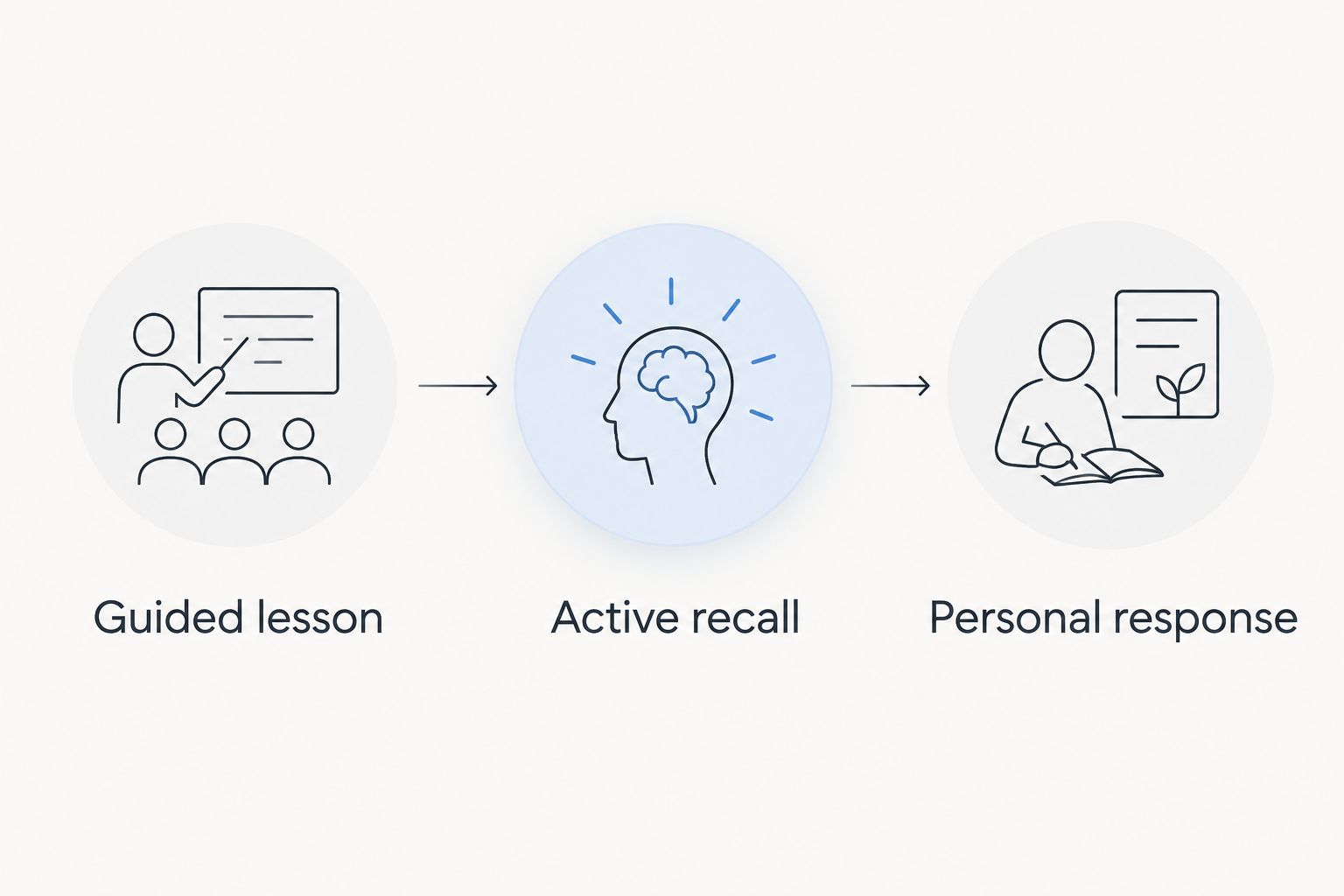
For your 2026 routine, choose a primary activity and a follow-up task. The following is a suggested practice session, not a claim about how quickly you will improve:
- Guided lesson: Spend 10 minutes on a Duolingo lesson or a focused grammar exercise.
- Active recall: Spend 5 minutes recalling useful words or sentences without looking at the answers.
- Personal response: Spend 2 minutes speaking or writing about your own life using that material.
The sequence matters more than installing every app. First encounter a pattern, then retrieve it, then use it for a meaning you chose yourself.
If you use HelloTalk, bring the personal response into an exchange rather than starting with an empty greeting. If you use AnkiDroid, save language you struggled to recall, not every unfamiliar word you encounter.
How the apps are ranked
The ranking prioritizes a clear learning purpose, meaningful free practice, active participation, understandable feedback, and preparation effort. Duolingo takes the default slot because it supplies a guided path; the other options win narrower use cases.
This is a feature-and-fit comparison, not a controlled learning-outcomes study. The ordering does not claim that one app produces faster fluency or better test results than another.
Which free English learning app should you choose?
Start with Duolingo if you cannot yet name a more specific need. Choose British Council LearnEnglish Grammar for sentence accuracy, HelloTalk for reciprocal interaction, or AnkiDroid for custom vocabulary recall on Android.
Before expanding your 2026 app collection, complete a session and attempt an independent response. The difficulty you encounter tells you more about your next tool than a long list of features does.
FAQ
What's the best free English learning app for beginners?
Duolingo is the default recommendation here for beginners who want structured lessons. Add a short speaking or writing task so your practice includes answers you create yourself.
Which free app should I use to practice English grammar?
British Council LearnEnglish Grammar is the focused grammar choice in this guide. Use the sentence forms from its exercises in your own writing rather than stopping at correct exercise answers.
Is HelloTalk better than Duolingo for speaking English?
HelloTalk is better suited to reciprocal interaction, while Duolingo is better suited to a guided lesson routine. HelloTalk practice depends on finding a partner who participates and offers useful feedback.
Can I use AnkiDroid as my only English learning app?
AnkiDroid is not a complete English course. It helps you review selected vocabulary and phrases, but you still need material to learn from and opportunities to use English.
Is Lingua a free English learning app?
Lingua is described as a subscription-based language-learning app, not a confirmed free option. Its English learning scope includes vocabulary, grammar, pronunciation, and Buddy conversational correction.
How long should I practice with an English app each day?
Use a routine you can repeat and finish with an independent response. One suggested session is 10 minutes of guided practice, 5 minutes of recall, and 2 minutes of speaking or writing; this is a schedule, not an improvement guarantee.
Do I need several English learning apps at once?
You do not need several apps to begin. Add another only when it addresses a specific gap, such as conversation practice that your main lesson app does not provide.
One last thing
A familiar exercise can feel easy because the answer is visible, not because you can produce the language independently. After your next lesson, hide the screen and explain the same idea using a different example. Choose your next practice task based on what you cannot yet say without help.