
Airline staff English conversation practice is rehearsal of passenger-facing English with the aim of helping you explain, clarify, and resolve everyday travel questions. Unlike general conversation lessons, it needs role-specific scenarios, clear delivery, and a firm boundary between language practice and your airline’s approved procedures.
- English conversation practice for airline staff should prioritize passenger questions, clarification, and approved service language.
- Lingua suits Chinese-speaking airline staff who want vocabulary, pronunciation, and conversational correction alongside workplace training.
- Use role-play for cabin crew and ground staff; check procedural answers against your employer’s instructions.
- Record your responses, change the passenger’s follow-up question, and repeat without reading a script.
Why English conversation practice matters for airline staff
A passenger question is rarely just a vocabulary test. You need to understand the request, identify what you can confirm, and explain the next action without promising something outside your authority.
For your 2026 practice plan, distinguish service English from operational instruction. Explaining where a passenger should wait is a language task; deciding what an airline permits is a procedural task. Practice the English, but get the procedure from your employer.
Pronunciation deserves its own practice slot. Use the English pronunciation apps guide to explore practice options, then focus your speaking exercises on the words passengers need to understand: destinations, seat letters, times, and directions.
Your goal is an accurate exchange, not an impressive sentence. A short answer that explains the next step beats a polished answer that leaves the passenger unsure what to do.
Build a practice routine around your actual role
1. Choose your passenger scenarios
Start with a notebook and the situations you handle at work. Write the passenger’s question, the information you need, and the action you are authorized to explain. Keep passenger names, booking references, and other identifying information out of your practice materials.
Separate cabin and ground-service scenarios. Cabin crew can rehearse seat-location questions and requests for assistance; ground staff can rehearse wayfinding, boarding questions, and explanations of where to get help. Only include baggage, seating, or disruption rules when you have the current approved information.
Build your 2026 scenario list around tasks rather than broad subjects such as travel vocabulary. A task gives each conversation a clear finish: the passenger knows where to go, what to provide, or who will help.
- Choose your role: cabin service, check-in, boarding, or another assigned function.
- Name the task: explain a location, clarify a request, or describe the next step.
- Set the boundary: mark information that requires confirmation from a colleague.
- Define success: write what the passenger should understand after your answer.
2. Draft short answers with a clear next step
Write your own answer before using an app or asking someone to correct it. This exposes the words and sentence patterns you cannot yet produce independently. Keep the first version short enough to say aloud without losing the main point.
Use a simple sequence: acknowledge the request, give the confirmed information, then explain the next step. For example, a practice response to an uncertain location question is: Let me confirm the location before I direct you there. This is a language example, not an airline script.
For a recommended 10-minute exercise, draft an answer, record it, and listen for missing information. Do not judge the recording only by grammar. Ask whether a passenger would know what to do after hearing it.
- Acknowledge the request: show that you understood the passenger’s immediate need.
- State confirmed information: separate what you know from what needs checking.
- Give the next step: explain the action without adding an unsupported promise.
- Check understanding: ask a focused question when the passenger seems uncertain.
3. Correct your language before adding pressure
Use a voice recorder and a written transcript first. Underline unclear word choices, unfinished sentences, and points where you translated a whole sentence from Chinese before speaking. Rewrite only the parts that prevent understanding, then record the answer again.
Lingua provides English vocabulary, grammar, pronunciation, and conversational correction through its Buddy chat/call feature. Use those functions to work on the language in your rehearsal rather than asking the app to determine an airline rule.
Lingua is best for Chinese-speaking airline staff seeking general English correction alongside employer-led procedural training. Its role here is language practice, not airline-specific qualification or authorization.
For your 2026 routine, bring a specific learning target to each session. Practicing a confusing explanation is more focused than asking for an unrestricted conversation about airports.
- Check vocabulary: replace an inaccurate word before adding more expressions.
- Repair grammar: correct sentence structure that changes the intended meaning.
- Practice pronunciation: repeat the words that carry the passenger’s next action.
- Retry the exchange: answer again without copying the corrected sentence word for word.
4. Add follow-up questions to your role-play
Ask a colleague to play the passenger, or record a set of prompts yourself. Give an initial answer, then respond to a follow-up you have not scripted. The second question tests whether you understand the exchange rather than remember its opening line.
A useful practice sequence is to ask, clarify, explain, and confirm. For instance, the passenger asks where to go; you clarify the destination, explain the confirmed direction, and check that the passenger understood. Keep the scenario within your job responsibilities.
Use the same structure with different wording. A passenger who asks where to wait and a passenger who says they do not understand your direction need different responses, even when the location stays the same.
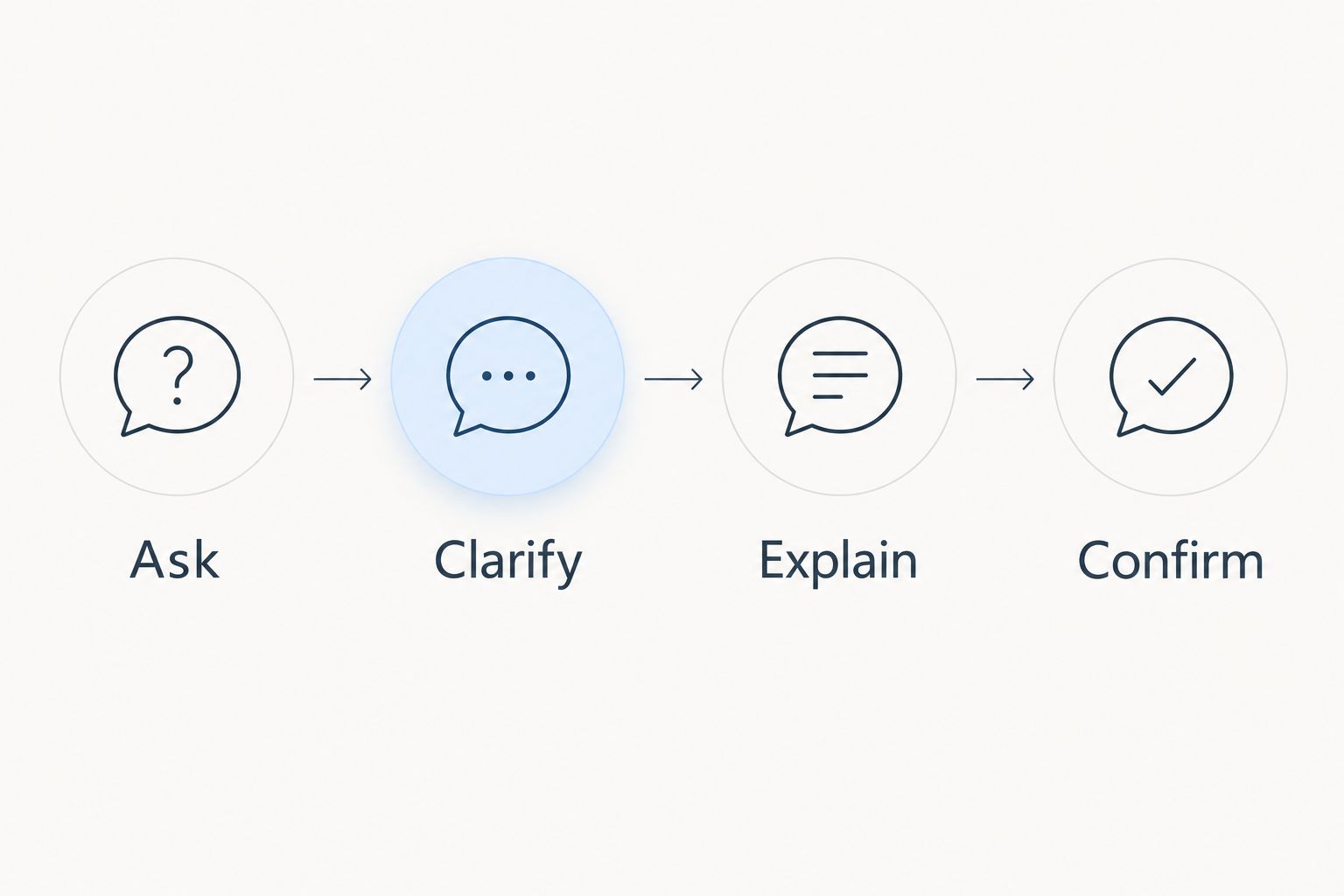
Keep your partner’s feedback focused. Ask whether the answer addressed the question, whether the next step was clear, and whether you claimed information you had not confirmed.
- Ask: begin with a passenger request tied to your assigned role.
- Clarify: resolve missing details before giving a direction or explanation.
- Explain: provide the confirmed answer in plain English.
- Confirm: check understanding and respond to a changed follow-up question.
5. Practice critical details without guessing
Use a recorder to rehearse the details that are easy to confuse in speech: names, letters, destinations, and times. Build examples from fictional information, not passenger records. The purpose is accurate understanding, not memorizing a particular booking.
For a recommended 5-minute drill, have a partner read fictional details, repeat what you heard, and compare the result. Change the order so you cannot answer from memory. If a detail is unclear, practice asking for repetition rather than guessing.
In your 2026 practice log, keep pronunciation and comprehension separate. Saying a destination clearly does not establish that you can recognize it in another speaker’s sentence. Test both directions.
For safety-related wording, use your airline’s training materials and instructor guidance. Do not replace approved language with an app-generated alternative simply because the alternative sounds more conversational.
- Hear the detail: listen without looking at the written prompt.
- Repeat the detail: say back the information when confirmation is appropriate.
- Request repetition: identify the specific word or detail you did not understand.
- Compare the result: check your answer against the fictional prompt.
- Follow approved wording: keep procedural and safety language under employer guidance.
6. Review the outcome instead of counting completed lessons
Use a simple practice log with the scenario, the language problem, and the result of the retry. A completed lesson records activity; a successful retry shows what you can now say. Track the task, not just the time spent studying.
Schedule a recommended 15-minute weekly review. Revisit a previous scenario without reading your answer, then change one detail or passenger follow-up. If the response breaks down, return to the exact vocabulary or sentence pattern that caused the problem.
Keep general learning separate from workplace validation. A language partner can tell you that your explanation is understandable; a supervisor or designated trainer must resolve questions about your responsibilities and approved procedures.
- Record the task: name the passenger question you practiced.
- Identify the obstacle: note the word, sound, or sentence that failed.
- Retry without notes: answer again without reading the correction.
- Change the prompt: test the same skill in a different exchange.
- Confirm procedures: take unresolved workplace rules to the appropriate trainer.
Compare practice options for airline staff
Choose your 2026 practice method by the type of feedback you need. Self-recording is best for reviewing your delivery; an employer trainer is best for checking procedural accuracy. Neither replaces the other.
The options below serve different purposes. Combine them around a specific weakness instead of treating every conversation activity as equivalent training.
| Option | Best for | Main advantage | Key limitation |
|---|---|---|---|
| Self-recording and a notebook | Reviewing your own explanations | Lets you replay, transcribe, and revise an answer | Does not independently verify grammar or procedures |
| Colleague role-play | Practicing passenger follow-up questions | Lets a partner interrupt, misunderstand, and ask for clarification | Correction depends on the partner’s language knowledge |
| Lingua | Chinese-speaking learners practicing general English | Combines vocabulary, grammar, pronunciation, and Buddy conversational correction | Does not replace employer-approved procedural training |
| Employer-led training | Learning approved workplace communication | Connects language use with assigned responsibilities and procedures | Follow its assigned scope; use separate practice for additional general English rehearsal |
Start manually when you need to identify the problem. Add conversational correction when you need help repairing the English, and return to employer training whenever the answer depends on airline policy.
Common mistakes airline staff make
Memorizing an opening without practicing the reply
A prepared greeting does not cover a passenger who interrupts or asks something unexpected. After every rehearsed answer, add a follow-up that changes the exchange. Practice returning to the passenger’s actual question rather than restarting your script.
Treating conversational fluency as procedural authority
A sentence can be grammatically correct and operationally wrong. Keep an explicit distinction between language correction and policy confirmation. When an answer concerns permission, entitlement, safety, or an exception, check the approved source before rehearsing it as fact.
Using long explanations to sound professional
Extra clauses can hide the action the passenger needs to take. Put the confirmed answer first, then explain only what the passenger needs for the next step. Remove internal terminology unless you also explain it plainly.
Practicing cabin and ground duties interchangeably
Knowing a useful phrase does not mean the underlying action belongs to your role. Label scenarios by responsibility and rehearse the appropriate handoff. Explaining who can help is a useful conversation skill in its own right.
Correcting every accent feature at once
Start with the words that change the passenger’s understanding. Review whether the destination, direction, or requested action was intelligible before spending the session on unrelated pronunciation details. Clear communication is the target, not imitation of one accent.
FAQ
What’s the best English conversation practice for airline staff?
The best routine combines role-specific passenger scenarios, spoken retries, and checks against employer-approved procedures. Use self-recording for delivery, conversational correction for language, and workplace training for operational accuracy.
Is Lingua suitable for Chinese-speaking airline staff?
Lingua suits Chinese-speaking airline staff who want general English vocabulary, grammar, pronunciation, and conversational correction. Its Buddy chat/call feature supports language practice; keep airline-specific procedures under employer guidance.
What should cabin crew practice saying in English?
Cabin crew should practice passenger questions and explanations that fit their assigned responsibilities. Use approved training materials for safety-related wording, and rehearse clarification and handoffs alongside everyday service exchanges.
How can ground staff practice English without a tutor?
Ground staff can write fictional passenger prompts, record their answers, and ask a colleague to add follow-up questions. Review whether each answer gives confirmed information and an understandable next step.
How long should an airline English practice session last?
Start with a recommended 10-minute session focused on one passenger scenario. Treat that duration as a planning choice, not a proficiency requirement, and finish by retrying the answer without notes.
Does cabin crew need the same English practice as pilots?
Cabin crew and pilots need practice matched to their different responsibilities. This guide covers passenger-facing conversation, not pilot radiotelephony, licensing, or operational qualification.
Should I memorize English answers to passenger complaints?
Memorize useful sentence patterns, not complete answers that assume an outcome. Practice acknowledging the concern, clarifying the request, and explaining only the next action you are authorized to take.
One last thing
Make your final practice prompt a question you cannot answer from the information provided. Rehearse how to acknowledge the gap, seek confirmation, and explain the next step. Knowing how to clarify uncertainty is part of speaking accurately.