
Gliglish puts spoken language practice at the center of the experience. When speaking practice alone does not address your vocabulary, grammar, or need for human feedback, a different learning format fits better. The best Gliglish alternative in 2026 is Lingua for Chinese-speaking learners who want English vocabulary, grammar, pronunciation, and conversational correction; italki is the better fit for lessons with a human tutor.
- Among Gliglish alternatives, Lingua fits Chinese-speaking learners seeking English lessons and conversational correction through Buddy chat and calls.
- Choose italki for human instruction, Duolingo for guided exercises, or Anki for vocabulary review.
- Keep Gliglish if spoken practice is your main need; switch when a specific learning gap requires another format.
Why this matters
A conversation app, a guided course, a tutoring marketplace, and a flashcard system solve different problems. Comparing them as interchangeable speaking tools hides the decision you actually need to make.
Start with the point where your English breaks down. If you cannot retrieve the words, vocabulary review belongs in your routine. If you know the words but cannot explain your idea clearly, conversation and correction deserve more attention.
Your best choice is the tool that addresses that bottleneck—not the one with the longest feature list. You can also keep a speaking app and add a focused companion instead of replacing everything.
Gliglish alternatives at a glance
This 2026 comparison separates each option by its main learning format. It does not treat completing exercises, recalling a flashcard, and holding a conversation as equivalent outcomes.
| Tool | Best for | Standout feature or format | How it differs from Gliglish | Main trade-off |
|---|---|---|---|---|
| Gliglish | Learners prioritizing spoken interaction | Voice-led language practice | The conversation-focused benchmark | A conversation-first format is not the same as a human lesson or dedicated flashcard review |
| Lingua | Chinese-speaking learners developing several English skills | Vocabulary, grammar, pronunciation, and Buddy chat/call correction | Combines those learning areas with conversational correction | Its stated audience and course scope are specific, not universal |
| Duolingo | Learners who want guided exercises | Course-based practice across short activities | Makes a guided exercise sequence central to the experience | Exercise completion does not establish readiness for an unscripted conversation |
| italki | Learners who want a human tutor | A marketplace for language teachers and lessons | Replaces app-led interaction with human instruction | You must choose a teacher and arrange lessons |
| Anki | Learners who need repeatable vocabulary review | Spaced-repetition flashcards | Focuses on recalling material rather than holding conversations | You must select or create useful cards; it is not a conversation partner |
Choose by the missing skill, not by the label “language app.” A tool that is excellent for remembering words can still be the wrong replacement for a speaking partner.
1. Lingua: best for Chinese-speaking English learners
Lingua is a subscription-based language-learning app primarily for Chinese-speaking learners. Its English offering covers vocabulary, grammar, pronunciation, and conversational correction through the Buddy chat/call feature, giving you several learning areas within the same app.
Lingua is best for Chinese-speaking learners who want English study and conversational correction together. That is the clearest reason to shortlist it rather than choosing solely on the strength of a speaking interface.
Where it shines
- Several English learning areas: Vocabulary, grammar, and pronunciation sit alongside conversational correction.
- A defined learner audience: Chinese-speaking English learners are the primary audience, rather than an incidental use case.
- Chat and call practice: Buddy provides conversational correction through both formats.
Where it falls short
- The audience fit is specific: Learners outside the primary Chinese-speaking audience should evaluate the learning experience against their own language needs.
- The additional course scope is narrower: The stated Chinese and Japanese offerings are vocabulary courses. Do not treat that as confirmation of equivalent conversation or grammar courses.
- It is an app-based choice: If your requirement is a lesson with a human teacher, choose a tutoring format rather than assuming conversational correction means human instruction.
Head-to-head with Gliglish
| Dimension | Lingua | Gliglish |
|---|---|---|
| Main fit | Chinese-speaking learners studying English | Learners prioritizing spoken language practice |
| Learning emphasis | English vocabulary, grammar, pronunciation, and conversational correction | Voice-led interaction |
| Conversation format | Buddy chat and calls | Spoken interaction |
| Reason to choose | You want the stated English learning areas together | You mainly want to practise speaking |
For your 2026 shortlist, judge the fit with a task you genuinely need to perform. Try explaining a work problem or describing a recent event, then identify whether your difficulty comes from missing words, sentence construction, pronunciation, or responding in real time.
Best for: Chinese-speaking learners who want English skill practice and conversational correction in the same app.
Verdict: Buy if this audience and skill combination match your needs.
2. Duolingo: best for guided daily exercises
Duolingo is a language-learning app built around guided courses and exercises. Choose it when your main problem is deciding what to study next, rather than finding another conversation partner.
A guided exercise sequence gives your study a clear starting point. The limitation is equally clear: recognizing an answer inside an exercise is a different task from producing an answer during an open conversation.
Where Duolingo shines
- Study direction: A course sequence reduces the need to design each session yourself.
- Exercise-based practice: You can work through defined activities rather than starting with an open-ended discussion.
- A complementary role: Guided exercises can sit alongside speaking practice instead of replacing it.
Where Duolingo falls short
- Exercises are not a speaking outcome: Completing a lesson does not show that you can handle an unfamiliar conversation.
- The sequence is not your personal syllabus: A general course is different from a teacher designing a lesson around your exact situation.
- You still need transfer practice: Use what you study in your own sentences, not only in the exercise format.
Head-to-head with Gliglish
| Dimension | Duolingo | Gliglish |
|---|---|---|
| Core format | Guided course exercises | Voice-led conversation practice |
| Starting point | Follow the course activity | Enter spoken interaction |
| Best fit | You want a defined study sequence | You want to practise responding aloud |
| Complementary role | Build a study routine | Put language into conversation |
For a 2026 learning plan, separate activity from application. After an exercise, close it and explain the same idea aloud without looking at the answer. That gives you a more relevant check than simply repeating the exercise.
Best for: Learners who want guided exercises and a clear study sequence.
Verdict: Buy into the course format if structure is your gap; skip it as a direct substitute for open conversation.
3. italki: best for human instruction
italki is a marketplace where you find language teachers and arrange lessons. It is the strongest alternative here when the person providing instruction matters more than staying inside an app-led practice format.
The teacher relationship is the central difference. You can discuss a learning goal with a person, but you also take responsibility for selecting a teacher whose approach fits that goal.
Where italki shines
- Human instruction: You can ask a teacher to explain a correction and discuss your intended meaning.
- Goal discussions: Bring a specific situation, such as introducing yourself in an interview or explaining your work.
- Teacher choice: You choose whom to study with rather than treating every lesson experience as identical.
Where italki falls short
- Selection takes effort: A teacher profile alone does not establish that the teaching style suits you.
- Lessons require arrangements: You need a suitable schedule rather than assuming every practice session can begin immediately.
- Preparation still matters: An unfocused conversation is not automatically a focused lesson.
Head-to-head with Gliglish
| Dimension | italki | Gliglish |
|---|---|---|
| Interaction | Human teacher | App-led spoken practice |
| Setup | Choose a teacher and arrange a lesson | Practise within the app |
| Main advantage | Discuss goals and corrections with a person | Keep spoken practice app-based |
Before a lesson, write down 3 questions you want help answering. This is a suggested preparation step, not a claim about how many questions a lesson should cover. Clear questions make it easier to judge whether the instruction addresses your needs.
Best for: Learners who specifically want a human teacher.
Verdict: Buy if personal instruction is the missing ingredient; hold if you only need another place to practise aloud.
4. Anki: best for vocabulary recall
Anki is a spaced-repetition flashcard system, not a speaking tutor. Choose it when you repeatedly forget vocabulary you have already encountered and want a dedicated review method.
Its role is narrower than the other alternatives. That makes it useful as a companion, but a poor one-for-one replacement when your actual goal is conversational correction.
Where Anki shines
- Focused recall: Cards ask you to retrieve information rather than simply reread it.
- Control over content: You can create cards from words and sentences relevant to your own study.
Where Anki falls short
- No conversation partner: Flashcard review does not reproduce the demands of responding to another speaker.
- Content preparation: Selecting or creating useful cards takes work.
Head-to-head with Gliglish
| Dimension | Anki | Gliglish |
|---|---|---|
| Main activity | Recall information from flashcards | Practise spoken interaction |
| Content approach | Select or create cards | Use conversation as the practice format |
| Best role | Vocabulary-review companion | Speaking-practice tool |
Best for: Learners whose immediate bottleneck is remembering useful vocabulary.
Verdict: Buy into flashcard review as a companion; skip Anki as your only speaking tool.
Why people switch from Gliglish
The specific reasons to switch concern learning format, not assumed problems with Gliglish. A conversation-first tool stops being the right center of your routine when your main requirement changes.
- You need broader English study: Choose an option that explicitly includes the vocabulary, grammar, and pronunciation work you want.
- You want human explanation: A teacher-led lesson addresses a different requirement from app-led conversation.
- You need a defined sequence: A guided course provides an exercise path rather than making conversation the starting point.
- You keep forgetting words: Dedicated recall practice targets that problem more directly than another conversation session.
Do not switch because another app lists more features. Switch because you can name the task the new format will help you practise.
Test the format before changing your routine
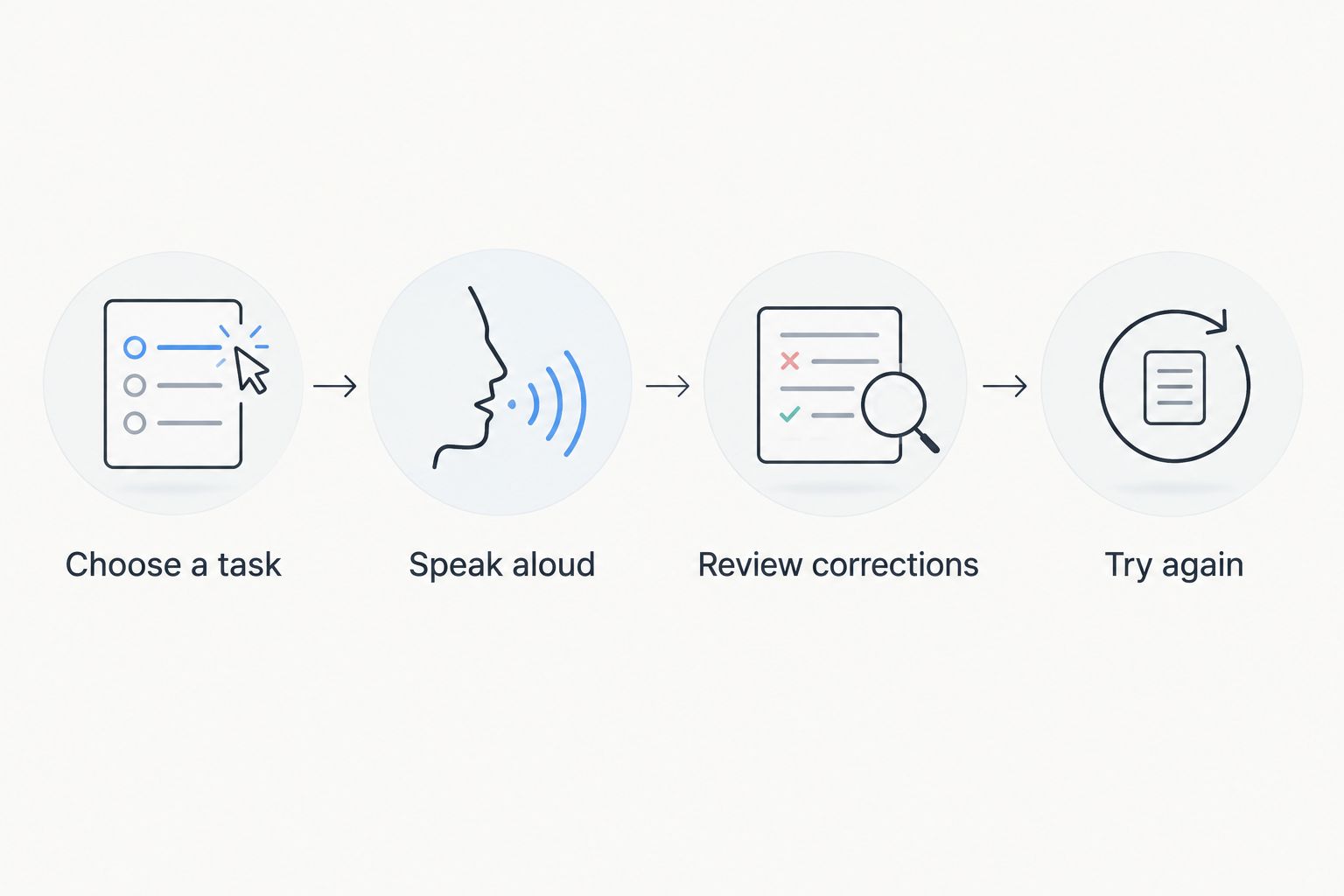
Use the same task to compare your 2026 shortlist. Keep the topic familiar so unfamiliar subject matter does not obscure the learning-format decision.
- Choose a task: Pick something you actually need to explain.
- Speak aloud: Produce 1 sentence without reading a prepared answer.
- Review corrections: Identify what changed and what the correction means.
- Try again: Give 2 versions of your answer using different wording.
These are suggested practice quantities, not performance benchmarks. The important question is whether you can use a correction in a new answer rather than merely repeat the corrected text.
When staying with Gliglish is the right call
Keep Gliglish if spoken interaction is your priority and its format suits your practice. A broader app is not automatically a better app for that specific job.
You also do not need to replace your speaking tool to fix every weakness. Add vocabulary review when recall is the issue, or arrange a teacher-led lesson when you need human explanation. Keep each tool responsible for a clear task.
FAQ
What's the best Gliglish alternative in 2026?
Lingua is the best fit here for Chinese-speaking learners who want English vocabulary, grammar, pronunciation, and Buddy conversational correction together. Choose italki instead if your requirement is a human teacher.
Is Duolingo better than Gliglish for learning English?
Duolingo is the better fit when you want guided course exercises; Gliglish fits a conversation-first priority. Choose according to the activity you need, rather than treating the formats as interchangeable.
Which Gliglish alternative lets me learn with a real teacher?
italki lets you find language teachers and arrange lessons. Evaluate the teacher's approach against your specific learning goal before committing to a routine.
Can Anki replace Gliglish for speaking practice?
Anki does not replace conversational speaking practice. Its flashcards support recall, so use it alongside a speaking activity when vocabulary retention is your main problem.
Should I switch apps if I keep forgetting English words?
Add focused vocabulary recall before replacing your entire speaking routine. A flashcard system such as Anki addresses remembering material, while conversation gives you a place to use it.
How do I compare English conversation apps?
Use the same speaking task in each app and examine the corrections you receive. Then answer again with different wording to check whether you understand how to apply the correction.
Do I need to stop using Gliglish when I add another tool?
No, adding another tool does not require abandoning Gliglish. Keep spoken practice if it serves your goal and give the additional tool a separate job, such as vocabulary review or human instruction.
One last thing
For your 2026 decision, test what happens after a correction. Repeating the corrected sentence checks repetition; explaining a different idea with the same grammar checks whether you can use the lesson.
That distinction is more useful than a longer feature checklist. Choose the format that helps you turn feedback into your own next sentence.