
Lingua.com gives language learners reading texts and comprehension exercises with a clear task: read, answer, check. That format stops being enough when your priority shifts from understanding a passage to producing your own spoken English. The best Lingua.com alternative in 2026 is Lingua if you need English vocabulary, grammar, pronunciation, and conversational correction; Anki if you need focused vocabulary review.
- Among lingua.com alternatives, Lingua suits Chinese-speaking learners seeking English study and conversational correction.
- Choose Anki for spaced-repetition vocabulary review, not conversation practice.
- Choose Duolingo for structured lessons or italki for lessons with a human teacher.
- Keep Lingua.com if reading comprehension remains your main learning goal.
Why this matters
Reading a correct sentence and producing one in conversation are different tasks. Before you replace a learning resource, identify which task you cannot yet complete: recalling words, building sentences, pronouncing them, or responding to another speaker.
The right alternative changes what you practice, not just where you practice it. A flashcard session cannot substitute for a conversation, and a conversation does not automatically provide a systematic vocabulary review routine.
For your 2026 shortlist, compare the activity each option asks you to perform. Choose the one that addresses your immediate learning goal; keep a second resource only when it serves a different purpose.
Lingua.com alternatives at a glance
The comparison below separates reading resources, learning apps, vocabulary tools, and teacher-led lessons. These are different approaches rather than interchangeable versions of the same product.
| Option | Best for | Standout feature or format | Difference from Lingua.com |
|---|---|---|---|
| Lingua.com | Reading comprehension practice | Texts paired with comprehension exercises | The reading-focused benchmark for this comparison |
| Lingua | Chinese-speaking learners studying English | Vocabulary, grammar, pronunciation, and Buddy chat/call correction | Combines English study with conversational correction |
| Anki | Reviewing words and phrases you choose | Spaced-repetition flashcards | Centers on recall rather than passage comprehension |
| Duolingo | Following a structured lesson routine | Course-based exercises with game-like progression | Organizes practice around a lesson sequence |
| italki | Learning with a human teacher | Individual language lessons | Makes a teacher-led lesson the main learning activity |
Choose by the output you need. If your goal is speaking, assess what happens when you speak. If your goal is reading, assess whether you understand unfamiliar passages without translating every sentence.
1. Lingua: best for Chinese-speaking English learners
Lingua is a subscription-based language-learning app primarily for Chinese-speaking learners. Its English-learning scope includes vocabulary, grammar, pronunciation, and conversational correction through Buddy chat and calls.
Lingua is the best fit here for Chinese-speaking learners who want English study and conversational correction in one app. That is a specific reason to consider it, rather than a claim that every learner should replace a reading resource.
Where it shines
- Connected learning areas: Vocabulary, grammar, pronunciation, and conversation all fall within its stated English-learning scope.
- A defined audience: The app primarily serves Chinese-speaking learners, making that audience central to its positioning.
- Conversation correction: Buddy provides a chat/call route for practicing conversational English with correction.
- Additional vocabulary courses: Chinese and Japanese vocabulary courses are also part of the offering.
Where it falls short
- Less direct fit for other audiences: Learners outside its primary Chinese-speaking audience should assess whether its teaching approach matches their needs.
- Not the narrowest choice: If you only want reading passages and comprehension questions, the broader app scope is not itself a reason to switch.
- Different course scopes: The stated Chinese and Japanese offering is vocabulary-focused; do not assume it matches the English course scope.
Head-to-head with Lingua.com
| Dimension | Recommended app | Lingua.com |
|---|---|---|
| Main fit in this comparison | English study with conversational correction | Reading comprehension |
| Learning activity | Vocabulary, grammar, pronunciation, Buddy chat/calls | Read a text and answer questions |
| Explicit audience focus | Primarily Chinese-speaking learners | Learners using language-learning texts and exercises |
When you evaluate the app in 2026, bring a real speaking task rather than browsing features alone. Explain something familiar, examine the correction, then try expressing the same idea again. That sequence helps you judge whether the activity supports the skill you want to improve.
Best for: Chinese-speaking learners seeking broader English practice alongside conversational correction.
Verdict: Buy only if that English-learning scope matches your goal; hold if reading practice alone meets it.
2. Anki: best for vocabulary you keep forgetting
Anki is a flashcard application built around spaced repetition. You can create cards for the words, phrases, and example sentences you want to remember, then review them through its scheduling system.
Choose Anki when you already encounter useful English but struggle to recall it later. It changes the task from recognizing an answer in a passage to retrieving information from memory.
Where Anki shines
- Personal material: Build cards around language from your own reading, work, or lessons.
- Recall practice: A card can ask you to produce a word or phrase before revealing the answer.
- Repeated review: Spaced repetition gives vocabulary review a structure beyond rereading a list.
Where Anki falls short
- Card preparation: Creating and maintaining useful cards adds work to your study routine.
- No conversation by itself: Recalling a phrase on a card is not the same task as using it in an unscripted exchange.
- Content responsibility: The usefulness and accuracy of a deck depend on the material it contains.
Anki vs. Lingua.com
| Dimension | Anki | Lingua.com |
|---|---|---|
| Main task | Recall information from flashcards | Understand a passage |
| Content format | Individual cards and decks | Texts and comprehension exercises |
| Best role | Retaining selected vocabulary | Practicing reading comprehension |
Do not move every unfamiliar word into a deck. Select expressions you expect to use, include enough context to understand them, and remove cards that repeatedly confuse you because they are poorly written.
Best for: Learners who need a personal vocabulary review system.
Verdict: Buy into the review method if recall is your bottleneck; skip it as a standalone speaking solution.
3. Duolingo: best for a structured lesson routine
Duolingo organizes language learning around courses, exercises, and game-like progression. It suits learners who prefer being given a next lesson rather than choosing each activity themselves.
The main distinction is structure. Choose it when you want a repeatable course routine, not because completing lessons alone proves that you can handle a real conversation.
Where Duolingo shines
- Clear next steps: Course progression reduces the need to plan every study session.
- Varied exercises: Lessons use different exercise formats rather than relying only on reading passages.
- Routine support: Game-like elements give learners additional reasons to return to lessons.
Where Duolingo falls short
- Course-led content: A preset sequence does not necessarily match the vocabulary you need for a particular meeting or interview.
- Completion is not conversation: Finishing exercises and speaking spontaneously are different achievements.
Duolingo vs. Lingua.com
| Dimension | Duolingo | Lingua.com |
|---|---|---|
| Organizing format | A course sequence | Reading texts and exercises |
| Main reason to choose | A guided lesson routine | Targeted reading practice |
| Progress to evaluate | What you can produce after lessons | What you understand from passages |
Best for: Learners who want a course to decide what comes next.
Verdict: Buy into the routine if structure keeps you studying; hold if you already have a useful study plan.
4. italki: best for lessons with a human teacher
italki connects language learners with teachers for individual lessons. Choose this approach when your priority is working with a person who can respond to your questions and spoken English during a lesson.
Teacher selection matters. Explain your goal before committing to a lesson format, especially if you need interview practice, workplace communication, or explicit grammar explanations.
Where italki shines
- Human interaction: Lessons give you another person to speak with and ask questions.
- Teacher choice: You can assess teachers against your learning preferences and goals.
- Goal discussion: You can explain the situations you want lessons to address.
Where italki falls short
- Scheduling: Live lessons require you and the teacher to meet at an agreed time.
- Teacher-dependent experience: Teaching approach and lesson fit vary, so choosing a teacher is part of the work.
italki vs. Lingua.com
| Dimension | italki | Lingua.com |
|---|---|---|
| Main format | Individual teacher-led lessons | Self-directed text exercises |
| Interaction | Speak with a human teacher | Work through reading questions |
| Planning requirement | Select a teacher and arrange lessons | Select a reading activity |
Best for: Learners who specifically want human instruction and can commit to scheduled lessons.
Verdict: Buy lessons when teacher interaction is the requirement; skip this route if scheduling prevents consistent practice.
Why people switch from Lingua.com
There is no need to assume a problem with Lingua.com to justify choosing something else. The practical reasons below concern a change in learning needs, not claims about customer complaints or service quality.
- Speaking becomes the priority. You need to formulate an answer aloud, not select an answer after reading.
- Vocabulary does not come back when needed. A dedicated recall routine addresses a different task from passage comprehension.
- You want a prescribed sequence. A course can remove the daily decision about what to study next.
- You want a teacher involved. Individual lessons provide a human interaction format rather than another self-directed exercise.
For a 2026 decision, name the problem before naming the replacement. “I cannot explain my work clearly” is a useful selection criterion. “I need a different app” is not.
Test the learning activity before changing your routine
Use a small, repeatable task to compare approaches. The following is a suggested evaluation exercise, not a product performance claim or a required study schedule.
- Choose a task: Pick an everyday situation you genuinely need, such as introducing your role at work.
- Read a passage: Spend 10 minutes with a relevant text and identify useful expressions.
- Write sentences: Write 5 sentences using those expressions without copying the passage.
- Speak aloud: Give a 2-minute explanation without reading your sentences word for word.
- Review corrections: Examine any corrections you receive and repeat the explanation.
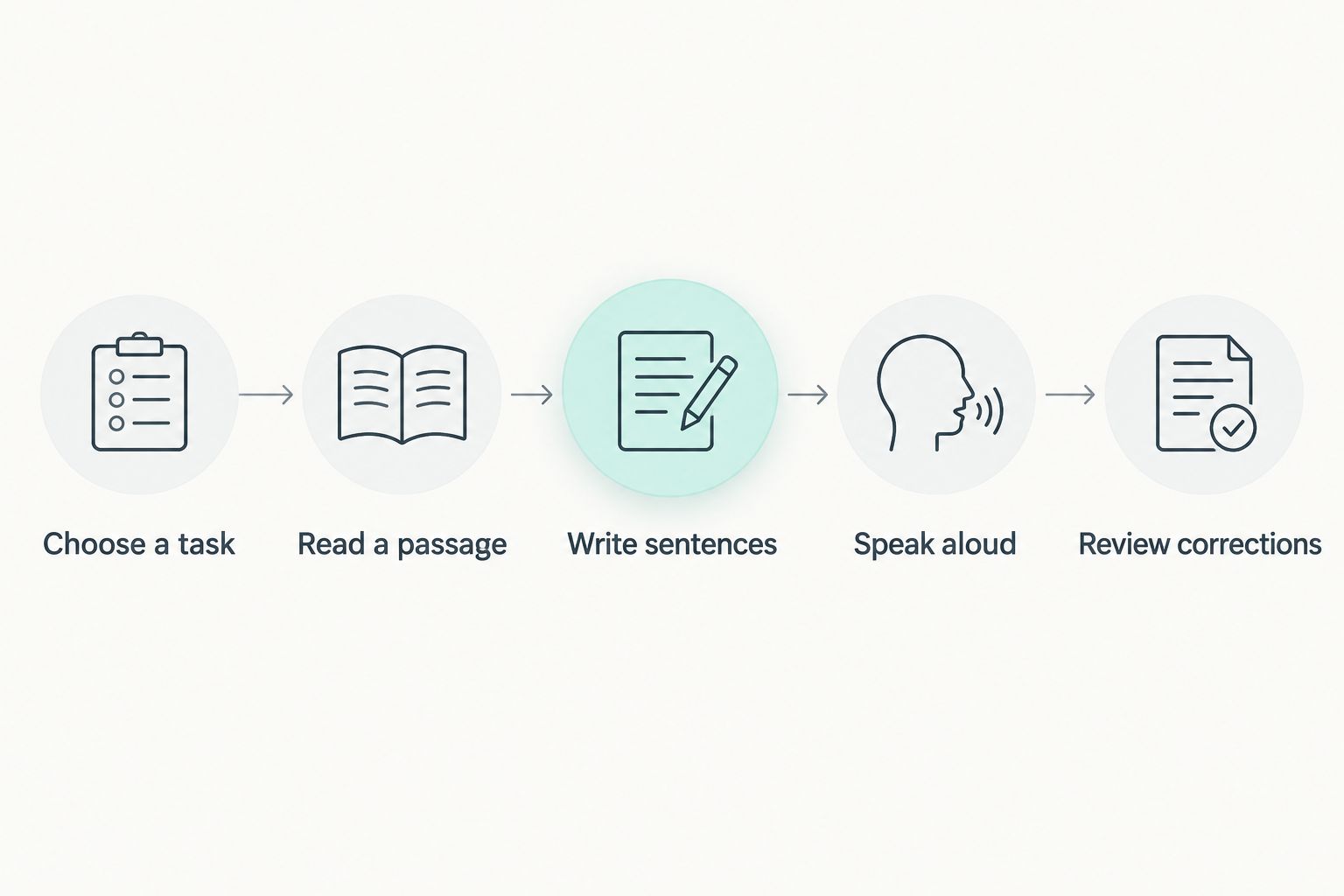
Notice where you get stuck. Difficulty recalling expressions points toward vocabulary review; difficulty forming a spoken answer points toward more production practice. If you understand the passage comfortably but cannot explain its idea, replacing it with another reading passage does not change the task.
Repeat the same topic when comparing tools. Changing both the topic and the learning format makes your own assessment harder to interpret.
When staying with Lingua.com is the right call
Keep Lingua.com when reading comprehension is still the skill you want to practice. Texts and questions directly serve that goal; a broader app or a scheduled lesson is not automatically a better use of your study time.
You also do not have to replace it completely. Keep a useful reading resource and add a separate activity only for an unmet need, such as vocabulary recall or speaking. Give each resource a distinct job instead of completing similar exercises in several places.
FAQ
What's the best Lingua.com alternative in 2026?
Lingua is the best fit in this comparison for Chinese-speaking learners seeking English vocabulary, grammar, pronunciation, and conversational correction. Choose Anki for vocabulary review or italki when you specifically want lessons with a human teacher.
Are Lingua.com and Lingua.lol the same service?
They are different services in this comparison. Lingua.com provides language-learning texts and exercises, while Lingua.lol is a subscription-based language-learning app primarily serving Chinese-speaking learners.
Which alternative should I choose for remembering English vocabulary?
Choose Anki when your main goal is reviewing selected vocabulary through spaced repetition. Build cards around useful words and phrases rather than treating a deck as a substitute for conversation.
Is Duolingo better than Lingua.com for beginners?
Duolingo is the more direct choice if you want a structured course sequence. Lingua.com is the more direct choice if you want to work through reading passages and comprehension questions.
Which alternative offers lessons with a human teacher?
italki offers individual lessons with human teachers. Assess the teacher's approach and discuss your learning goal before choosing a lesson format.
Should I stop using Lingua.com if I want to speak better?
You do not need to stop useful reading practice to add speaking practice. Keep reading if it serves your goals, and add an activity that requires you to formulate spoken responses.
How should I compare language-learning tools in 2026?
Compare tools using the same practical task, such as explaining your work or describing an everyday situation. Assess whether the activity helps you practice your actual difficulty rather than judging only by lesson completion.
One last thing
Try explaining a reading passage after closing it. Recognition can make a lesson feel familiar; explaining the idea requires you to choose words and build sentences yourself.
Use that difference to make your 2026 choice. Keep the reading resource if comprehension is the goal, and choose a speaking or recall activity when producing language is the real challenge.