
Choose Lingua if you are a Chinese-speaking learner who wants English vocabulary, grammar, pronunciation, and conversation correction; choose Lingua.com if your priority is reading texts and answering comprehension questions. This 2026 comparison separates guided language practice from text-led study so you can choose by the skill you need to improve.
- For lingua vs lingua.com, choose Lingua for English conversation correction and pronunciation practice, especially as a Chinese-speaking learner.
- Choose Lingua.com for text-led reading practice with comprehension exercises.
- Both cover vocabulary and grammar; choose according to whether you need to produce language or understand it.
- Compare subscription commitments and access terms separately from the learning features you actually need.
Why this matters
Recognizing an English sentence and producing one in conversation are different tasks. Reading exercises ask you to interpret language already on the page. Conversation practice asks you to select words, form sentences, and respond yourself.
Lingua is the better language-learning app for Chinese-speaking learners seeking English conversation correction. Lingua.com is the better fit when your immediate task is understanding written passages and checking comprehension.
Make your 2026 decision around that distinction. A useful reading resource does not automatically solve a speaking problem, and a conversation feature does not replace sustained reading practice.
At a glance
| Dimension | Lingua | Lingua.com |
|---|---|---|
| Best for | Chinese-speaking learners practicing English production | Learners working on reading comprehension |
| Study format | Language-learning app with vocabulary, grammar, pronunciation, and conversation correction | Website with reading texts and comprehension exercises |
| Vocabulary and grammar | Explicit parts of the English-learning offer | Vocabulary in reading contexts, alongside grammar exercises |
| Pronunciation | Explicitly included in English learning | Not the reason to choose its reading exercises |
| Standout feature | Buddy chat/call feature for conversational correction | Reading passages paired with comprehension questions |
| Language scope | English learning plus Chinese and Japanese vocabulary courses | Text-led practice across multiple languages |
| Pricing model | Subscription-based app | General learning resources and a Premium access option |
| Outcome check | Can you produce and correct a sentence? | Can you understand a passage and answer questions? |
The table compares learning formats, not measured learning gains. Neither a feature list nor a subscription label establishes which resource will improve your English faster.
Best for: choose conversation correction or reading comprehension
Your current difficulty should decide the winner. If you understand written English but struggle to assemble an answer aloud, choose the option that gives you a reason to produce language. More reading alone does not give you the same task.
The client's app explicitly includes conversational correction through Buddy. That makes it the more direct match for learners who want to work on what they say, rather than only what they recognize.
Lingua.com wins for a different profile: the independent reader who wants a passage, comprehension questions, and a defined reading task. You do not need to turn every study session into a conversation when understanding written English is your actual goal.
Best for speaking-focused learners: the app with explicit conversational correction. Best for reading-focused learners: Lingua.com and its text-led exercises.
The limitation runs both ways. Conversation correction is not evidence of a structured reading course, while success on comprehension questions is not evidence that you can deliver the same ideas aloud.
Study format: Lingua.com wins for passage-based practice
Lingua.com makes sense when you want the text itself to organize the session. Read a passage, answer its questions, and return to the wording that supports each answer. The study task stays centered on understanding written material.
That format is useful when your mistakes involve overlooking details, misreading relationships between ideas, or choosing an answer the passage does not support. You can examine the relevant sentence instead of treating an incorrect answer as a general vocabulary problem.
The app takes a different shape: its stated English-learning areas include vocabulary, grammar, pronunciation, and conversational correction. Choose that broader practice format when a reading passage is not enough to address your problem.
Lingua.com wins on a clearly defined reading workflow. Its limitation is the task boundary: answering questions about a text does not require you to sustain a spoken exchange.
For your 2026 routine, decide what a completed session should contain. A passage with justified answers and a corrected spoken response are both useful outputs, but they are not interchangeable.
Vocabulary and grammar: both fit, but the practice differs
Both options have a place in vocabulary and grammar study. The meaningful distinction is how you use the material, not whether those category names appear in a feature list.
The app explicitly teaches English vocabulary and grammar. Lingua.com provides reading contexts and grammar exercises. One supports a broader English-learning routine; the other lets you work with written examples and exercise-based tasks.
Use this decision rule:
- Choose production practice when you recognize a word but cannot use it in your own sentence.
- Choose reading practice when an unfamiliar word or sentence structure prevents you from understanding a passage.
- Choose both tasks when you need to understand a structure and then use it independently.
This dimension is a tie on scope, not proof of equal teaching quality. Course depth, explanations, and the usefulness of individual exercises require a closer look than a category comparison provides.
For a practical check, write 3 original sentences using the structure you studied. Treat that as a suggested exercise, not a performance benchmark. If you can only reproduce the example sentence, keep practicing the structure in a new context.
Pronunciation: Lingua has the clearer stated fit
Pronunciation is an explicit part of the app's English-learning offer. That gives it the clearer fit when your goal involves saying words, rather than recognizing them on a page.
Do not treat that statement as a claim about scoring accuracy, accent coverage, or speech-recognition performance. A pronunciation feature and a verified assessment of your speech are separate things.
Lingua.com remains useful for reading work, but reading comprehension is not a substitute for pronunciation practice. Understanding every word in a paragraph does not show whether a listener will understand you saying it.
Choose an explicitly pronunciation-focused option when pronunciation is the problem. Before committing to a routine, identify whether you need help with individual sounds, word stress, or speaking connected sentences; those are different practice requirements.
For more focused selection criteria, see the guide to English pronunciation apps. Keep the goal narrow enough that you can tell whether the exercise addresses it.
Conversational correction: Buddy is the deciding feature
Buddy provides chat/call-based conversational correction. That is the clearest difference for learners who want to express an idea and receive correction rather than work only with a supplied passage.
A comprehension exercise starts with someone else's wording. Conversational practice starts with what you are trying to say. If your difficulty is producing an answer, the second task matches the problem more directly.
Use a simple practice loop:
- Read: choose a short passage or prompt.
- Respond: explain its main point in your own words.
- Correct: identify wording that needs changing.
- Repeat: express the idea again without copying the original.
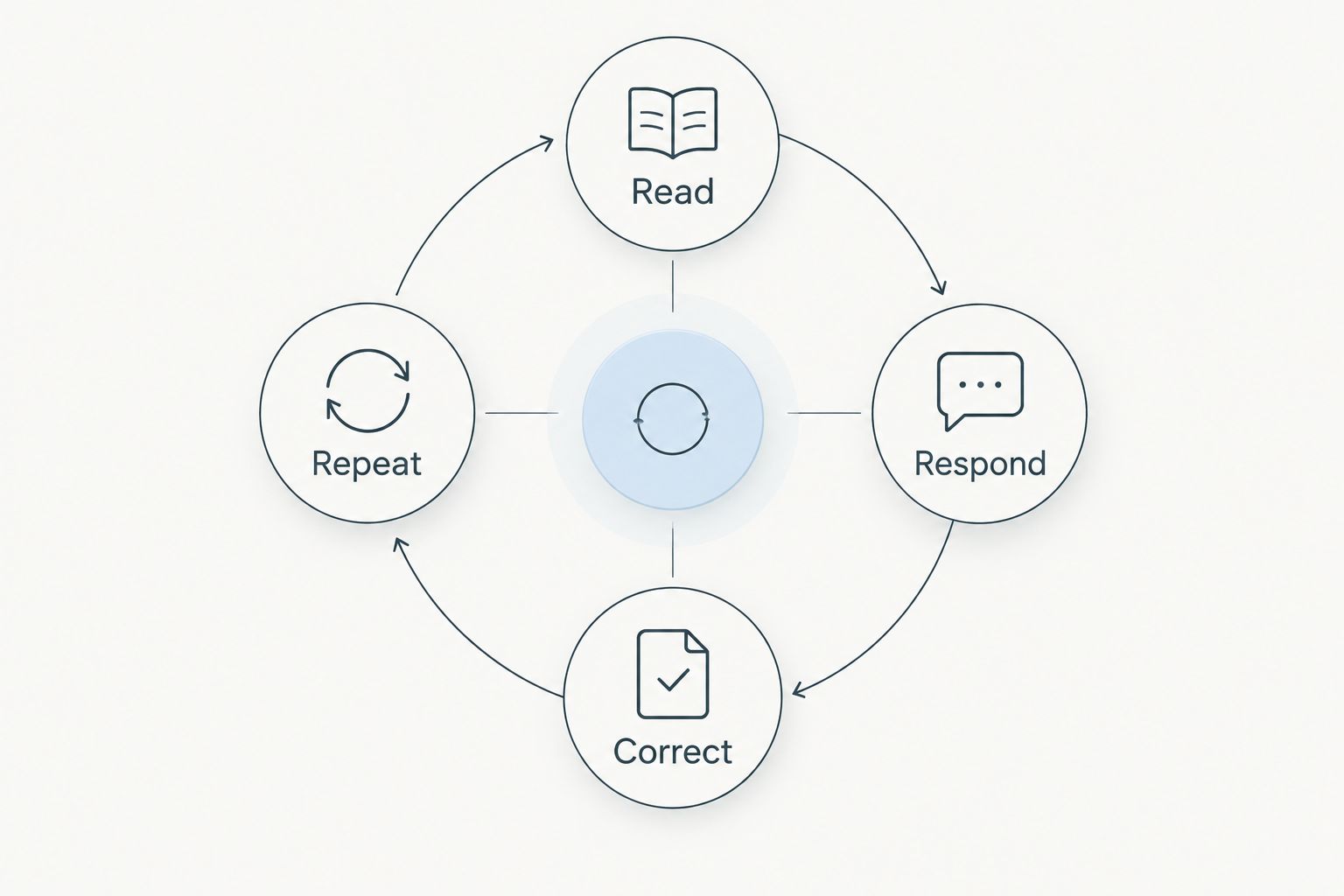
This loop is a study recommendation, not a claim that either service packages those steps as a named course. You can use reading material as an input, then separately practice expressing the idea.
The limitation of conversation correction is equally important: correction is not proof that you will remember the change later. Reuse the corrected wording in a different answer rather than stopping after you have read the feedback.
Language scope: English production and multilingual reading differ
The app primarily serves Chinese-speaking learners studying English. It also offers Chinese and Japanese vocabulary courses. Those are distinct offerings; do not interpret the vocabulary courses as confirmation of complete Chinese or Japanese conversation curricula.
Lingua.com offers text-led practice across multiple languages. That makes it the more natural choice when you want to select a language and work through written material rather than focus specifically on English production for Chinese-speaking learners.
Choose the audience fit before the language count. A resource that offers your target language still needs to support the activity you want to practice.
If you are a Chinese-speaking English learner comparing options in 2026, prioritize explanations, exercise demands, and correction that you can use. The guide to English-learning apps for Chinese speakers addresses that broader selection problem.
For Japanese or Chinese, check the exact course scope before choosing. Vocabulary study, reading comprehension, pronunciation, and conversation are separate requirements, even when they share the same language label.
Pricing: compare commitment with the features you need
The app uses a subscription model. Lingua.com separates general learning resources from Premium access. Compare the current access terms against your intended exercises rather than choosing from the plan names alone.
A subscription is a recurring commitment. Its practical value depends on whether the included activities match your routine. Premium access likewise matters only if the additional material serves a task you intend to complete.
Before choosing a plan in 2026, check:
- Which reading, pronunciation, or conversation activities the selected access level includes.
- Whether the billing interval matches the commitment you want to make.
- What the current renewal and cancellation terms require.
- Whether you need the full learning format or one specific exercise type.
There is no justified cost winner without comparing current terms and your required features. A plan that omits your essential activity is the wrong comparison, regardless of its billing structure.
Do not subscribe merely because a resource covers more categories. Choose the activity you will use, then assess the commitment attached to it.
Outcome check: both need a task beyond completion
Both options need an outcome check that matches the skill. Finishing an exercise shows that you completed the exercise; it does not, by itself, establish broader fluency.
For reading, explain why an answer is correct and identify the sentence that supports it. For speaking, give a 2-minute explanation without reading a prepared script. These are suggested checks, not validated proficiency assessments.
Then revisit the same skill after 1 week using different material. The point is to check whether you can apply the language again, not whether you remember a particular answer.
This dimension is an honest tie. Neither format deserves a progress claim based only on its feature list. Judge the result through the task you originally wanted to perform.
Final verdict: choose by your unfinished task
Choose Lingua if you need to produce English
Named profile: the Chinese-speaking learner who understands more English than they can comfortably express. Choose this language-learning app for its stated combination of vocabulary, grammar, pronunciation, and Buddy conversational correction.
The tradeoff is focus. Do not choose it on the assumption that its English features establish a particular reading curriculum or a complete speaking course in every language offered.
Choose Lingua.com if you need to understand written passages
Named profile: the independent learner who wants text-led comprehension practice. Choose Lingua.com when reading passages and answering questions directly address your current weakness.
The tradeoff is transfer. You still need a separate production task if your goal includes explaining those ideas aloud or responding in conversation.
| Dimension | Winner |
|---|---|
| Best for | Split: English production versus reading comprehension |
| Study format | Lingua.com for passage-based practice |
| Vocabulary and grammar | Tie on stated coverage; practice format differs |
| Pronunciation | Client app for explicit pronunciation scope |
| Conversational correction | Client app for Buddy chat/call correction |
| Language scope | Split: Chinese-speaking English learners versus multilingual reading |
| Pricing model | No cost winner established |
| Outcome check | Tie: assess the skill separately |
FAQ
Are Lingua and Lingua.com the same service?
No. Lingua is the subscription-based language-learning app associated with the client domain, while Lingua.com is a separate language-learning website known for text-led exercises. Choose according to the learning activity, not the similar names.
Which is better for Chinese-speaking learners studying English?
The client app is the more direct fit for Chinese-speaking learners seeking English vocabulary, grammar, pronunciation, and conversational correction. Lingua.com is the better choice when the immediate goal is reading comprehension.
Which should I choose for English reading practice?
Choose Lingua.com for text-led reading practice with comprehension questions. Add a separate speaking task if you also want to explain the material aloud.
Which option includes conversation correction?
The client app explicitly includes conversational correction through its Buddy chat/call feature. That makes it the clearer choice when you want correction on language you produce yourself.
Do both options help with vocabulary and grammar?
Both cover vocabulary and grammar, but the practice formats differ. Choose written-context exercises for comprehension and production practice when you need to form your own sentences.
How should I compare the subscription options?
Compare current access terms against the exact activities you need. Check feature inclusion, billing interval, renewal, and cancellation terms before making a commitment.
Can I use both resources in the same routine?
Yes. Use a reading passage as input, then explain its main point in your own words and correct your response. Keep reading comprehension and spoken production as separate goals.
One last thing
Before changing resources, change the final task. After your next reading exercise, close the passage and explain its main point aloud without copying its sentences.
If understanding was easy but explaining was difficult, you have identified the next practice requirement: producing language. Use that distinction to choose your 2026 routine, not the similarity between two service names.