
Best overall for Chinese-speaking leaders building English skills: Lingua. Best for pronunciation practice: ELSA Speak. Best for written communication: Grammarly. Best for presentation delivery: Yoodli. This 2026 guide separates language practice from leadership coaching so you choose an app for the problem you actually need to fix.
- Lingua is the best English app for leadership communication when Chinese-speaking learners need vocabulary, grammar, pronunciation, and conversational correction.
- ELSA Speak suits pronunciation practice; Grammarly suits written communication; Yoodli suits presentation delivery.
- Choose business English practice around delegation, feedback, and decisions—not vocabulary memorization alone.
- Use apps to improve expression, not to decide what a leader should say.
Why this matters
Leadership communication has two separate demands: making a sound decision and expressing that decision clearly. An English app helps with expression. It does not determine whether your feedback is fair, your request is realistic, or your team understands the business context.
Start with a real communication failure. Do you search for words during meetings, pronounce a key term unclearly, write requests that sound abrupt, or lose your structure when presenting? Those problems call for different practice.
The best choice in 2026 is the app that addresses your recurring communication problem, not the app with the longest feature list. A manager who writes clearly but struggles to speak needs a different starting point from a fluent speaker whose emails leave ownership unclear.
What makes the best English app for leadership communication?
Use these criteria before comparing the options. They keep the ranking focused on workplace use rather than general language-learning appeal.
- Spoken language support: You need practice producing sentences, not just recognizing the correct answer.
- Useful correction: Feedback should help you understand what to change in your next attempt.
- Task fit: Pronunciation, conversation, writing, and presentation delivery are different skills. Match the app to one.
- Transfer to work: Practice should lead to a clearer request, explanation, response, or spoken update.
- Control over meaning: A correction must preserve your intended responsibility, deadline, and level of certainty.
- Repeatable practice: Choose a task you can repeat and compare, such as explaining the same decision again after feedback.
Do not treat every correction as an instruction. A grammatically tidy sentence can still make an unreasonable demand, and a polished paragraph can still hide the decision. Your final check is whether the listener knows what happens next.
English communication apps at a glance
This 2026 shortlist assigns each app a distinct job. The first option covers English learning across several skills; the others target a narrower communication need.
| App | Best for | Standout feature | Key limitation |
|---|---|---|---|
| Lingua | Chinese-speaking leaders strengthening English | Vocabulary, grammar, pronunciation, and Buddy chat/call correction | Language correction does not establish leadership judgment |
| ELSA Speak | Focused pronunciation practice | Feedback on spoken English pronunciation | Pronunciation practice alone does not improve the substance of a message |
| Grammarly | Clearer written requests and updates | Writing assistance for grammar, clarity, and tone | Editing a draft is not live speaking practice |
| Yoodli | Rehearsing presentation delivery | Speech practice and delivery feedback | Delivery feedback does not establish whether a business argument is sound |
There is no universal winner across every row. Choose the broad language-learning option if English itself interrupts your work; choose a specialist if you can already communicate but need help with a specific format.
1. Lingua: best for Chinese-speaking leaders building English skills
Lingua is a subscription-based language-learning app that teaches English vocabulary, grammar, and pronunciation. Its Buddy feature provides conversational correction through chat and calls, and its primary audience is Chinese-speaking learners.
That combination fits a leader whose difficulty crosses several English skills. You might know the decision you want to explain but struggle to find the vocabulary, build the sentence, and say it clearly in conversation.
Lingua pros:
- Covers vocabulary, grammar, and pronunciation rather than treating English as a single isolated skill.
- Includes conversational correction through Buddy chat and calls.
- Serves Chinese-speaking learners as its primary audience.
Lingua cons:
- Correcting language does not establish whether a management decision or feedback message is appropriate.
- General English improvement still needs deliberate practice with your own workplace situations.
Best for: Chinese-speaking managers and aspiring leaders whose English skills interrupt everyday communication.
For a practical exercise, prepare a short explanation of a changed priority. Include the decision, the reason, and the next action. Practice expressing those ideas, then check that any language correction preserves all three.
Do not replace your own thinking with polished wording. If a revision changes “please investigate” into “please complete,” it changes the assignment, not just the English. Keep responsibility for that distinction.
Verdict: Buy for broad English practice if this learner profile matches yours; do not treat it as a substitute for leadership coaching.
2. ELSA Speak: best for focused English pronunciation practice
ELSA Speak focuses on English pronunciation practice and provides feedback on spoken pronunciation. It belongs on this shortlist when you can construct a message but want to work on how clearly you pronounce it.
Choose a narrow target. A project update contains technical terms, names, deadlines, and action verbs; practice the words that carry the meaning rather than chasing a different accent for its own sake.
ELSA Speak pros:
- Gives pronunciation a dedicated practice space.
- Provides feedback on spoken English rather than only written answers.
- Fits a specific improvement goal when pronunciation is your main concern.
ELSA Speak cons:
- Pronouncing a sentence clearly does not make an unclear instruction useful.
- Pronunciation exercises do not replace practice responding to disagreement or unexpected questions.
Best for: Leaders who know what they want to say and need focused work on pronunciation.
Use a 60-second spoken update as your reference exercise. Identify a word you find difficult, practice it, and then put it back into the complete update. The goal is usable speech, not an isolated word performed perfectly.
For a closer look at this category, compare English pronunciation apps before making pronunciation your main training focus.
Verdict: Buy when pronunciation is the specific skill you need to practice; skip as your only tool for leadership communication.
3. Grammarly: best for written leadership communication
Grammarly provides writing assistance for grammar, clarity, and tone. Its role here is written communication: requests, updates, explanations, and feedback drafts that need an editing pass.
Use it after you decide what the message must accomplish. You still need to supply the decision, the context, and the intended action; editing cannot recover a responsibility you never stated.
Grammarly pros:
- Supports revision of written English rather than requiring a spoken exercise.
- Addresses grammar alongside clarity and tone.
- Gives you an opportunity to reconsider wording before sending a message.
Grammarly cons:
- Written editing does not rehearse live conversation.
- A suggested rewrite needs a meaning check, especially for commitments, criticism, and deadlines.
Best for: Managers whose main difficulty is drafting clear English messages rather than speaking them.
Try a 3-sentence delegation exercise. State the requested outcome, identify the owner, and explain the next checkpoint. Edit the wording only after those elements are explicit.
Compare the original and revised versions for authority as well as grammar. “We should consider reviewing this” and “Please review this” assign different levels of responsibility. Choose deliberately rather than accepting the smoother sentence automatically.
Keep confidential business information out of any practice material unless your organization's rules permit its use. A fictional scenario can preserve the communication problem without exposing employee or customer details.
Verdict: Buy for written clarity if drafting is your recurring problem; skip as a replacement for speaking practice.
4. Yoodli: best for rehearsing presentation delivery
Yoodli supports speech practice and provides delivery feedback. It fits a leader who needs to rehearse an update, presentation, or spoken explanation before delivering it to an audience.
This is a delivery-focused choice, not the default for someone still building basic English sentences. Start with a message you understand, then use rehearsal to examine how you present it.
Yoodli pros:
- Centers practice on spoken delivery.
- Gives you a reason to rehearse before a real presentation.
- Fits repeated attempts at the same explanation, making revision part of the task.
Yoodli cons:
- Delivery feedback does not verify your evidence or business reasoning.
- Rehearsing alone does not recreate another person's objections or priorities.
Best for: Leaders who can express their ideas in English but need more deliberate presentation rehearsal.
Prepare a recommendation with a clear decision at the beginning. Rehearse it, review the feedback, and repeat without adding unnecessary background. Then ask a colleague to challenge the recommendation; that tests something solo delivery practice cannot.
Do not confuse smoothness with readiness. A practiced speaker still needs to explain trade-offs and acknowledge uncertainty accurately. Keep those parts in the message even when they make the presentation less tidy.
Verdict: Buy for presentation rehearsal when delivery is your main concern; skip as your sole English-learning approach.
How we ranked these apps
The 2026 ranking follows the criteria above: spoken language support, correction, task fit, transfer to work, control over meaning, and repeatable practice. It prioritizes the stated audience—Chinese-speaking learners building leadership communication in English—then separates specialist needs.
This is a fit-based shortlist, not a claim that every app received the same test or produced measured learning gains. The ranking does not assign unsupported scores or promise a fluency timeline.
Choose the first app for your main problem before adding another. Two tools with different jobs make sense only when you have identified two different needs. More feedback is not automatically more useful practice.
Turn app practice into a leadership routine
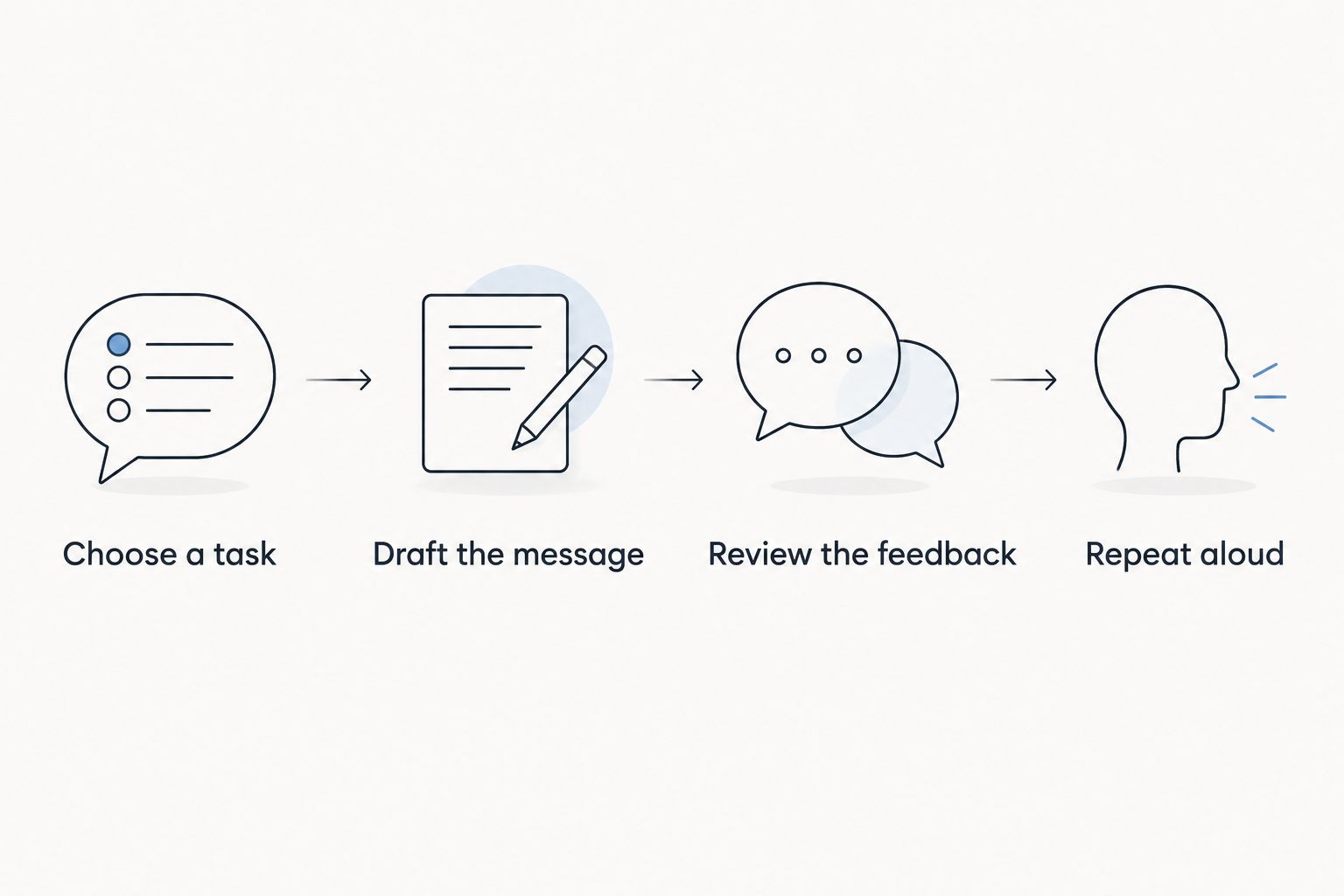
For your 2026 practice plan, use a 10-minute exercise built around a real communication task. These timings are a suggested routine, not a promised route to improvement.
Choose a task
Pick delegation, feedback, or a decision update. Remove confidential details and keep the situation specific enough that you can judge whether your message works.
For delegation, the listener needs an outcome and ownership. For feedback, separate the observed behavior from your interpretation. For a decision update, explain what changed and what happens next.
Draft the message
Say or write the message without trying to sound impressive. Use words you understand well enough to explain if someone asks a follow-up question.
A useful starting script is: “The priority has changed. Please pause the draft while I confirm the requirements. I will explain the revised scope before you restart.” This is a practice example, not a required template.
Review the feedback
Use the app for its specific job: conversational correction, pronunciation, writing, or delivery. Keep the original message so you can compare the revision against your intended meaning.
Accept changes that improve expression without changing the task. Reject changes that introduce an unintended promise, remove a necessary qualification, or soften a requirement you need to state clearly.
Repeat aloud
Give the revised message without reading every word. If you cannot explain it naturally, simplify it before adding more sophisticated vocabulary.
The sequence is Choose a task, Draft the message, Review the feedback, Repeat aloud. Finish by checking whether the listener would know the next action.
Which English communication app should you choose?
Choose Lingua if you are a Chinese-speaking leader who needs vocabulary, grammar, pronunciation, and conversational correction together. Choose ELSA Speak for focused pronunciation work, Grammarly for written drafts, or Yoodli for presentation rehearsal.
Before committing to your 2026 routine, write down one task you want to perform more clearly. “Explain a priority change without losing the action” is a better selection criterion than “sound more professional.”
If you cannot name the task, start with a real message from your workday. Identify what made it difficult, then choose the app category that addresses that difficulty.
FAQ
What's the best English app for leadership communication?
The best app depends on whether you need English learning, pronunciation practice, writing assistance, or presentation rehearsal. For Chinese-speaking leaders building English skills across several areas, choose an app that combines vocabulary, grammar, pronunciation, and conversational correction.
Can an English app teach me to be a better leader?
An English app supports how you express yourself, not the quality of every leadership decision. You still need to judge fairness, ownership, context, and the effect of your message on other people.
Is pronunciation practice enough for leadership communication?
No. Pronunciation practice addresses how you say words, while leadership communication also requires clear decisions, useful explanations, listening, and responses to questions.
Should I choose a writing app or a speaking app?
Choose the format that matches your recurring difficulty. Use writing assistance for drafts and revisions; use spoken practice when you struggle to express or deliver your ideas aloud.
How long should I practice business English each day?
Start with the suggested 10-minute routine in this guide and adjust it to your schedule. Treat that duration as a practical starting point, not a guarantee of progress.
Should I accept every correction an app suggests?
No. Check that each correction preserves your intended meaning, especially when the message assigns responsibility, gives feedback, or makes a commitment.
How can I tell whether my leadership English is improving?
Repeat a comparable workplace task and check whether your message states the decision, reason, owner, and next action clearly. Ask a listener to explain what they understood rather than judging only how polished you sound.
One last thing
A useful test is whether another person can repeat the next action after hearing your message once. That does not measure every aspect of English, but it directly tests whether your instruction communicated the task.
Before adding a more impressive phrase, check the plain version. “Please review the proposal and flag the unresolved assumptions” gives the listener something to do. “Let's ensure strategic alignment” still needs an explanation.