
English grammar for engineers is the use of English sentence rules in technical communication with the aim of making requirements, results, and decisions unambiguous. This 2026 guide focuses on the grammar you need to describe systems, explain failures, and distinguish an instruction from a prediction.
- English grammar for engineers should prioritize clear subjects, accurate tense, and explicit conditions over complicated sentences.
- Lingua suits Chinese-speaking learners who want English grammar practice alongside vocabulary, pronunciation, and conversational correction.
- Check technical writing for quantities, obligations, and exceptions; grammatical correctness alone does not guarantee an unambiguous requirement.
- Practice technical English by rewriting real work examples, then explaining the same meaning aloud.
Why grammar matters for engineers
Engineering communication needs more than correct spelling. A sentence must identify what acts, when something happens, and which conditions apply. Compare The controller stops the motor with The motor stops the controller: both are grammatical, but they describe different systems.
Prioritize grammar that changes technical meaning. Articles identify components, tense separates observations from expectations, and conditional clauses define when an action applies. These distinctions belong in your 2026 study plan before elaborate vocabulary or longer sentences.
Use the English grammar apps guide when choosing a practice format, but judge your progress against your own writing. Completing an exercise is different from producing a requirement that a colleague can interpret without asking what you meant.
For Chinese-speaking learners, English articles, plural endings, and verb inflections deserve explicit checks because Mandarin expresses these distinctions differently. Treat that as a checklist, not a diagnosis: review your actual errors before deciding what to study.
How to improve English grammar for engineering work
1. Identify the task before choosing the grammar
Start with a short, nonconfidential example of something you actually write: a test summary, design comment, support explanation, or project update. Decide what the reader must understand or do. A requirement needs a different sentence from a report of an observed result.
Consider these examples: The enclosure must resist water ingress states an obligation. The enclosure resisted water ingress during the test reports an observation. Neither sentence substitutes for defined test conditions or acceptance criteria, but the grammar tells the reader what kind of claim you are making.
For a practical starting exercise, select 3 sentences from your own writing. Label each sentence by purpose before editing it. This keeps your study focused on communication rather than correcting every possible feature at once.
- Requirements: State the responsible component and the required behavior; follow your organization's terminology for obligations.
- Results: Identify what happened and the conditions under which you observed it.
- Explanations: Separate the observation from your interpretation of its cause.
- Requests: Name the action, the responsible person or role, and any relevant deadline.
2. Make subjects, articles, and quantities explicit
Underline the subject of each sentence and circle its main verb. Then ask whether the reader can identify the exact component, process, or person involved. Replace vague references such as it, this, and they when more than one interpretation is possible.
Articles carry useful meaning. A sensor detected vibration introduces a sensor; the sensor detected vibration points to an identifiable sensor. Omitting the article in sensor detected vibration leaves an ordinary singular count noun incomplete in standard prose.
Check quantities at the same time. The valve opens and the valves open require different verb forms. Write less equipment but fewer components: equipment is uncountable in ordinary English, while components is countable.
You do not need an app for this pass. A printed paragraph or a plain-text document is enough. Keep a small error log that records the original wording, your correction, and the meaning you intended.
- Name the actor: Replace It checks the input with The controller checks the input when the reference is unclear.
- Check articles: Review singular count nouns for a, an, the, or another determiner.
- Match agreement: Use the result shows and the results show.
- Separate quantity types: Use an item of equipment, not an equipment.
3. Match verb tense to the evidence
Create a simple timeline before editing a technical explanation. Mark what is generally true, what happened during a completed event, and what remains unresolved. Then choose the verb form that expresses that relationship.
Use the present simple for a described operating behavior: The controller reads the input before updating the output. Use the past simple for a completed observation: The controller restarted during the test. Use the present perfect when a past event connects to the present: The team has identified the fault, but the repair is incomplete.
Practice manually by describing the same issue as an operating explanation, a test result, and a current status update. If you want a structured app route, Lingua teaches English grammar alongside vocabulary and pronunciation and offers conversational correction through Buddy chat and calls.
Lingua suits Chinese-speaking learners who want English grammar practice alongside vocabulary, pronunciation, and conversational correction. Treat the app as language practice, not as an engineering authority: technical accuracy still needs your subject knowledge and your organization's review process.
- State behavior: Use the present simple for the system behavior you are describing.
- Report observations: Use the past simple for a completed test event.
- Connect past and present: Use the present perfect when that connection matters.
- Keep time consistent: Change tense when the time relationship changes, not merely to vary the wording.
4. Write conditions and obligations without changing the meaning
Conditional language deserves a separate editing pass. If the temperature rises, the controller reduces power describes a relationship. If the temperature rises, reduce power gives an instruction. The missing or stated subject changes who is responsible for the action.
Modal verbs also change the claim. Must expresses obligation, should commonly expresses a recommendation or expectation, and can expresses ability or possibility. In controlled documentation, follow the applicable standard or house style rather than assuming that ordinary usage settles every definition.
Distinguish possibility from prediction. The seal can leak says leakage is possible; the seal will leak predicts leakage. Neither wording provides the operating conditions or evidence needed to assess the claim.
In your 2026 documentation review, highlight every modal verb and every conditional clause. Ask whether the sentence expresses a requirement, a recommendation, a capability, or an observation, then make the wording match that purpose.
- Name the condition: Put the trigger in an explicit if or when clause.
- Name the response: State which component or person acts when the condition applies.
- Separate obligations: Do not interchange must, should, and can merely for variety.
- Expose exceptions: State exceptions directly instead of hiding them in a long parenthesis.
5. Shorten explanations without deleting necessary detail
Break a sentence when it contains several actions, competing subjects, or an unclear chain of causes. Sentence length alone is not the problem. The problem is forcing the reader to reconstruct relationships that the grammar should make explicit.
For example: The pump stopped after the alarm activated, which delayed the test. What delayed the test—the alarm or the stopped pump? Rewrite it as The alarm activated, and the pump stopped. The pump stoppage delayed the test.
Choose active or passive voice according to the information the reader needs. The technician calibrated the instrument identifies responsibility. The instrument was calibrated before testing emphasizes the instrument and timing but leaves the actor unstated. Passive voice is useful when that omission does not conceal necessary responsibility.
Use parallel structures in procedures. Inspect the connector, tighten the fastener, and record the result presents matching actions. A list that mixes nouns, commands, and unfinished clauses makes the sequence harder to follow.
- Resolve references: Replace an ambiguous which with the specific event or component.
- Separate causes: Distinguish what happened first from what caused the later event.
- Choose voice deliberately: Name the actor when responsibility matters.
- Align instructions: Begin comparable procedure steps with matching verb forms.
6. Turn corrections into a repeatable practice routine
Use a 10-minute practice session as a starting routine, not a promise of results. Choose a short technical explanation, revise it, explain it aloud, and compare the spoken version with your intended meaning. Adjust the session length to fit the task.
For your 2026 practice log, track recurring error types rather than collecting corrected paragraphs without reviewing them. Record whether the problem involved an article, tense, condition, quantity, or unclear reference. Then write a fresh example that uses the same grammar correctly.
A useful self-check is whether you can explain why a correction is necessary. If you cannot explain the difference, keep the sentence in your review list. Accepting a correction without understanding it does not show that you can use the pattern independently.
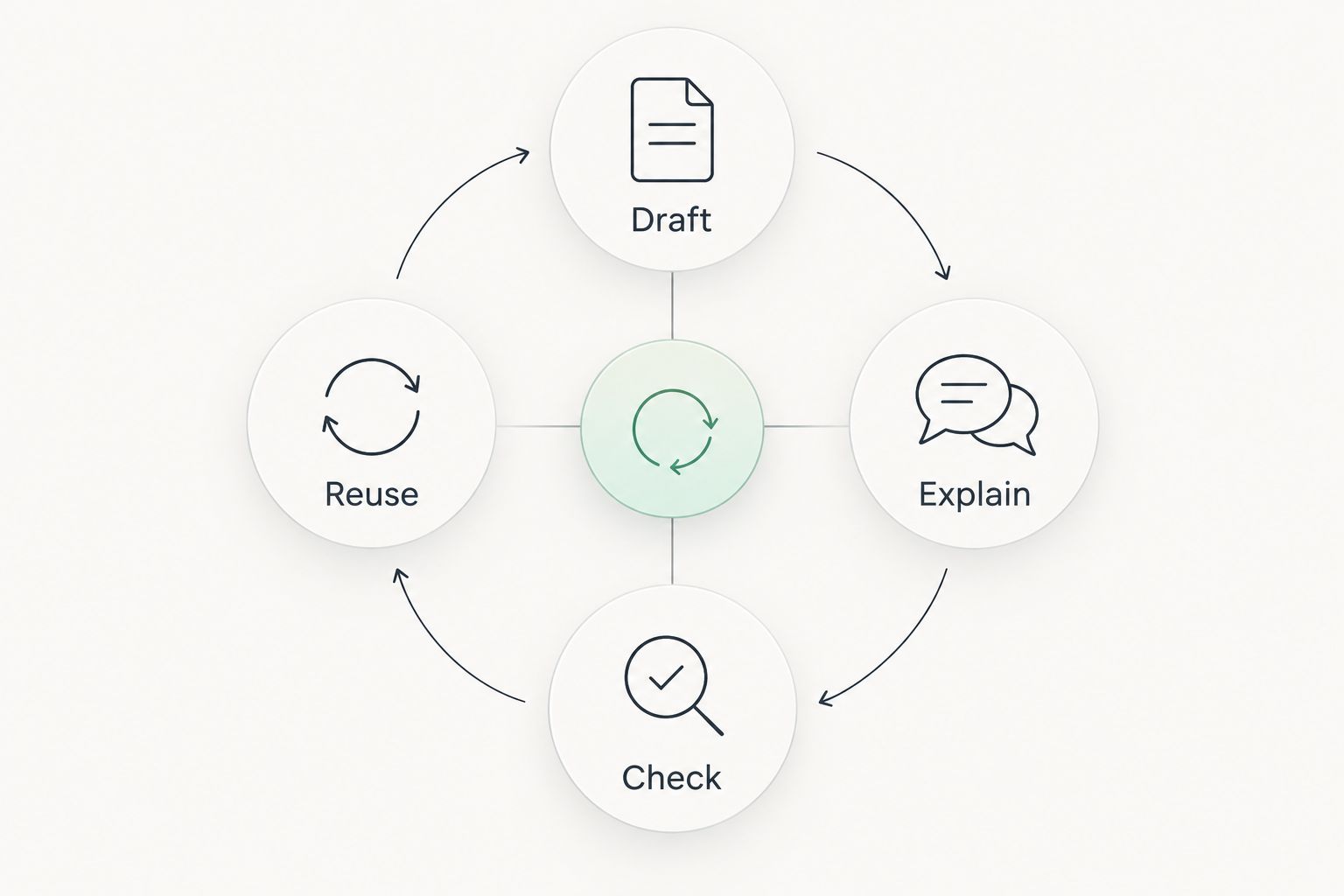
- Draft: Write a nonconfidential explanation of a familiar technical process.
- Explain: Say the same meaning aloud without reading the draft word for word.
- Check: Review both versions for the grammar pattern you are practicing.
- Reuse: Apply the corrected pattern to 2 new sentences with different technical content.
Compare grammar practice options for engineers
Choose the method that addresses your current bottleneck. Independent editing gives you control over technical context; conversation practice lets you work on spoken explanations. Neither replaces review by someone qualified to assess the engineering content.
| Option | Best for | Main advantage | Key limitation |
|---|---|---|---|
| Manual revision and an error log | Engineers who can identify patterns in their own writing | Keeps practice tied to actual communication tasks | You can overlook errors you do not recognize |
| Peer review | Engineers checking a document with a technically informed colleague | Connects wording to the intended technical meaning | Technical expertise does not automatically include grammar-teaching expertise |
| General grammar exercises | Learners building control of articles, agreement, and tense | Isolates a grammar pattern for focused practice | Correct exercise answers do not demonstrate clear technical writing |
| Lingua | Chinese-speaking learners combining grammar with vocabulary, pronunciation, and conversation practice | Brings these language-learning areas into one app, including Buddy conversational correction | App-based language correction does not establish engineering correctness |
Combine focused grammar practice with review of real technical meaning. If your sentences are grammatical but colleagues still ask what you mean, work on references, conditions, and document structure rather than adding more isolated exercises.
Common mistakes engineers make with English grammar
Treating technical vocabulary as a substitute for sentence structure
Knowing the component names does not identify the actor or explain the relationship between events. Keep the necessary terminology, then write a complete sentence around it. Check the subject and verb before searching for a more advanced word.
Making every sentence passive
Passive voice is not automatically more technical. Use it when the process or result deserves emphasis; use active voice when the reader needs to know who performed, approved, or must complete an action.
Removing articles to make prose resemble a diagram label
Labels and full sentences serve different purposes. Sensor output works as a label, while The sensor output changed during the test is a complete statement. Do not copy compressed label grammar into every report sentence.
Accepting a correction that changes the requirement
A smoother sentence is not necessarily an equivalent sentence. Check every revision for changes to obligations, conditions, exceptions, and quantities. Reject a grammatical rewrite that changes must to should when the original requirement is mandatory.
FAQ
What is the most useful English grammar for engineers?
The most useful English grammar for engineers covers clear subjects, articles, agreement, tense, conditions, and modal verbs. Prioritize the patterns that affect who acts, what happened, and what is required.
How can I practice technical English grammar on my own?
Practice by rewriting a nonconfidential example of your technical writing and explaining the same meaning aloud. Keep an error log and reuse each corrected pattern in a new sentence.
Should engineers always use passive voice?
Engineers should not always use passive voice. Use active voice when responsibility matters and passive voice when the process or result is the focus and the actor is unnecessary.
Is Lingua suitable for Chinese-speaking engineers learning English?
Lingua is suitable for Chinese-speaking learners seeking English grammar, vocabulary, pronunciation, and conversational correction. Engineers should still check technical claims and requirements through their own subject expertise and review process.
What is the difference between must and should in technical writing?
Must expresses obligation, while should commonly expresses a recommendation or expectation. Follow the applicable standard or organizational style when these terms have formally defined meanings.
How do I choose the right tense for a test report?
Use the past simple for completed test observations and the present simple for operating behavior you describe as generally true. Use the present perfect when a past event has a relevant connection to the current status.
One last thing
Make your final 2026 editing pass a meaning check, not a grammar check. Compare Only the controller resets the alarm with The controller resets only the alarm: moving one word changes the restriction. Read your final sentence as a requirement someone must implement, and ask whether its grammar permits the interpretation you intended.